Here are 5 questions we'd like answered on Thursday's CDPAP hearing.
Here are 5 questions we'd like answered on Thursday's CDPAP hearing. ·  View in browser
NEWSLETTER

Funding local news is more important than ever, and it will take a village to succeed. Join us in our work to rebuild local journalism as a pillar of democracy in New York.

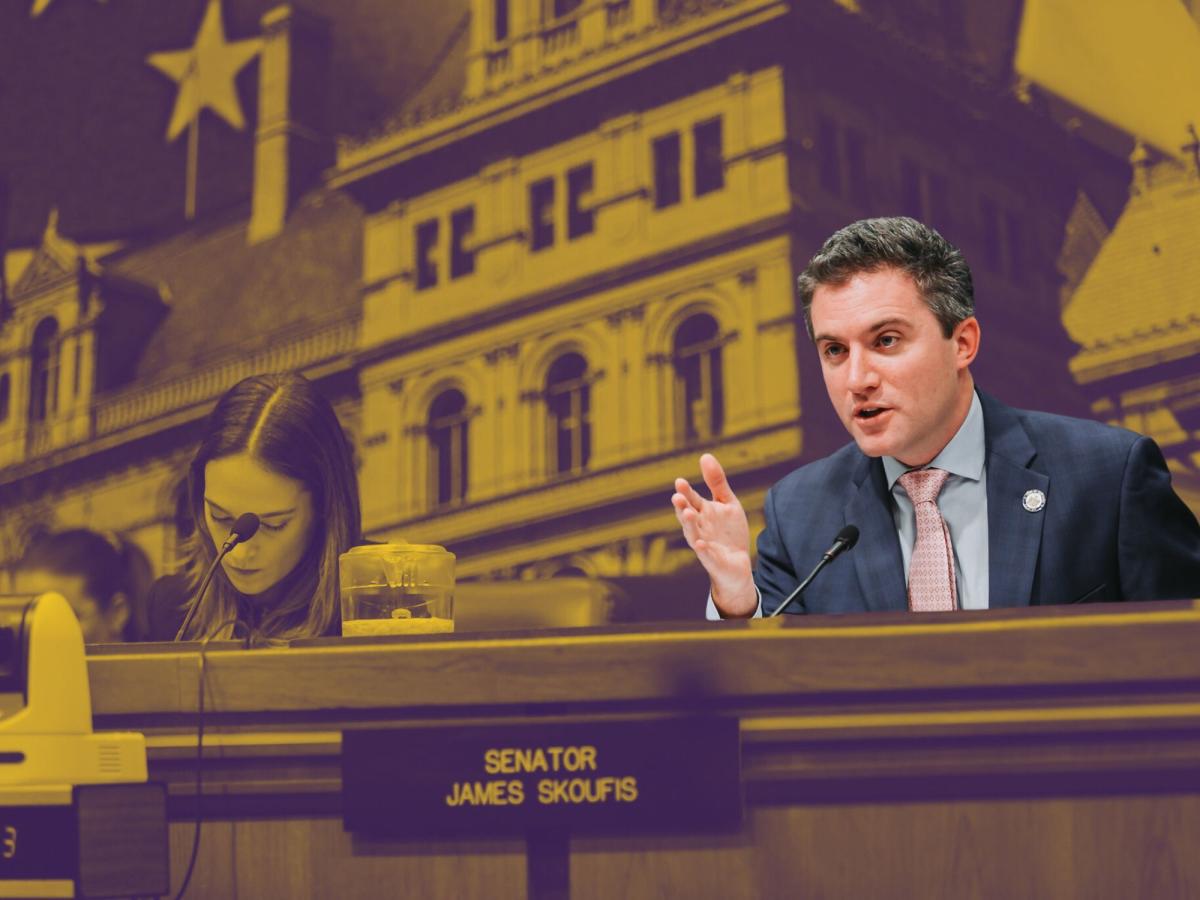
Senator James Skoufis will co-chair a joint public hearing centered on the Consumer Directed Personal Assistance Program (CDPAP) on Thursday, Aug. 21, 2025. Photo: NY Senate, Flickr; Illustration, NY Focus
With a hearing on New York’s troubled home care program set for Thursday, here are five questions we’d like answered.
By Sam Mellins

New York’s state-funded home care program for the elderly and disabled has been in turmoil for months.

The $9 billion program serves hundreds of thousands of New Yorkers and was taken over by Georgia-based company Public Partnerships LLC (PPL) in April, with the stated goal of making the program more efficient and reducing fraud. Since then, workers and patients have complained of missed paychecks, randomly slashed hours, breaches of sensitive data, and other issues.

On Thursday, New York lawmakers will hold a hearing focused on the program, which is known as CDPAP, to try to understand why the transition has been beset by so many serious issues.

New York Focus has reported extensively on this topic, with a particular eye on Leading Edge Administrators, the company that PPL hired to provide health insurance and other benefits to the army of low-wage health aides who provide the individualized care.

Much of what we’ve found out has been disconcerting. For starters, Leading Edge’s founder, the health care entrepreneur Jerry Weissman, was convicted of insurance-related felonies in the 1990s, for which he served time in federal prison. We’ve also learned that Leading Edge has regularly refused to pay its enrollees’ medical bills, once tried to cancel a patient’s insurance coverage while he was hospitalized with a coma, and has pioneered multiple ways to help employers keep money that by law is supposed to go to their workers.

In interviews with New York Focus, former Leading Edge employees described these strategies as a “shitty situation,” “very disheartening,” and a “cash cow.”

But there’s more we’d like to know.

Here are five open questions from our reporting that we hope lawmakers will ask about on Thursday.

Mayor Adams has not exceeded the combined total of new and preserved affordable housing units of his two predecessors. Photos: Office of Governor Kathy Hochul; Jimme Deknatel/Pexels | Illustration: Leor Stylar

The New York City mayor made the claim during a press conference in late July.
By Ferdi Ferhat Özsoy

NO.

Mayor Adams has surpassed each of his predecessors individually in terms of new and preserved affordable housing units, but he has not exceeded their combined total — as he said he did during a press event in July.

According to official city figures, Adams reports 229,800 affordable homes built or preserved since 2022, plus 197,000 units planned through rezonings that may take years to materialize. Bloomberg’s administration produced more than 175,000 units built or preserved in 12 years, and de Blasio’s plan produced about 200,000 in 8 years.

Together, Bloomberg and de Blasio delivered about 375,000 built or preserved units, which is far more than Adams’s current total. Adams’s claim of 426,800 built, preserved, or planned homes only holds if planned rezonings are treated as completed housing, which is misleading since many projects may never break ground, and some began under previous administrations.

New York Focus partners with Gigafact to produce fact briefs, or quick-response fact checks, about trending claims relating to New York state.

This fact brief is responsive to conversations such as this one.

Got a claim you want us to check? Submit it here.

Recent Stories

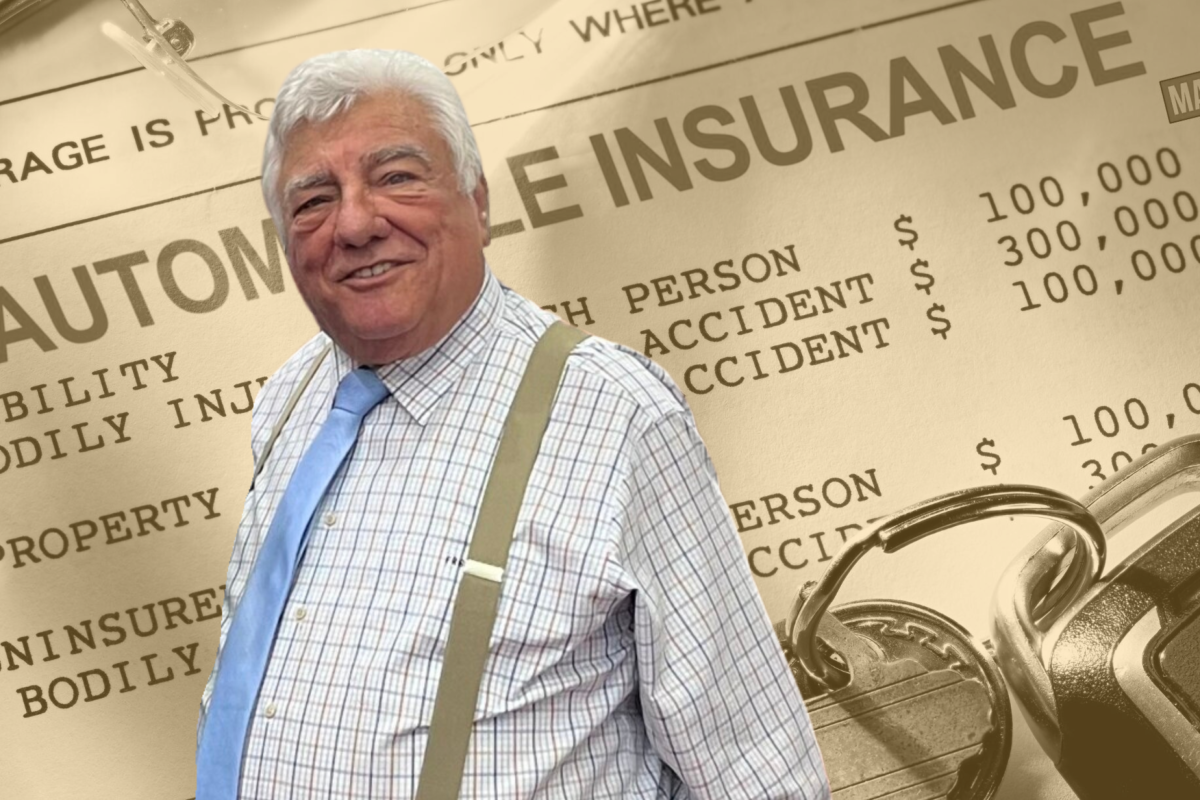
Frank Seddio has filed over 900 “no-fault” auto insurance cases. Photo: Chris Bragg | Illustration: Leor Stylar
Frank Seddio is representing Jules Parisien in over 500 cases — despite the physician’s history of insurance fraud allegations.
By Chris Bragg

A notable New York politico has filed hundreds of lawsuits on behalf of a doctor repeatedly accused of being a key cog in a sprawling auto insurance fraud ring, according to records reviewed by New York Focus.

Between May 2024 and July 2025, Frank Seddio, Brooklyn’s Democratic commissioner on the New York City Board of Elections, filed more than 500 “no-fault” auto insurance lawsuits on behalf of a Brooklyn-based physician. The cases were filed under the state law meant to expedite drivers’ reimbursements for medical expenses stemming from accidents — regardless of who is at fault.

Before becoming Seddio’s client, Dr. Jules F. Parisien had been accused across multiple lawsuits of participating in schemes to obtain money from insurance companies by submitting thousands of fraudulent, unlawful, and non-reimbursable claims for purported medical services.

Seddio is a former state assemblymember, Surrogate’s Court judge, and chair of the Brooklyn Democratic Party whose recent campaign spending as a Brooklyn Democratic Party district leader has faced media scrutiny. He has not been charged with any wrongdoing and did not respond to questions about how he became involved with filing the cases.

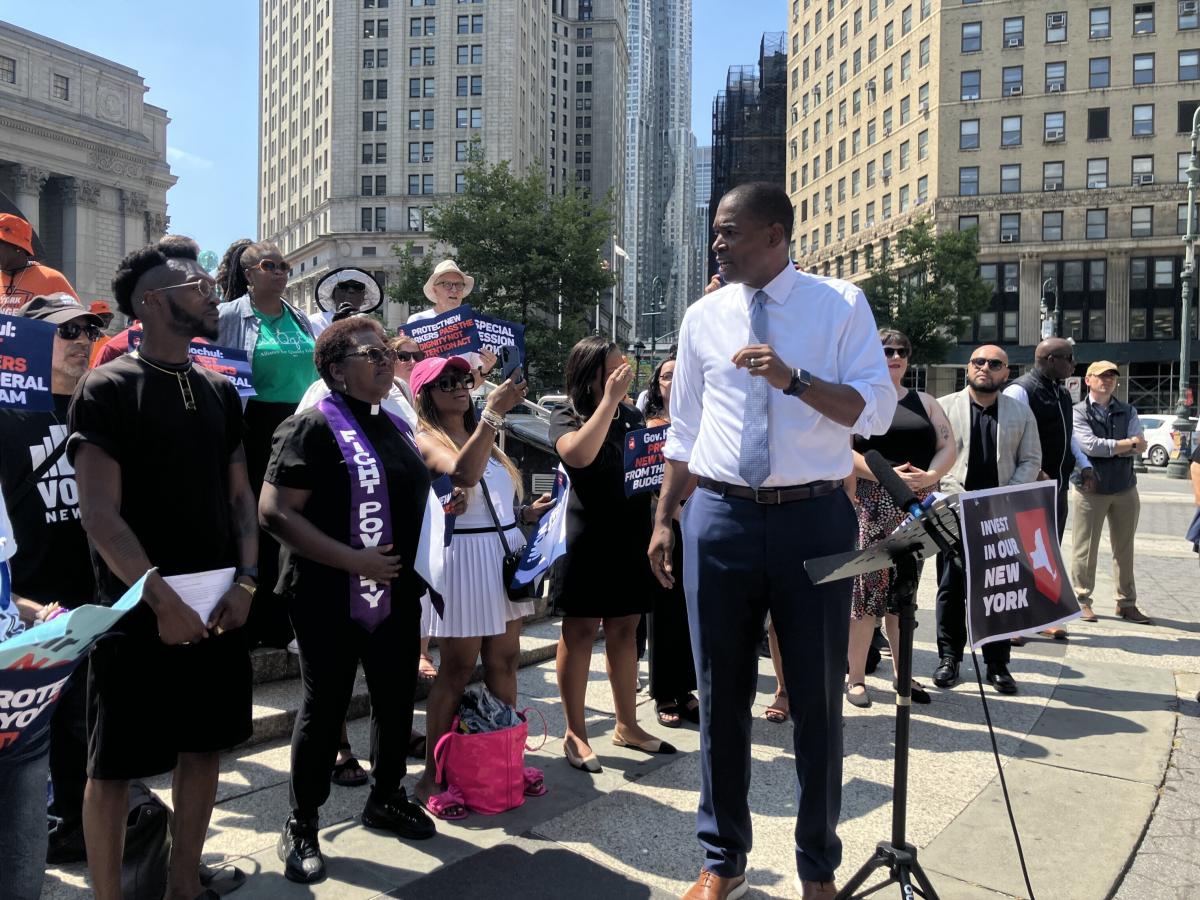
Lt. Governor Antonio Delgado was flanked by Assemblymembers during a rally in lower Manhattan on Aug. 13, 2025. Jie Jenny Zou
Whether legislators should return to Albany this year to tackle historic cuts to Medicaid and food assistance has become a thorny political question.
By Jie Jenny Zou

Progressive lawmakers rallied in lower Manhattan on Wednesday with a message for Governor Kathy Hochul: It’s time for New York to act on President Trump’s federal cuts.

Backed by over 60 left-leaning groups, the event called for state legislators to return immediately to Albany and get to work fortifying New York’s safety net.

“It doesn’t make sense to wait for the cuts to actually happen,” Assemblymember Claire Valdez, one of the legislators who spoke at the rally, told New York Focus. “It’s pretty simple: The Republicans have made their decisions and it’s time for us to make some as well,” Valdez said of the Democratic party.

“It isn’t sufficient anymore to say the Republicans did such a bad job. What have we done?”

Legislators departed Albany for the year in June after delivering a delayed state budget that largely ignored inevitable federal cuts. Weeks later, Trump signed his “One Big, Beautiful Bill Act” into law, slashing over $1 trillion to Medicaid and the Supplemental Nutrition Assistance Program (SNAP) over the next decade.

The result is billions less in federal support for New York’s Medicaid program — the most generous in the country, with nearly 7 million New Yorkers enrolled — and an unprecedented funding cliff for SNAP, which feeds 1.7 million households statewide. The largest Medicaid cut takes effect January 1, giving the state little headway.

Despite the high stakes and tight deadline, top Democrats including Assembly Speaker Carl Heastie and Senate Majority Leader Andrea Stewart-Cousins quickly ruled out the need for a special session, delaying the matter until next year. Governor Kathy Hochul, whose office was granted emergency powers to temporarily manage any fiscal gaps, has seemingly agreed.

Now, a contingent of progressive leaders and groups are calling on the legislature to reconvene and raise taxes to avoid cuts to lifeline services, as well as to expand protections for immigrants from Trump’s mass deportation push.

The idea is proving to be politically divisive in more ways than one.

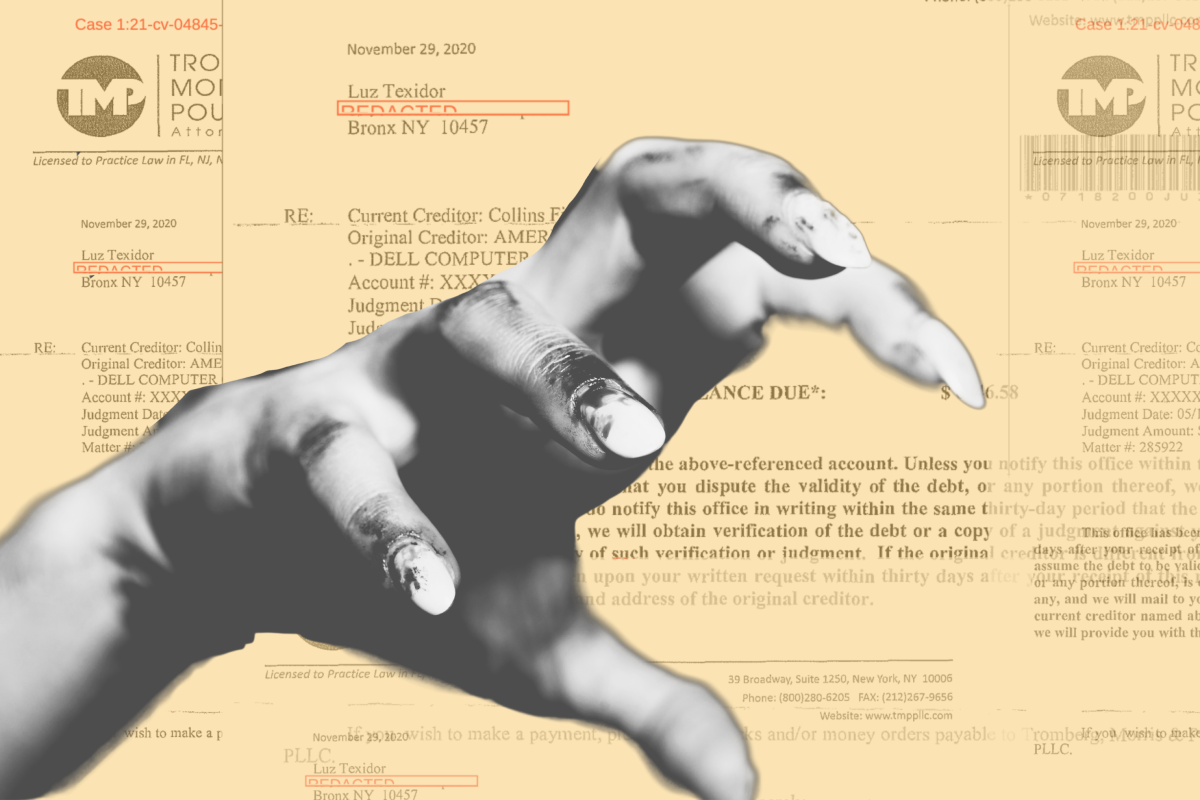
Industry experts refer to delayed debt-collection attempts as “zombie debt.” Photo: neoblues/Getty Images | Illustration: Leor Stylar
Fraud and falsehoods often don’t stop debt collectors from pursuing their targets for years.
By Sam Mellins

In recent months, New York Focus has been reporting on “sewer service,” the term for when plaintiffs in a lawsuit fail to properly inform defendants that they’re being sued.

Sewer service is particularly widespread in the debt collection industry, where it frequently results in creditors winning cases and garnishing a defendant’s paycheck before those defendants even realize they’ve been sued.

It’s often the result of dishonest process servers — people hired by plaintiffs to hand-deliver lawsuits to defendants — who lie about having done their job.

High-profile lawsuits over sewer service in the early 2000s prompted government crackdowns and reforms designed to rein in lawless servers. Since then, some of the most notorious actors have been banned from the industry.

Yet the fraud can still haunt New Yorkers years later. That’s because a plaintiff can collect a debt up to 20 years after winning a judgment in New York, even if serious doubts arise about the process server’s integrity. Industry experts refer to these delayed debt-collection attempts as “zombie debt.”

New York Focus found several examples of zombie debt persisting for years after a server was credibly accused of widespread fraud. In most cases, the defendants never fight back. Here are three stories of defendants who did.

Related: Have You Been Sued for Credit Card Debt? Your Fake Relative Might Know.

Copyright © New York Focus 2024, All rights reserved.
Staying Focused is compiled and written by Alex Arriaga
Contact Alex at alex@nysfocus.com

Feedback? Tips? Pitches? Contact us at: editor@nysfocus.com

Support our work!

Interested in sponsoring these emails? Get in touch! Email editor@nysfocus.com.

This email was sent to *|EMAIL|*

unsubscribe from this list  ·  update subscription preferences

New York Focus · *|HTML:LIST_ADDRESS_HTML|* · USA