‘Zombie Debts’ Refuse to Die, Haunting New Yorkers for Decades

Fraud and falsehoods often don’t stop debt collectors from pursuing their targets for years.

Sam Mellins   ·   August 14, 2025
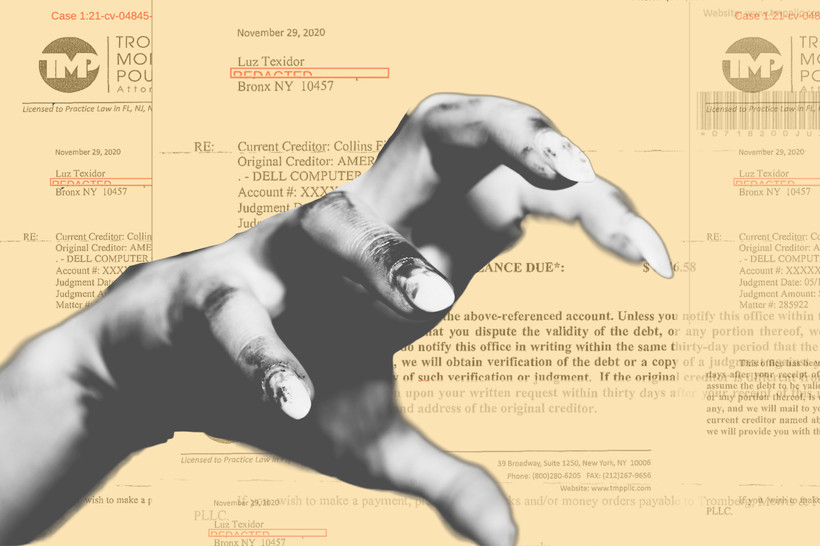
Industry experts refer to delayed debt-collection attempts as “zombie debt.” | Photo: neoblues/Getty Images | Illustration: Leor Stylar

Sign up for Staying Focused, our newsletter keeping readers up to speed on New York politics.

In recent months, New York Focus has been reporting on “sewer service,” the term for when plaintiffs in a lawsuit fail to properly inform defendants that they’re being sued.

Sewer service is particularly widespread in the debt collection industry, where it frequently results in creditors winning cases and garnishing a defendant’s paycheck before those defendants even realize they’ve been sued.

It’s often the result of dishonest process servers — people hired by plaintiffs to hand-deliver lawsuits to defendants — who lie about having done their job.

High-profile lawsuits over sewer service in the early 2000s prompted government crackdowns and reforms designed to rein in lawless servers. Since then, some of the most notorious actors have been banned from the industry.

Yet the fraud can still haunt New Yorkers years later. That’s because a plaintiff can collect a debt up to 20 years after winning a judgment in New York, even if serious doubts arise about the process server’s integrity. Industry experts refer to these delayed debt-collection attempts as “zombie debt.”

New York Focus found several examples of zombie debt persisting for years after a server was credibly accused of widespread fraud. In most cases, the defendants never fight back. Here are three stories of defendants who did.

After serving time in prison from 2003 to 2007, Luz Texidor tried hard to get her life back on track. She started working in a Brooklyn nursing home and made enough money to pay for food and rent.

One day in November 2020, everything threatened to unravel. The city marshal notified Texidor’s employer that she had been sued 12 years earlier for unpaid debt, had lost, and now owed nearly $4,000 plus interest. The letter ordered her employer to withhold 10 percent of her paycheck until the debt was paid off.

“I’m really bugging out, because how am I supposed to pay my rent?” Texidor said, recalling her reaction. “Without me having a roof over my head, I’ll have to go into a shelter or halfway house.”

Texidor said she’d never heard of the lawsuit or the debt. Plus, she had evidence that she’d never been served with court papers: At the time, she was living at an address miles away from where a process server had dropped them off, proved by a letter from New York’s parole agency confirming that her address on file at the time wasn’t where the papers had been delivered.

The server in Texidor’s case, Azzam Abderrahman, had his New York City server license permanently suspended in 2014 after the city’s Department of Consumer Affairs accused him of falsely claiming to have served defendants on seven different occasions. But that didn’t stop the city from ordering Texidor’s wages to be garnished six years later based on Abderrahman’s work.

Many sewer service victims aren’t aware if their servers have been disciplined or found to be engaging in misconduct “because there’s no way to track every case that server worked on,” said attorney Elena Rodriguez, who helps clients with sewer service cases at the nonprofit New Economy Project.

“If anything, every default judgment that server touched should be automatically reviewed, not left to chance until it’s too late,” she said.

Unlike most accused debtors, Texidor took the step of challenging the judgement. After several months of fighting in court, she got it tossed out.

Like Texidor, Timothy Williams had served time. And the same law firm that sued Texidor, called Tromberg, Morris, & Poulin, had sued him, leading to a $3,500 wage garnishment.

The garnishment was based on a 2008 default judgment that Williams said he didn’t hear about until 2021, when a city marshall told him that money would be taken out of his wages to pay off the debt. Williams didn’t know about the lawsuit for a simple reason: he was in prison on the day that the process server, Gene Gagliardi, claimed to have served him at a Brooklyn apartment.

Gagliardi would go on to be one of the chief suspects in a case then-Attorney General Andrew Cuomo brought against fraudulent process servers in 2009.

Cuomo’s team found that in 2007 and 2008, Gagliardi had recorded serving defendants in two different places at once on 450 separate occasions. On one day, Gagliardi swore he served two defendants more than 80 miles apart within one minute.

As a result, his New York City process server license was permanently revoked in 2009 — the year after he purportedly served Williams. But the judgments he enabled remained on the books, allowing Tromberg to garnish Williams’s wages in 2021.

Williams became homeless in August 2022. His attorney said it was due in part to Tromberg, Morris, & Poulin refusing to return the money it had garnished from him, despite a judge ordering the firm to do so.

The issue isn’t confined to New York City.

Westchester County resident Barbara Stinson faced an attempt to collect nearly $20,000 from her in 2018 due to a default judgment from a dozen years earlier.

She, too, had strong evidence that she had never been served: Process server Harry Torres swore he had given the papers to a relative with the same name as Stinson’s son, who had died 25 years earlier at the age of three years old. She was able to get her case dismissed.

Torres worked for a company called Serves You Right, owned by a fellow process server named David Warshall.

In 2010, Cuomo sued Warshall and Serves You Right, alleging that they had committed widespread service fraud, including over 800 instances of servers claiming to deliver papers to two defendants in different locations at once. Torres was personally responsible for 40 of those instances, according to the suit.

Serves You Right was dissolved shortly after. Warshall was banned from the service industry and fined $50,000 — but there were no consequences for Torres.

In fact, enforcement against shady servers, it turns out, is severely limited.

If defendants claim they were never served, a judge can order a hearing to investigate. But this happened fewer than 700 times out of more than 400,000 cases in New York during a recent five-year period, according to records obtained by New York Focus.

In New York City, the Department of Consumer and Worker Protection can revoke a process server’s license if they violate laws or regulations, but this is also a rare occurrence. In the rest of the state, no license is needed.

There’s no way of knowing how many cases that hinge on ethically dubious process servers, like Torres and Gagliardi, are still pending in New York’s courts.

Stinson, Texidor, and Williams’ cases stand out because they retained lawyers and fought back. Most defendants are not so lucky — there is no right to a lawyer in civil cases. Less than a fifth of defendants even responded to the debt lawsuits brought against them in New York City from 2019 to 2023.

For Texidor, fighting back was a matter of principle.

“I am a credible person, and I do handle my business,” she said. “I refuse to accept something that I didn’t do.”

Additional reporting by Julia Rock.

At New York Focus, our central mission is to help readers better understand how New York really works. If you think this article succeeded, please consider supporting our mission and making more stories like this one possible.

New York is an incongruous state. We’re home to fabulous wealth — if the state were a country, it would have the tenth largest economy in the world — but also the highest rate of wealth inequality. We’re among the most diverse – but also the most segregated. We passed the nation’s most ambitious climate law — but haven’t been meeting its deadlines and continue to subsidize industries hastening the climate crisis.

As New York’s only statewide nonprofit news publication, our journalism exists to help you make sense of these contradictions. Our work scrutinizes how power works in the state, unpacks who’s really calling the shots, and reveals how obscure decisions shape ordinary New Yorkers’ lives.

In the last two decades, the number of local news outlets in New York has been nearly slashed in half, allowing elected officials and powerful individuals to increasingly operate in the dark — with the average New Yorker none the wiser.

We’re on a mission to change that. Our work has already shown what can happen when those with power know that someone is watching, with stories that have prompted policy changes and spurred legislation. We have ambitious plans for the rest of the year and beyond, including tackling new beats and more hard-hitting stories — but we need your help to make them a reality.

If you’re able, please consider supporting our journalism with a one-time gift or a monthly gift. We can't do this work without you.

Thank you,


A photo of Sam Mellins.
Sam Mellins is senior reporter at New York Focus, which he has been a part of since launch day. His reporting has also appeared in The San Francisco Chronicle, The Intercept, THE CITY, and The Nation. Reach him on Signal: mellins.613
Also filed in New York State

In May, state lawmakers passed a $269 billion budget after haggling for months over thousands of line items and policies affecting New Yorkers.

Millions in outside spending was a boon to Gov. Kathy Hochul’s 2022 opponent, Lee Zeldin, and influenced down-ballot races.

The legislation would make it easier for currently and formerly incarcerated people and child victims to sue the state over allegations of past abuse.

Also filed in New York City

Resorts World is floating legislation to avert more than $500 million in payments to the horseracing industry.

Some of the city’s new aid will be canceled out by pension boosts.

The Department of Justice has terminated more than 100 immigration judges since last year as it has pressured courts to order more deportations.