‘There’s an Urgency to It’: Eli Northrup Has a Plan to Push Criminal Justice Reform in Albany

Northrup, a former public defender and now Democratic nominee for state Assembly, says it’s time to move toward more humane and effective policies.

Chris Gelardi   ·   July 17, 2026
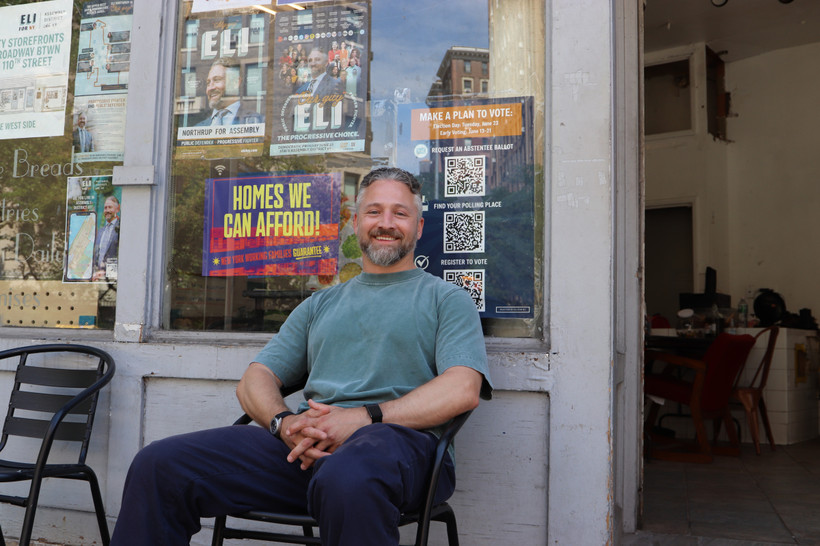
Eli Northrup outside his campaign office.
Eli Northrup, the Democratic nominee for state assembly in 69th district, says New York is at a "tipping point" on criminal justice reform. | Chris Gelardi

Sign up for Staying Focused, our newsletter keeping readers up to speed on New York politics.

New York state has oscillated on criminal justice reform in recent years. Under former Governor Andrew Cuomo, it passed ambitious reforms to overhaul the bail system and give defendants readier access to the evidence against them. Since taking office, Governor Kathy Hochul has sought to roll them back, following a national trend of Democrats re-embracing tough-on-crime policies.

Eli Northrup believes that it’s time for the political pendulum to swing once again. A former public defender and policy advocate, Northrup won the June Democratic primary for the 69th state Assembly district on Manhattan’s Upper West Side. He’s running unopposed in the general election.

While not a member of the Democratic Socialists of America, whose candidates in New York City, Buffalo, and Syracuse triumphed on Primary Day, he earned endorsements from prominent socialists Mayor Zohran Mamdani, Representative Alexandria Ocasio-Cortez, and US Senator Bernie Sanders. He’s now among a class of newly elected and existing legislators who want to rein in police, give defendants a fairer shot in court, and reduce the prison and jail populations.

“From what I’ve seen in my advocacy work, that’s when movements have a chance to be successful — when the body of a legislative house shifts,” Northrup said.

New York Focus sat down with Northrup at a table outside of his campaign office on 104th Street. In the following conversation, edited for length and clarity, he discussed his career, his campaign, and why he’s bullish about New York’s criminal justice reform movement.

New York Focus: You were one of a number of lefty candidates who trounced “establishment”-style candidates for state Assembly and Senate. Everyone has a take about what that means for the political moment. What’s yours?

Eli Northrup: I think there is a frustration with more “establishment” Democratic politics, and there’s a desire for something different and new. I’ve sensed it for a few years, but I think Zohran’s race has validated it. I think it comes from this frustration with how things have been done, and I think it’s generational. Young people are motivated and interested in politics, and they’re not beholden to this older way of doing things.

Around here — the Upper West Side, Morningside Heights — by and large, people trust and like their elected officials. It’s a highly concentrated Democratic area, and people vote. I think there were more votes in the 69th district than almost any other Assembly district.

Each neighborhood has its own story, but I think you’re starting to see it across the country. I think it’s generational, and I think it’s a movement, and I don’t think we’re going back.

NYF: You didn’t take a super traditional path to elected office. How did you go from Bronx criminal courthouses to the state Capitol?

EN: When I went to law school, I thought a lawyer was in a courtroom, and I thought a lawyer helped people. When you go to law school, you figure out that’s not what the majority of lawyers do. But when I found public defense, it totally matched with my idea of how I could use the law in an effective way and what I thought my skill set was. So I really focused on being a public defender. And I loved that work. When I first met a group of public defenders, I was like, “These are my people.” I was never thinking about politics.

I started at Bronx Defenders in 2015, and I think it was around 2017 that I got invited to go up to Albany for a lobby day around cannabis legalization. At that time, the number one case that I handled in the Bronx was low-level possession of cannabis. Even though people weren’t really going to jail at that point, many people were being arrested. And despite the fact that usage rates were equal across races, [over] 90 percent of the people being arrested were Black or brown. Fifty percent of all arrests in the city were taking place in the Bronx, and the collateral consequences were devastating for people. I mean, people had their children taken away. People lost their jobs. People lost their housing. I had clients deported. And it felt like there wasn’t urgency for legalization, even though there were these devastating consequences. People in power weren’t feeling at all that this was an issue.

“I think it’s generational, and I think it’s a movement, and I don’t think we’re going back.”

—Eli Northrup

I got on a bus at Union Square at like 4:30 in the morning, and went up to the Capitol, and that was my first exposure to advocacy work. It was eye-opening for me. I was like, “Oh, these people have the power to change the dynamics in court, and most of them have no idea what’s happening.” I was not super impressed with our local leaders, honestly. But I started to realize, this is how you change things so that you never have to handle a case like this again.

Our office started a policy team, and I started to take elected officials to court and sit with them and explain the bail laws and stuff like that. So I got to know a few of them, and that demystified politics. We passed bail reform, we passed discovery reform [governing the rules by which the prosecution and defense in a criminal case share information], and we legalized cannabis in this three-year period, and it profoundly impacted the lives of my clients. I saw the difference.

I took a sabbatical in 2023 — we unionized, we won sabbaticals. That was like the first time I had been able to take time off with no cases. I got to think about what I would want to do or what was next. Amanda Septimo, who’s become a friend of mine — she’s an assemblymember from the Bronx, and she encouraged me [to run]. She made me feel like it was possible.

[Northrup first ran for Assembly in 2024. The winner of that race, Assemblymember Micah Lasher, is now running for Congress instead of seeking reelection.]

There were five of us that ran in that first race, and I was really proud to have stuck with it and finished second place. It certainly ended up setting me up for this race.

NYFIt seems pretty uncommon for a legislator, especially a first-time legislator, to embrace criminal justice as their cause. How did you make it a winning issue?

EN: I think in general that this is a lefty progressive area, and they just appreciate a public defender. They know what it is, and they think that it’s a righteous job.

But I have to be honest, [criminal justice] wasn’t my main thing that I was talking about. I wasn’t talking about sentencing reform or my work on marijuana or bail reform as much, just because it was, like, Trump and immigration and affordability — and then scaffolding and  empty storefronts. But when I was asked about it, I think it was clear that I could talk about it in depth. They know that I have the expertise.

And it was not a liability — like, “Oh, he’s soft on crime.” It feels, especially after 2020 [when protests erupted after George Floyd’s murder], that people have more of an understanding of the injustice of the criminal-legal system and an understanding that public defenders are trying to work against that injustice. The attitude toward that has changed.

NYF: So tough-on-crime is not so much the attitude among your electorate, or maybe the public in general. But I think there’s a lag in Albany. How do you deal with that still often being the assumption — like, “This is the wise way to go about Democratic politics, being tough on crime”?

EN: I think it’s about being about solutions that work. And one thing I can do is speak to those solutions directly. The person in the system who has the most contact with the accused is their public defender. So we have this insight into the actual individuals and what they’re going through and — even people who have done things that are really bad and damaging and harmful — how to change their trajectory. When you’ve done this for a long time, you see what works, and I think I can speak about that with credibility within the conference.

I also think it means going to the Hudson Valley and going to Long Island and places that are seen as purple — where maybe the leadership is worried that, if we do this, it’s going to impact these marginal seats — and explaining to them, and being there to support them. You can’t just say, “This is right.” You actually have to do the work on the ground.

I think that, also, this election changed things. In my experience, the leadership within the body responds to the members.

NYF: I was going to ask you about [Assembly leadership]. I hear this all the time on my beat: You can pass things in the Senate, but ambitious legislation either dies in the Assembly or it gets watered down. How do you deal with that?

EN: With complicated issues, people are always reticent to act when they don’t understand. When I’ve had success in advocacy work up there, it’s explaining complicated issues in a way that resonates — and so once the members really get it, they can advocate for it, too. Because there’s always going to be lobbyists and advocates on the other side scaring them — and a lot of times, scaring them with misinformation. During the bail and discovery rollback fights, I was outside the room, but I saw how valuable it was to be able to be like, “No, they’re saying this, but this is how it would play out.”

I’ve been talking to Gabriella Romero [former Albany County public defender elected to the Assembly in 2024], who’s become a friend. In the two years she’s been up there, she’s been able to really make an impact on those criminal justice issues because of her ability to explain them and demystify them to people.

I don’t anticipate it being easy, but I have seen major criminal-legal system reform be passed and be successful. And I think with bail, discovery, and cannabis, now that we’re years out, if you look at data, it is an unmitigated success story. There was all this up and down and backlash, and I think part of the backlash came with not explaining it in the first place in a way that was really coherent to begin with.

“With bail, discovery, and cannabis, now that we’re years out, if you look at data, it is an unmitigated success story.”

—Eli Northrup

I’m optimistic about sentencing reform. It’s the right thing to do. It’ll save us money as a state, it’s moral, and there’s an urgency to it.

NYF: Tell me more about sentencing reform. What are the must-pass bills?

EN: The priority bills for me would be the Earned Time Act and the Second Look Act, as well as the parole reform bills. There’s broad support for releasing elderly people, and all of these bills would go towards a more just and equitable sentencing and forgiveness system. The Marvin Mayfield Act, which would eliminate mandatory minimum sentences in New York, is also vital. Marvin [a formerly incarcerated advocate for sentencing reform] was a friend, somebody I really looked up to when I first started going up to Albany.

I think about the RAPP [Release Aging People in Prison] campaign, the Communities Not Cages [sentencing reform] campaign. I mean, we’ve got tens of thousands of community members upstate, long-serving prisoners, based on these draconian and racist sentencing laws from the ’80s and ’90s. We don’t sentence in the same way today that we did back then, and so we have people upstate serving 20-year, life sentences that never would have gotten those sentences if they had been in front of a judge today. But there’s no mechanism to right that wrong, and that’s a tragedy.

What I always get frustrated with in Albany is the lack of urgency to these fights. It’s like, “Oh yeah, well, we did criminal justice.” But if you spend 30 minutes in prison with somebody, you’re going to see how every day feels urgent.

NYF: How do you build urgency around reform? A lot of these bills have been introduced over and over and over, even with a very strong and dedicated advocacy movement behind them.

ENRight, but I think that’s necessary. We have built every year. We gain co-sponsorship, and they pass committee. Bail, discovery, they were pending for years. Cannabis, the same thing. The moment needs to meet the campaign. These campaigns, now we have built a strong enough base and infrastructure behind them that I feel like they’re at the tipping point.

NYF: The other elephant in the room that we didn’t mention: Hochul has been pretty hostile to criminal justice reform. How do you get over that?

ENWhat I’ve seen is that the governor, the executive in general, responds to politics and is responsive to the body and what people want. So you need to make it a political necessity and politically popular. That’s work you need to do. When these kinds of things happen, it’s because people are asking for it. So you just got to build. You have to build the narrative and build the power behind the campaigns. And then it’s feasible.

BEFORE YOU GO, consider: If not for the article you just read, would the information in it be public?

Or would it remain hidden — buried within the confines of New York’s sprawling criminal-legal apparatus?

I started working at New York Focus in 2022, not long after the outlet launched. Since that time, our reporters and editors have been vigorously scrutinizing every facet of the Empire State’s criminal justice institutions, investigating power players and the impact of policy on state prisons, county jails, and local police and courts — always with an eye toward what it means for people involved in the system.

That system works hard to make those people invisible, and it shields those at the top from scrutiny. And without rigorous, resource-intensive journalism, it would all operate with significantly more impunity.

Only a handful of journalists do this type of work in New York. In the last decades, the number of local news outlets in the state has nearly halved, making our coverage all the more critical. Our criminal justice reporting has been cited in lawsuits, spurred legislation, and led to the rescission of statewide policies. With your help, we can continue to do this work, and go even deeper: We have endless ideas for more ambitious projects and harder hitting investigations. But we need your help.

As a small, nonprofit outlet, we rely on our readers to support our journalism. If you’re able, please consider supporting us with a one-time or monthly gift. We so appreciate your help.

Here’s to a more just, more transparent New York.

Chris Gelardi
Justice Bureau Chief
A photo of Chris Gelardi
As New York Focus’s justice bureau chief, Chris Gelardi reports and edits work on the state’s criminal-legal and immigration systems. His writing on cops, jails, ICE, and the US military has appeared in more than a dozen other outlets, most frequently The Intercept… more
Also filed in Criminal Justice

A bill awaiting the governor’s signature would relax restrictions on who can qualify for victim compensation.

In May, state lawmakers passed a $269 billion budget after haggling for months over thousands of line items and policies affecting New Yorkers.

The legislation would make it easier for currently and formerly incarcerated people and child victims to sue the state over allegations of past abuse.

Also filed in New York State

Health care union 1199SEIU helped Public Partnerships LLC take over the state’s home care program, even as it warned some workers could see wage cuts.

Boards of Visitors are supposed to oversee state-run disability and psychiatric programs. Almost none of them have enough members.

Starting this fall, Salamanca High School will deploy a humanoid robot and avatar teaching assistant.