DSA Dominates Albany Elections Despite Super PAC Deluge

The DSA made gains in New York despite super PACs spending $9.6 million in state legislative races — nearly five times the total from 2024.

Nick Garber and Chris Bragg   ·   June 24, 2026
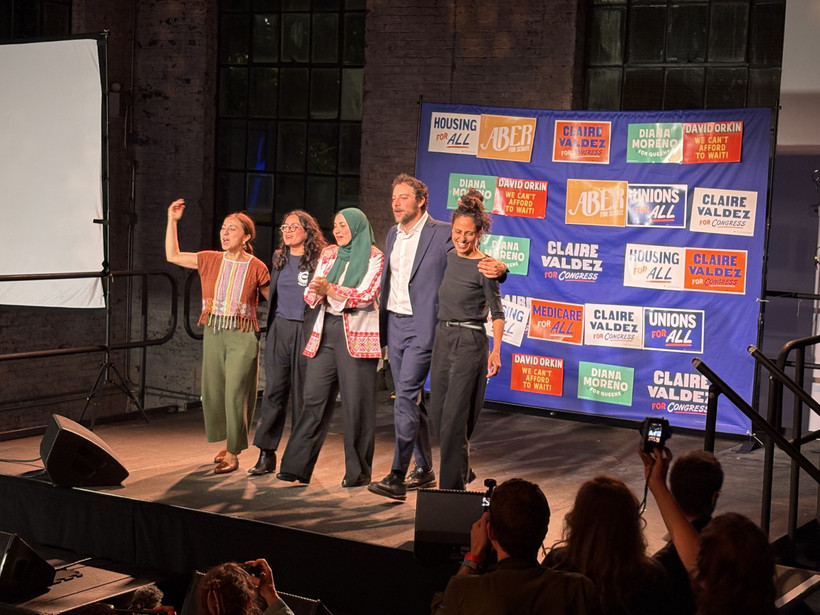
Winning DSA candidates at a watch party
Assemblymember Diana Moreno, Congressional nominee Claire Valdez, state Senate nominee Aber Kawas, Assembly nominee David Orkin, and Assembly nominee Samantha Kattan (left to right) take the stage at a watch party on Tuesday. | Nick Garber/New York Focus

Sign up for Staying Focused, our newsletter keeping readers up to speed on New York politics.

Socialist candidates racked up victories in New York’s primary elections for the state legislature on Tuesday, with the Democratic Socialists of America poised to pick up at least six seats despite an enormous wave of outside spending.

Super PACs had spent $9.6 million on primaries for state Assembly and Senate as of Monday, according to a New York Focus analysis — nearly five times the amount spent through the same period in 2024. Much of the spending was focused on defeating candidates endorsed by local DSA chapters, which fielded their biggest-ever slate of candidates for state office in an effort to build on last year’s election of Zohran Mamdani as New York City mayor.

“Zohran is the catalyst. His win woke people up,” said Jeff Leb, a strategist who is running a super PAC devoted to supporting moderate candidates against DSA-aligned challengers.

DSA has momentum, they’re running their largest slate in New York, and they think they’ve figured out the playbook. That’s why people are responding,” he said, referring to groups spending against socialists.

The anti-DSA spending, which totaled more than $2.5 million, largely failed to win races. In New York City, Senate candidate Aber Kawas and Assembly contenders Christian Celeste Tate, David Orkin, Eon Huntley, Illapa Sairitupac, Samantha Kattan all defeated their opponents by double digits. In Buffalo, Assembly candidate Adam Bojak appears likely to become DSA’s first legislator from Western New York. And in Syracuse, Maurice Brown’s challenge against a 28-year incumbent Assemblymember was too close to call on Tuesday night.

The only DSA-backed candidate to concede Tuesday was Assembly candidate Conrad Blackburn, who was trailing incumbent Jordan Wright. Outside groups spent over $900,000 against Blackburn, more than against any other DSA candidate.

At a watch party on Tuesday, Gustavo Gordillo, co-chair of New York City DSA, attributed the victories to the group’s volunteer army. “The incumbents just were not able to keep up,” he said.

Another $1.4 million was spent to support more moderate candidates facing progressive opponents not backed by DSA, such as Stephanie Ruskay against Eli Northrup for Assembly and Grace Lee against Yuh-Line Niou for Senate. Ruskay lost to Northrup by a wide margin, while Lee easily defeated Niou.

The gains will give DSA at least 15 endorsed lawmakers between the Senate and Assembly starting next year, assuming the primary winners all prevail in the November general election. Although the bloc remains a small fraction of the 63-seat Senate and 150-seat Assembly, DSA has been influential in Albany since electing its first lawmaker in 2018 — shaping laws to prevent evictions and allow the state to build its own renewable energy projects. A bigger socialist bloc could help Mamdani as he readies for another campaign next year to increase taxes on wealthy people and corporations.

Gambling companies, the delivery company DoorDash, and pro-charter school groups were among the biggest spenders on state races this year. Though the influx had the potential to reshape the balance of power in Albany, it was overshadowed by the even greater outside spending in New York’s congressional races.

The congressional primary cycle has been the most expensive in New York’s history, according to the watchdog group OpenSecrets, with more than $50 million in outside spending. Super PACs took center stage in those races, as rival AI giants faced off in Manhattan’s 12th District (along with a billionaire former mayor), pro-Israel and pro-Palestine PACs dueled in Upper Manhattan’s 13th District race, and outside spending supplied some of the biggest attack lines in the progressive civil war of Brooklyn’s 7th District. 

Still, super PAC activity in state-level races grew more dramatically over recent election cycles than it did in congressional races. (People and companies can donate unlimited amounts of money to super PACs, avoiding the contribution limits that apply to campaigns.)

Including the $449,000 spent to influence the primary for state comptroller, super PACs had spent $10 million on state races through Monday. Just $2 million had been spent at the same point in 2024.

The $10 million figure does not include nearly $12 million that an Uber-funded group had reported spending on advertisements boosting Governor Kathy Hochul and her efforts to rein in auto insurance premiums. Hochul did not have a primary opponent after her challenger dropped out in early February.

Through Monday, the biggest spender seeking to influence this year’s Democratic primaries for the legislature was the super PAC New York Future, which had spent $2.6 million and was funded primarily by the gaming companies FanDuel and DraftKings. A group funded by DoorDash had reported the second-most spending ($885,000).

mysterious group called Progress for New York had reported spending $781,000, and according to paperwork filed by the committee, planned to spend solely to influence the outcome of a single Democratic primary for Senate in Queens. The incumbent senator in the district, Jessica Ramos, charges that Mets owner Steve Cohen is funding the super PAC as retribution for Ramos unsuccessfully opposing Cohen’s Queens casino project. A spokesperson for Cohen’s casino project has not responded to the accusation. 

Ramos lost her reelection bid on Tuesday night to Assemblymember Jessica González-Rojas,  who had the super PAC’s backing. 

The next highest spender ($752,000) was a pro-charter school group, Moving New York Families Forward, that has received substantial past funding from former New York City Mayor Michael Bloomberg. That was followed by the liberal Working Families Party ($709,000) and a group called Westside Progress ($705,000) that has ties to allies of former governor Andrew Cuomo and also recently received $250,000 from the state teachers union.

This year’s spending is also a massive jump from 2022, when Hochul was running for a first full term of office. Although there were Democratic and Republican primaries for governor that year, only about $2.3 million in primary-related spending had been reported up to primary day. (This figure does not include $2 million spent by a group that supported Hochul’s Democratic primary challenger that year but never registered its activities with the state Board of Elections.)

In the 2020 primaries, even less — about $830,000 — had been spent to this point.

Strategists said much of this year’s jump in outside spending can be attributed to DSA’s rise. Donors to super PACs that opposed DSA candidates include real estate companies like SL Green and the Durst Organization; the developers Gary Barnett and Henry Elghanayan; and wealthy individuals like Adeena Rosen and Lori Schreiber who donate frequently to pro-Israel causes.

“Groups aligned with traditional Democrats are concerned that if the DSA has a stranglehold in the legislature, are they going to start seeing these policies that Zohran said he was going to pass in the city?” said a strategist who was granted anonymity to avoid antagonizing the leaders of a super PAC for whom they are working this year.

About half the outside spending was directed against socialist and progressive candidates. The other half came from groups pushing their own interests with less of an ideological focus; the pro-betting PAC, for example, supported both the progressive Northrup for Assembly as well as moderate incumbent state Senators Jessica Scarcella-Spanton and Joseph Addabbo. (Addabbo chairs the Senate gaming committee and has championed the legalization of online casino games in New York, a top legislative priority for the gaming companies funding the group.)

The state’s matching fund system, intended to empower small donors, may also have the perverse effect of encouraging super PAC activity, the strategist argued, by lowering limits on direct donations to campaigns.

“How do you curry favor with electeds? How do you make the case that you were more responsible for getting someone elected than not?” the strategist said. “The only way to do that now is with outside spending.”

Leb, who runs a super PAC that backed moderate candidates, said more clients are waking up to their ability to shape state races without spending as much as in a congressional election. The DSA’s victories won’t change that, he predicted Tuesday night.

“These races are competitive now, and that’s not going away,” he said. “Tonight’s lesson isn’t that spending doesn’t matter. It’s that late spending isn’t enough.”

Benjy Sachs contributed research.

At New York Focus, our central mission is to help readers better understand how New York really works. If you think this article succeeded, please consider supporting our mission and making more stories like this one possible.

New York is an incongruous state. We’re home to fabulous wealth — if the state were a country, it would have the tenth largest economy in the world — but also the highest rate of wealth inequality. We’re among the most diverse – but also the most segregated. We passed the nation’s most ambitious climate law — but haven’t been meeting its deadlines and continue to subsidize industries hastening the climate crisis.

As New York’s only statewide nonprofit news publication, our journalism exists to help you make sense of these contradictions. Our work scrutinizes how power works in the state, unpacks who’s really calling the shots, and reveals how obscure decisions shape ordinary New Yorkers’ lives.

In the last two decades, the number of local news outlets in New York has been nearly slashed in half, allowing elected officials and powerful individuals to increasingly operate in the dark — with the average New Yorker none the wiser.

We’re on a mission to change that. Our work has already shown what can happen when those with power know that someone is watching, with stories that have prompted policy changes and spurred legislation. We have ambitious plans for the rest of the year and beyond, including tackling new beats and more hard-hitting stories — but we need your help to make them a reality.

If you’re able, please consider supporting our journalism with a one-time gift or a monthly gift. We can't do this work without you.

Thank you,

Akash Mehta
Editor-in-Chief
A photo of Akash Mehta.
A photo of Nick Garber.
Nick Garber covers politics for New York Focus. He previously worked for Crain’s New York Business, where he covered city and state government, housing and real estate, and money in politics. He also covered neighborhood news in Manhattan and Queens for Patch, and got… more
A photo of Chris Bragg.
Chris Bragg is the Albany bureau chief at New York Focus. He has done investigative reporting on New York government and politics since 2009, most recently at The Buffalo News and Albany Times Union.
Also filed in Elections

The last-minute influx, the biggest ever for a legislative primary, is boosting her opponent, Jessica González-Rojas.

Millions in outside spending was a boon to Gov. Kathy Hochul’s 2022 opponent, Lee Zeldin, and influenced down-ballot races.

Hakeem Jeffries urged Albany to avoid maps that aggressively boosted Democrats, sources told New York Focus.

Also filed in New York State

At a Board of Regents meeting Monday, state officials proposed eliminating credit-based diploma requirements.

City budget gaps and an ambitious affordability agenda may require pressing Albany again for taxes and aid.

A bill awaiting the governor’s signature would relax restrictions on who can qualify for victim compensation.