ICE Is Building a ‘Hard-Sided’ Detention Facility Near Buffalo. What Does That Mean?

The agency is adding 100 beds to the Buffalo Federal Detention Facility.

Isabelle Taft   ·   July 9, 2026
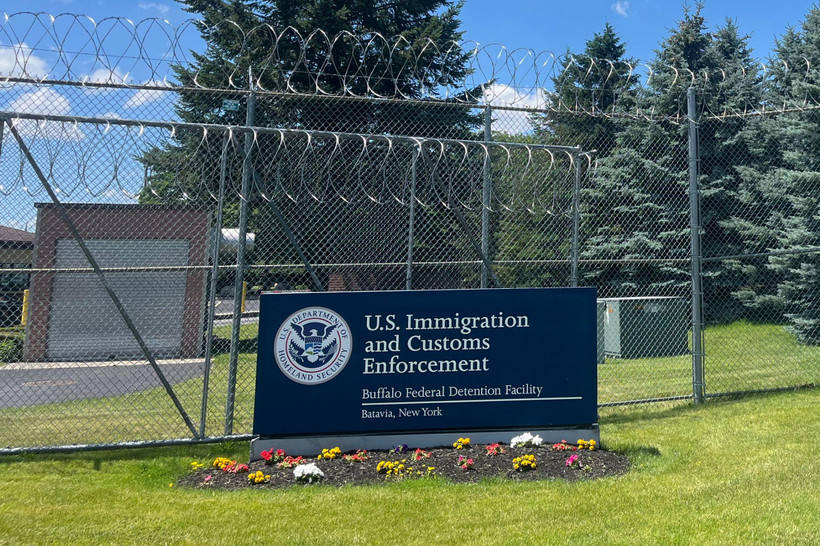
A blue sign reading "U.S. Immigration and Customs Enforcement, Buffalo Detention Center, Batavia New York" sits on the grass in front of a tall metal fence with barbed wire at the top.
The announcement comes as ICE is slated to lose access to beds in county jails. | Isabelle Taft / New York Focus

Sign up for Staying Focused, our newsletter keeping readers up to speed on New York politics.

Immigration and Customs Enforcement is adding 100 beds to New York’s largest and only ICE-run immigration detention center, but it has refused to describe what form the expansion will take, raising the possibility that the agency could use trailers or prefabricated structures to house detainees.

ICE said last week that it was expanding the 650-bed Buffalo Federal Detention Facility in Batavia in response to a recent state law that will bar the agency from detaining people in county jails, which it has increasingly relied on in New York since President Donald Trump returned to office. As of March, ICE was detaining up to about 250 people a day in the state’s jails.

ICE is constructing a new hard-sided detention facility on federal property,” a Department of Homeland Security spokesperson said in a statement. The spokesperson did not respond to questions about how ICE will build the addition or what it means by “hard-sided.”

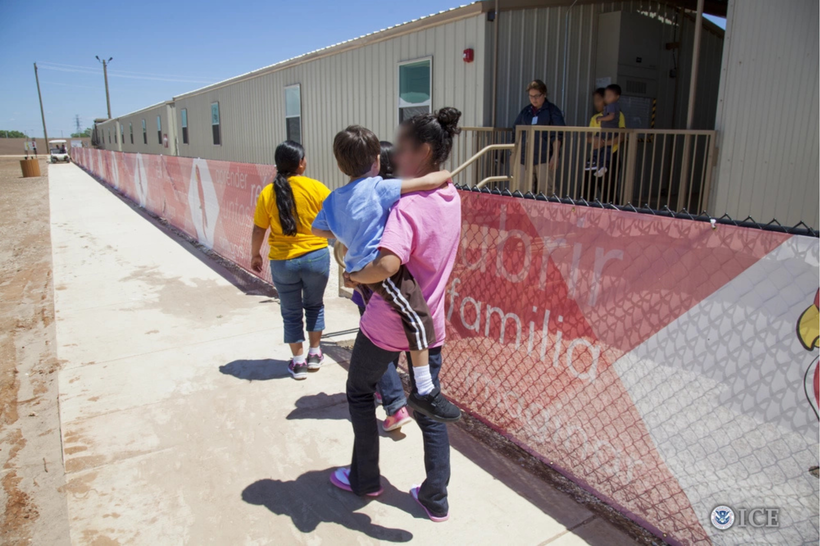
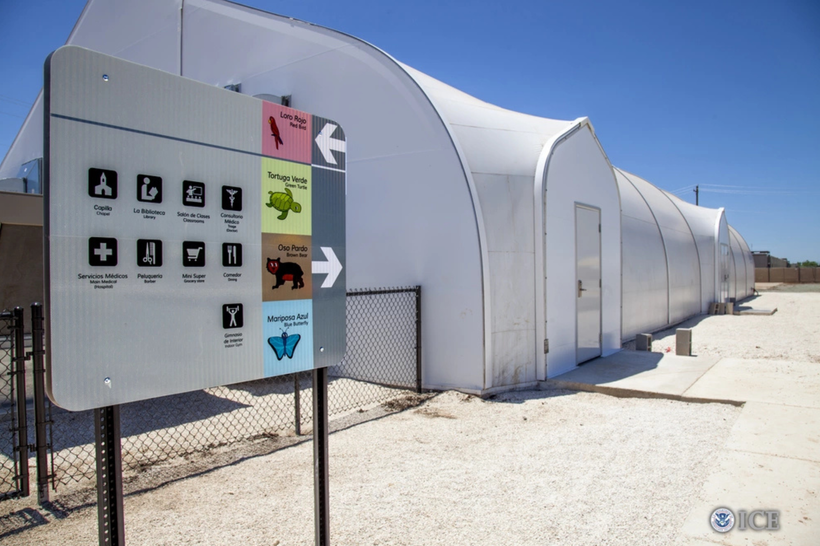
The phrase could refer to a normal building, but could also mean a prefabricated building or a tent with cinderblock walls set up on a concrete base, according to five former Department of Homeland Security and federal law enforcement officials who spoke to New York Focus. For example, a contractor used the term “hard-sided” to describe the trailers and prefabricated buildings at the large family immigration detention center in Dilley, Texas.

Three people, one of them holding a child, walk on a sidewalk near a prefabricated building in a desert-like area.
Photo: DVIDS
A white prefabricated structure in a desert-like area. In the foreground, a sign lists directions to a chapel, library, classrooms, grocery store, and barber; and lists the names of a few different animals, in English and Spanish.
Photo: DVIDS

The South Texas Family Residential Center in Dilley.

Some structures other than brick-and-mortar buildings could become operational quickly, within 60 days, the former officials said. But some designs can be difficult to manage, particularly when it comes to security and climate control at a site so far north. 

“Especially in Buffalo, it’s going to be a challenge in the wintertime,” said a former federal law enforcement official, who spoke on the condition of anonymity because he now works for ICE as a consultant.

Prior to ICE’s public announcement, New York Focus learned that the agency had recently discussed building a “soft-side” tent structure to house up to 100 people at the Buffalo facility. New York Focus reviewed notes from those discussions and spoke with a source familiar with the plans. Wayne County Sheriff Rob Milby said an ICE contact confirmed the agency was considering building the tents. ICE did not respond to questions asking whether it had abandoned that plan.

“Especially in Buffalo, it’s going to be a challenge in the wintertime.”

—former federal law enforcement official

People detained at the Buffalo facility, which exclusively houses men, have long described overcrowding, poor access to medical care, and the use of solitary confinement as punishment. Rosa Cohen-Cruz, immigration policy director for the Bronx Defenders, argued it was unlikely that any expansion, particularly one set up quickly, would prioritize immigrants’ safety.

“It is very hard to believe that anything that is sort of slapped together quickly will come anywhere close to meeting the needs,” she said.

In its statement, the Department of Homeland Security assured that the new facility “will provide a safe, secure, and humane environment for individuals in ICE custody and will operate in accordance with applicable National Detention Standards.”

The expansion comes as ICE is set to lose access to hundreds of beds it has used at local jails in New York in recent months. As part of the state budget passed in May, New York banned counties from detaining people for ICE. The law goes into effect August 25, and counties with existing detention agreements then have three months to terminate them.

The Department of Homeland Security’s statement said the expansion was needed “due to New York State laws prohibiting counties from contracting with ICE to house illegal aliens.” The Trump administration sued New York last month over the laws, which also prohibit local law enforcement agencies from entering into so-called 287(g) agreements that deputize their officers to perform immigration enforcement.

Cohen-Cruz pushed back against ICE’s claim that New York’s new law prompted the detention expansion plan, pointing out that the agency is trying to expand its capacity in states that do allow immigration detention in county jails.

It had also sought to expand its detention capacity in New York long before the state passed the new restrictions. The agency is building detention cells in a federal building in downtown Rochester, and the federal government has leased a 40,000-square-foot warehouse in Newburgh that documents suggest could be used by ICERadio Catskill recently reportedICE abandoned plans to turn a warehouse in Chester, in the Hudson Valley, into a detention facility after local outcry. Currently, the only other federal facility in New York that houses ICE detainees is Brooklyn’s Metropolitan Detention Center.

Under the Trump administration, ICE has used tents and other structures to quickly expand immigration detention around the country. Florida rushed to construct “Alligator Alcatraz,” a tent complex in the Everglades, last summer. (The facility recently shut down.) A massive tent camp opened last year in El Paso, Texas, is now the country’s largest immigration detention facility.

The Buffalo Federal Detention Facility is one of only a handful of ICE jails that the agency owns outright, rather than contracting with a private company or local jail. (Privately run detention facilities are illegal in New York.)

That could make it easier to build there, said Claire Trickler-McNulty, who worked for ICE under the Biden, Obama, and first Trump administrations.

“They already own the land, they have more control, and they don’t have to deal with zoning issues or other things that may come up if it’s a private company or a vendor,” Trickler-McNulty said.

Milby, who has criticized Governor Kathy Hochul’s efforts to limit collaboration with ICE, applauded the expansion plan. 

“From what everybody understands, space is at a premium” at the Buffalo detention center, he said. “Now with the new law that she’s enacting, she’s taking away the ability of sheriffs to help the situation.”

Cohen-Cruz sees it differently. “There’s no reason why people cannot be at liberty while they fight their deportation cases,” she said. “If we really are trying to create a safe, just, and humane immigration system, we should not be funneling more resources into expanding detention.”

Justice for Migrant Families, a Buffalo-based nonprofit that works with immigrants in western New York, including people detained at the Buffalo detention center, said it strongly opposes the expansion plan.

“Individuals held there, who are disproportionately Black and brown — many of whom are Indigenous — are our friends, neighbors, and family,” the organization said in a statement. “They are farm workers, roofers, construction workers, cleaners, tourists, parents, children, and attendees of local churches and mosques across New York and beyond.”

Immigrant rights advocates in New York speculate that the new construction could be used to detain women. Four people involved in rapid response to ICE detentions in upstate and western New York told New York Focus that agents often quickly release women they arrest during traffic stops, apparently because they have nowhere to detain them locally.

In recent months, ICE has been detaining women at the Allegany and Niagara county jails, according to ICE data, but no more than about 20 at a time, and Niagara’s sheriff announced earlier this year that he would not detain anyone on a civil immigration violation alone. Under New York’s new law, ICE will lose access to those facilities by late November.

At New York Focus, our central mission is to help readers better understand how New York really works. If you think this article succeeded, please consider supporting our mission and making more stories like this one possible.

New York is an incongruous state. We’re home to fabulous wealth — if the state were a country, it would have the tenth largest economy in the world — but also the highest rate of wealth inequality. We’re among the most diverse – but also the most segregated. We passed the nation’s most ambitious climate law — but haven’t been meeting its deadlines and continue to subsidize industries hastening the climate crisis.

As New York’s only statewide nonprofit news publication, our journalism exists to help you make sense of these contradictions. Our work scrutinizes how power works in the state, unpacks who’s really calling the shots, and reveals how obscure decisions shape ordinary New Yorkers’ lives.

In the last two decades, the number of local news outlets in New York has been nearly slashed in half, allowing elected officials and powerful individuals to increasingly operate in the dark — with the average New Yorker none the wiser.

We’re on a mission to change that. Our work has already shown what can happen when those with power know that someone is watching, with stories that have prompted policy changes and spurred legislation. We have ambitious plans for the rest of the year and beyond, including tackling new beats and more hard-hitting stories — but we need your help to make them a reality.

If you’re able, please consider supporting our journalism with a one-time gift or a monthly gift. We can't do this work without you.

Thank you,

Akash Mehta
Editor-in-Chief
A photo of Akash Mehta.
A photo of Isabelle Taft.
Isabelle Taft covers immigration for New York Focus. She’s also a corps member with Report for America, a national program that places reporters in local newsrooms. She previously covered national news as a fellow at the New York Times, worked on the health… more
Also filed in New York State

Amid growing spending on universal pre-K, school districts failed to spend millions earmarked for the 2024-25 school year.

New York City has no plans to opt into NY HELPS, which has been extended to 2028 after filling 60,000 government jobs.

New York’s free air conditioner program ran out of funding before summer, even as extreme heat becomes a deadlier threat.

Also filed in Immigration

Under Trump, a status for young immigrants who have experienced abuse or neglect no longer offers much protection.

A lawsuit accuses federal officials of ignoring evidence that the boy, born in Mexico, held US citizenship through his mother.

We’ve compiled information for the 450,000 New Yorkers who will lose health care coverage on July 1.