What To Do If You’re Impacted By Changes to the Essential Plan

We’ve compiled information for the 450,000 New Yorkers who will lose health care coverage on July 1.

Jie Jenny Zou   ·   June 15, 2026
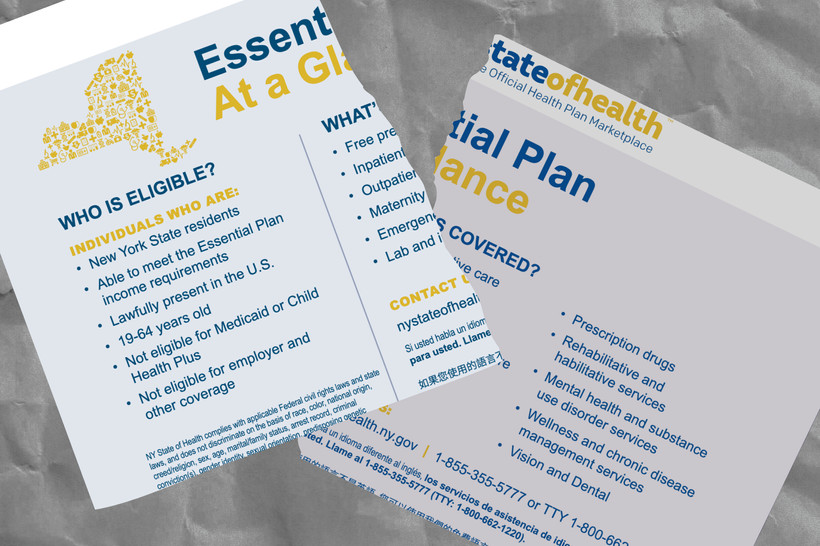
The Essential Plan has enabled New York to offer near-universal health insurance coverage — but hundreds of thousands of people on the plan could soon be dropped. | Card: NY State of Health | Illustration: Leor Stylar

Sign up for Staying Focused, our newsletter keeping readers up to speed on New York politics.

Starting July 1, hundreds of thousands of New Yorkers enrolled in the state’s Essential Plan will lose their health insurance due to federal cuts. The plan provides free or low-cost health care for New Yorkers ineligible for Medicaid. 

Below, we’ve compiled information for Essential Plan users about what these changes mean and alternative options for coverage. If you have specific questions about your coverage and choices, contact the state’s health care marketplace, New York State of Health.

Note: This information is up to date as of June 2026.

Are you one of the hundreds of thousands New Yorkers impacted by the coverage cliff for Essential Plan users? Our social services reporter wants to hear from you. Email Jie Jenny Zou at jenny@nysfocus.com

What is the Essential Plan?

The Essential Plan provides free or low-cost health care to New Yorkers below certain income limits (see the next section, titled “How do I know if my coverage is ending?” for more details). You must also meet ALL of the following criteria:

  • 19 to 64 years old,
  • ineligible for Medicaid, Child Health Plus, or Medicare, 
  • ineligible for employer-sponsored coverage, AND
  • a US citizen or meet immigration status requirements.

Those enrolled in the plan do not pay monthly premiums or meet deductibles. Depending on household income, enrollees may have to pay low fees for certain procedures or services. You can apply for the Essential Plan through the state’s health care marketplace at any point in the year.

How do I know if my coverage is ending?

You may have received notices from the state health department or your insurer notifying you that your Essential Plan coverage is ending this summer. Due to recent federal changes, coverage for enrollees over a certain income threshold will be terminated on July 1, 2026. Coverage will end or shift for immigrants with Deferred Action for Childhood Arrivals status, even if they earn below that amount. (Contact New York State of Health for more details.)  

Essential Plan enrollees fall into five different tiers based on how their household income compares to the federal poverty level, also known as the FPL. (The FPL is updated annually, so your overall eligibility for the plan may change year to year)Your tier is calculated using the total number of people in your household. 

Enrollees in a tier called “200-250,” with household income between 200%–250% of the 2026 FPL, will lose coverage July 1. That includes the following incomes:

  • Single-person household: $31,920–$39,900
  • 2-person household: $43,280–$54,100
  • 3-person household: $54,640–$68,300
  • 4-person household: $66,000–$82,500

This change is expected to impact an estimated 450,000 New Yorkers. Some temporary exceptions apply to those who are pregnant or recently gave birth, depending on citizenship or immigration status. 

If you’re unsure whether you’re in the impacted tier or whether immigration-related changes impact you, contact New York State of Health.

What should I do before I lose coverage?

If you are going to be impacted by changes to the plan, you can continue to use your coverage until July 1, 2026. Consider scheduling or moving your medical appointments or procedures so they take place before that date. Your doctor’s office may be able to help you refill a larger quantity of your medications or issue an emergency refill before that date, too, depending on the type of medication and your coverage.

State health officials are encouraging New Yorkers to review alternative options for coverage. This likely entails purchasing a new plan through the New York State of Health or obtaining insurance through your employer, union, or another organization.

What should I do when I lose my insurance?

Understanding private insurance:

The terms used in private insurance can be confusing. Here are some brief definitions and resources: 

A premium is the amount you must pay each month to keep your health care policy active, regardless of how often you use your insurance.

A deductible is the annual amount you must spend out-of-pocket before your plan starts to pay for your care. For example, if your deductible is $1,000, you must first pay $1,000 for covered health care services before your plan starts to cover additional expenses.

A copayment is the fixed amount that you pay for a service both before and after you’ve reached your deductible. For example, your plan may require a $30 copay for every specialist visit.

Coinsurance is the percentage of the costs of a service that you pay for after you’ve reached your deductible. For example, if your coinsurance for emergency room visits is 20 percent, once you meet your annual deductible, your plan will pay for 80 percent of the visit.

An out-of-pocket maximum is the maximum amount you will pay any services and prescriptions in a year. Once you reach this limit, your plan will cover 100 percent of remaining expenses.

Impacted New Yorkers can enroll in what’s known as a Qualified Health Plan — a type of private insurance policy — through New York State of Health until August 30, 2026. Unlike with the Essential Plan, private insurance requires that you pay monthly premiums to use your coverage, and meet deductibles. 

Impacted Essential Plan 200-250 users will be eligible for tax credits that immediately discount the monthly premiums for a Qualified Health Plan. For example, if your monthly premium is $700 and you are eligible for a tax credit of $400 per month, you would only pay $300 each month. The credits are based on your estimate of your household income for the year; if you end up earning more or less than what you estimate, you will have to pay back the difference or will receive a tax refund.

According to the state Department of Health, the average monthly cost of Qualified Health Plans that impacted users will be eligible for is $250 after tax credits, with an average annual deductible of $2,150.

State health officials recommend taking your time to carefully review all offerings to find the plan that’s right for you. You can request that any coverage you enroll in before August 30, 2026, have a retroactive start date of July 1, 2026, meaning health expenses incurred during that time will be covered by your new plan. 

Here’s a detailed guide to all your rights as a health insurance consumer in New York state, including protections against surprise billing, how to appeal coverage denials, and more.

How can I get help reviewing my options?

There are people, called “assistors,” who are trained to help you review options for your specific medical needs and income. You can connect with an assistor from the New York State of Health

If you live in New York City, you can also connect with certified counselors through the City Health Department who can help review your coverage options. A network of community-based organizations throughout the five boroughs are also assisting with enrollment.

I can’t afford to purchase health coverage.

Many New Yorkers will be unable to afford a Qualified Health Plan or obtain employer-sponsored coverage. If you become uninsured, there are several programs for accessing free or low-cost health care:

  • Federally Qualified Health Centers provide preventative care, dental care, mental health care, substance abuse treatment, specialty care, and transportation services for a sliding-scale fee. You can look up your nearest center here
  • Some clinics and pharmacies provide free or low-cost care to uninsured and underinsured patients. Find your nearest free or charitable clinic or pharmacy here.
  • Many medical schools have student-run clinics that offer free or low-cost care, including Weill Cornell Community Clinic in Manhattan, WISH Clinic and Stony Brook HOME on Long Island, Lighthouse Free Medical Clinic in Buffalo, and more. Check with your nearest medical school.
  • New York Rx Card provides prescription discounts across a network of pharmacies. Most drug companies offer patient assistance programs that can lower the cost of your medication if you’re uninsured or underinsured.
  • Remote Area Medical operates mobile pop-up clinics offering free medical exams, dental care, and vision care in rural and underserved areas across the state.
  • New York’s Uninsured Care Programs provide access to free health care for uninsured or underinsured New Yorkers living with or at high risk for HIV/AIDS. This includes the AIDS Drug Assistance Program, the HIV Home Care Program, the PrEP Assistance Program, and more.
  • The Medicaid Cancer Treatment Program expands Medicaid eligibility for New Yorkers diagnosed with breast, cervical, colorectal, or prostate cancer who earn below 250 percent of the federal poverty level. The program also covers some pre-cancerous conditions.
  • Your local elected official may be able to connect you with additional health resources. Look up your elected officials using this website.

If you live in New York City or on Long Island:

Accessing hospital or emergency care

You cannot be turned away at the hospital if you are uninsured. Under federal law, hospital emergency rooms must provide care to anyone facing an emergency, regardless of their ability to pay. 

All nonprofit hospitals in the state are required to offer a form of assistance called charity care, a sliding-scale discount program, to patients earning up to 400 percent of the federal poverty level regardless of immigration status. Ask the hospital billing department about it. Here’s our detailed guide on how to navigate charity care.

How to navigate medical debt

New York has some of the strongest consumer protections for medical debt in the country, including laws that limit debt collection, cap the amount of interest that can be charged, prohibit providers from reporting medical debt to credit agencies, and bar providers from suing most patients for medical debt. The statute of limitations for medical debt in New York state is three years, which means health care providers only have until three years from the date of treatment to collect unpaid medical bills. Here is a detailed guide about medical debt from the New York State Attorney General.

Advocates warn against using personal credit cards to pay for medical services, because it eliminates these protections. Those charges are treated as credit card debt. 

All medical debt can be negotiated, and billing errors are common. Community Health Advocates is a nonprofit that may be able to help you negotiate or correct your medical bills, and provides guides on how to negotiate medical bills in English and Spanish, and what to do if you’re being sued for medical debt.

At New York Focus, our central mission is to help readers better understand how New York really works. If you think this article succeeded, please consider supporting our mission and making more stories like this one possible.

New York is an incongruous state. We’re home to fabulous wealth — if the state were a country, it would have the tenth largest economy in the world — but also the highest rate of wealth inequality. We’re among the most diverse – but also the most segregated. We passed the nation’s most ambitious climate law — but haven’t been meeting its deadlines and continue to subsidize industries hastening the climate crisis.

As New York’s only statewide nonprofit news publication, our journalism exists to help you make sense of these contradictions. Our work scrutinizes how power works in the state, unpacks who’s really calling the shots, and reveals how obscure decisions shape ordinary New Yorkers’ lives.

In the last two decades, the number of local news outlets in New York has been nearly slashed in half, allowing elected officials and powerful individuals to increasingly operate in the dark — with the average New Yorker none the wiser.

We’re on a mission to change that. Our work has already shown what can happen when those with power know that someone is watching, with stories that have prompted policy changes and spurred legislation. We have ambitious plans for the rest of the year and beyond, including tackling new beats and more hard-hitting stories — but we need your help to make them a reality.

If you’re able, please consider supporting our journalism with a one-time gift or a monthly gift. We can't do this work without you.

Thank you,

Akash Mehta
Editor-in-Chief
A photo of Akash Mehta.
A photo of Jie Jenny Zou.
Jie Jenny Zou covers social services and public benefits for New York Focus. She previously worked as an investigative reporter at the Los Angeles Times and the Center for Public Integrity where she delved into topics ranging from environmental health and worker safety… more
Also filed in New York State

A lobbyist who has been romantically linked to Assembly Speaker Carl Heastie led a rally opposing the legislation a week before the speaker declined to bring it to a vote.

In May, state lawmakers passed a $269 billion budget after haggling for months over thousands of line items and policies affecting New Yorkers.

Millions in outside spending was a boon to Gov. Kathy Hochul’s 2022 opponent, Lee Zeldin, and influenced down-ballot races.

Also filed in Health

Despite last-ditch efforts by a coalition of lawmakers, the state failed to avert a health coverage cliff coming this summer.

160,000 injured New Yorkers seek workers’ compensation each year — but in recent years, regulators have tilted the scales towards employers and insurers.

Amid abortion bans and rising digital surveillance, Albany lawmakers are revisiting an effort to stop companies from selling sensitive health information.

Also filed in New York City

The citizens assembly model, used for public decision-making around the world, is gaining traction in New York.

Resorts World is floating legislation to avert more than $500 million in payments to the horseracing industry.

Some of the city’s new aid will be canceled out by pension boosts.

Also filed in Immigration

The Department of Justice has terminated more than 100 immigration judges since last year as it has pressured courts to order more deportations.

The legislation comes after months of haggling over how best to protect New Yorkers from President Trump’s immigration crackdown.

Footage published by New York Focus sparked a debate over deputies’ practice of calling Border Patrol on Spanish-speaking drivers.

Also filed in Explainers

We’ve compiled information for SNAP recipients in New York on the changing work requirements.

We answer your questions on the state’s notoriously opaque budget process.

Unions want state leaders to sweeten their retirement packages. What would it cost, and what would it achieve?

Also filed in Social Services

New York state has pumped millions of taxpayer dollars into an online portal that vowed to make life easier for Rochester’s neediest, but critics say it’s fallen short.

The Hochul administration now has a chance to relax New York’s child care staffing ratios — among the country’s strictest — after 26 years. But will it?

New rules could result in thousands of New Yorkers losing their food benefits this summer.

Also filed in Affordability

Governor Kathy Hochul was successful in her bid to upend the Climate Leadership and Community Protection Act after legislators caved to finalize an overall budget deal.

Fossil fuel interests have enlisted prominent former elected officials to make the case that gas is here to stay.