New York High Schoolers Might Be Getting a New Diploma. Here’s What to Know.

At a Board of Regents meeting Monday, state officials proposed eliminating credit-based diploma requirements.

Melissa Manno   ·   June 19, 2026
A high-contrast photo of a rolled up graduation diploma closed with a tassel against an orange and black background.
High school graduates in New York could soon start receiving diplomas that reflect their skills and knowledge, rather than the number of credits they’ve earned. | Photo: Halustd/Canva | Illustration: Leor Stylar

Sign up for Staying Focused, our newsletter keeping readers up to speed on New York politics.

At a Board of Regents meeting Monday, state education officials announced that high school graduates in New York could soon start receiving a new type of diploma — one that reflects their skills and knowledge, rather than the number of credits they’ve earned.

The new diploma is a central component of New York Inspires, the State Education Department’s multiyear effort to overhaul graduation requirements to ensure students leave high school ready for modern careers and higher education. If approved by the board, it would replace the current graduation framework, which allows students to earn one of three diplomas depending on how they perform on statewide standardized tests known as Regents exams.

At the meeting, Education Department officials called it the most significant transformation of the state’s graduation system in generations. The plan would direct school districts to shift away from awarding credits based on the time a student spends in a course and instead adopt a “competency-based” model with flexibility in how they develop mastery of specific skills.

“The big idea is that New York is moving away from an outdated factory-style education model toward a model system built for how students actually learn,” said Jeffrey Matteson, the department’s senior deputy commissioner for education policy.

The Education Department has only shared preliminary plans so far, so many implementation details remain unclear. During and after the meeting, some Board of Regents members and education advocates raised concerns about how schools will maintain academic rigor and support teachers as they adopt flexible models, and whether students across the state will have equal access to opportunities.

Jeff Smink, deputy director at the advocacy group EdTrust-New York, said New York must strengthen K-8 instruction in order for the initiative to succeed, noting that students can only access opportunities like internships and college courses if they are proficient in reading and math.

The department plans to present the final plan to the board for approval once it’s complete and start a phased rollout in certain grade levels by the end of next school year. Here’s what we know so far.

What is competency-based education?

The Education Department defines competency-based education as a system in which students get closer to graduating after proving they’ve actually learned material instead of just completing required class time.

Students would still enroll in traditional courses, but would also be able to participate in activities outside of the classroom, such as internships, capstone projects, community service and career and technical education programs, to move toward their degrees. Instead of a single exam, students would have different ways to show what they know in each subject, such as assessments, projects, presentations, or portfolios.

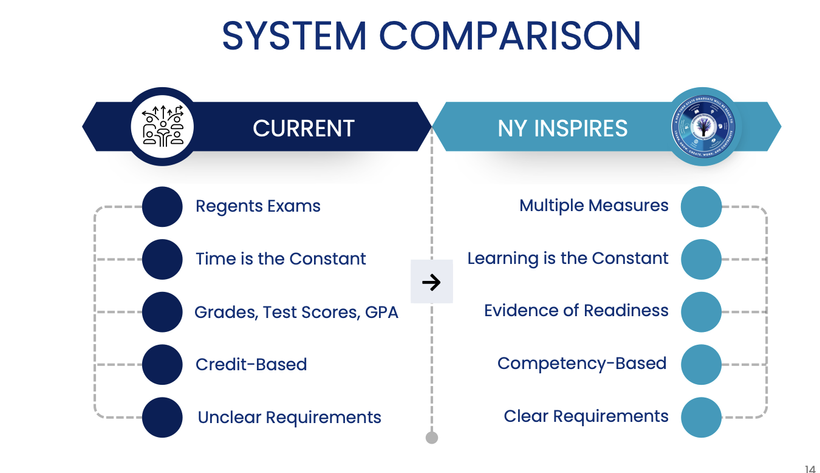
A graphic titled "System Comparison" shows two side-by-side lists. The leftmost, titled "Current," lists "Regents Exams; Time is the Constant; Grades, Test Scores, GPA; Credit-Based; Unclear Requirements." The rightmost column, titled "NY Inspires," lists "Multiple Measures; Learning is the Constant; Evidence of Readiness; Competency-Based; Clear Requirements."
A graphic from a June 2026 State Education Department presentation showing proposed changes to New York's graduation requirements. | New York state Education Department


In 2024, the Board of Regents announced plans to eliminate the requirement that students pass the Regents exams to receive a diploma. Currently, they can earn one of three diploma designations: a Regents diploma, an advanced Regents diploma for students who pass additional tests, and a local diploma for students who meet testing requirements a different way. On Monday, state officials explained that the exams would be one of many options students can use to qualify for a diploma.

“What will matter moving forward is the quality and substance of the evidence that a student produces, not the particular route that produced it or how long it took,” said Shannon Logan, director of strategic priorities and coordination in the department’s Office of Cultural Education.

What will the new transcript look like?

Current transcripts include a list of classes and assessments with corresponding grades, which do not “adequately reflect what a student knows and what they are able to do,” Angelique Johnson-Dingle, one of the department’s deputy commissioners, said at the meeting. Under the new framework, graduating students would receive a “universal transcript or learner profile.” 

The transcript would document alignment with state learning standards and the six attributes the state outlined in its graduation blueprint, called the Portrait of a Graduate. It’s unclear exactly what the transcript would look like.

Will it affect college applications?

There is little evidence that competency-based education disadvantages students in the college admissions process. Many colleges have embraced more holistic admissions practices that consider portfolios and other demonstrations of skills that extend beyond GPA and standardized test scores.

Education Department officials said they are working with colleges and universities to ensure every institution that serves the state’s high school graduates ”understands and trusts” the new diploma.

What does this mean for current students?

Students who started ninth grade in 2023 would be the final cohort to graduate under the state’s current requirements.

Students starting high school in 2024, 2025, or 2026 would still have to fulfill current credit requirements and take the Regents exams, but they would not have to pass the exams to graduate. For the 2027 and 2028 cohorts only, the state would impose a yet-to-be-determined credit requirement.

The new flexible system introduced Monday, which would eliminate time-based credits, would be fully implemented for students who enter high school in 2029.

What are the next steps?

The state is currently reworking learning standards, competency rubrics, and the universal transcript and will release them within the next year. The department said it will continue to schedule working groups and advisory panels to gather feedback on the changes, and is updating the state’s data system to track student progress.

The Education Department encouraged school districts to start designing pilot programs for next school year that include hands-on learning outside of traditional classrooms, a wider range of ways to assess student learning beyond standard exams, and expanded career-related opportunities. Schools could hire work-based learning coordinators, for instance, or partner with local employers.

At New York Focus, our central mission is to help readers better understand how New York really works. If you think this article succeeded, please consider supporting our mission and making more stories like this one possible.

New York is an incongruous state. We’re home to fabulous wealth — if the state were a country, it would have the tenth largest economy in the world — but also the highest rate of wealth inequality. We’re among the most diverse – but also the most segregated. We passed the nation’s most ambitious climate law — but haven’t been meeting its deadlines and continue to subsidize industries hastening the climate crisis.

As New York’s only statewide nonprofit news publication, our journalism exists to help you make sense of these contradictions. Our work scrutinizes how power works in the state, unpacks who’s really calling the shots, and reveals how obscure decisions shape ordinary New Yorkers’ lives.

In the last two decades, the number of local news outlets in New York has been nearly slashed in half, allowing elected officials and powerful individuals to increasingly operate in the dark — with the average New Yorker none the wiser.

We’re on a mission to change that. Our work has already shown what can happen when those with power know that someone is watching, with stories that have prompted policy changes and spurred legislation. We have ambitious plans for the rest of the year and beyond, including tackling new beats and more hard-hitting stories — but we need your help to make them a reality.

If you’re able, please consider supporting our journalism with a one-time gift or a monthly gift. We can't do this work without you.

Thank you,

Akash Mehta
Editor-in-Chief
A photo of Akash Mehta.
A photo of Melissa Manno.
Melissa Manno is a reporter at New York Focus, covering the state’s school system and education politics. She was previously an education reporter for the San Antonio Express-News, where she reported on discipline, special education, school funding and other issues impacting students in… more
Also filed in New York State

The last-minute influx, the biggest ever for a legislative primary, is boosting her opponent, Jessica González-Rojas.

City budget gaps and an ambitious affordability agenda may require pressing Albany again for taxes and aid.

A bill awaiting the governor’s signature would relax restrictions on who can qualify for victim compensation.

Also filed in Education

In May, state lawmakers passed a $269 billion budget after haggling for months over thousands of line items and policies affecting New Yorkers.

Some of the city’s new aid will be canceled out by pension boosts.

The Hochul administration now has a chance to relax New York’s child care staffing ratios — among the country’s strictest — after 26 years. But will it?