NY Budget Brings Historic Child Care Investments — But Not for Its Workforce

Advocates welcomed the additional funding but said it falls short of need and doesn’t do enough to support workers.

Melissa Manno   ·   May 28, 2026
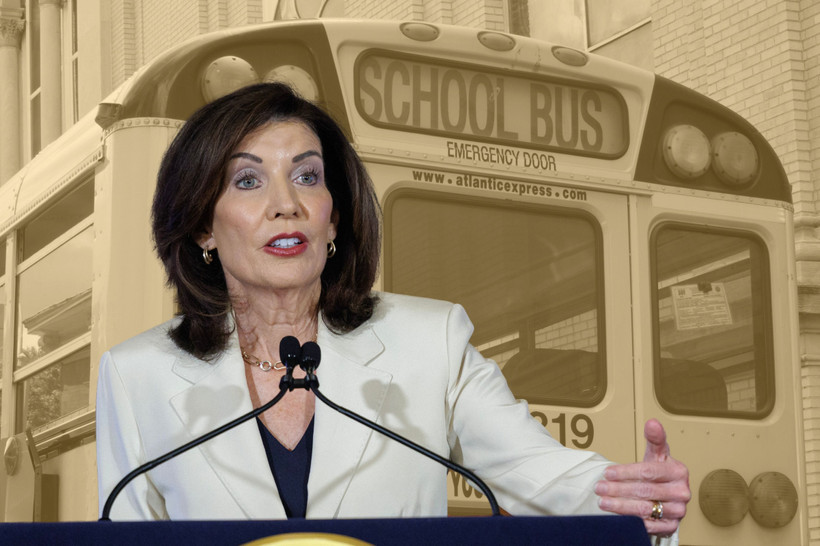
A photo collage of Governor Kathy Hochul in the foreground, with a yellow-tinted photo of a school bus in the background.
Senators failed to squeeze their $500 million workforce compensation fund proposal into the final budget. | Photos: Mike Groll/Office of Governor Kathy Hochul; Mike Beale/Flickr | Illustration: Leor Stylar

Sign up for Staying Focused, our newsletter keeping readers up to speed on New York politics.

Governor Kathy Hochul’s final budget agreement with the state legislature makes a landmark investment in child care — but advocates worry gaps in support could prevent low-income New Yorkers from benefiting. 

The budget will boost funding for child care subsidies, fully fund the first two years of free child care for 2-year-olds, and shore up funding for 3-K in New York City; pilot affordable day care for children under 3 in other parts of the state; and require school districts to offer universal pre-K by the 2028–29 school year.

Hochul said the plan sets New York “on a historic path to statewide universal child care.” 

But there’s one omission in the child care budget that advocates said is glaring: any measure to address the low wages driving the child care workforce shortage. Senators failed to squeeze their $500 million workforce compensation fund proposal into the final budget. 

“We consider that a really jarring misstep that threatens the success of the shared goal of universal child care,” said Dede Hill, vice president of policy at the Schuyler Center for Analysis and Advocacy. “We just don’t see a way that the state can achieve this goal without investing in the child care workforce.”

Some also fear the budget won’t stabilize the state’s child care voucher program, which helps low- and middle-income families cover the cost of a wide range of child care options, including day care and before- and after-school programs. As of early May, 31 counties and New York City were not enrolling eligible parents into the program, which serves children up to 13, due to insufficient funding

The final budget adds $1.2 billion in new, recurring funding for the voucher program, the largest single increase in its history. The Empire State Campaign for Child Care and other advocacy groups were unsuccessful in urging the state to add an additional $1.2 billion to meet demand, especially in New York City, where the voucher waitlist has ballooned to over 24,000 children. 

Lauren Melodia, director of economic and fiscal policy at the Center for New York City Affairs, worries the state’s investment in the city’s child care system focuses too much on creating new programs and not enough on meeting the needs of vulnerable residents underserved by existing ones.

“We’re building something on top of a very fractured system, which requires a slower, more comprehensive approach,” she said. Funding for the voucher program and the workforce “are the two things that people who work in this system have identified as the bare minimum to stabilize the sector.” 

Child care workers in New York are primarily women of color and earned an average salary of roughly $38,000 last year — an average lower than that of 96 percent of all other occupations in the state.

The legislature got its way with some education funding and policy. 

Lawmakers successfully revised Foundation Aid, the state’s complicated school funding formula. While Hochul’s executive proposal left the formula unchanged, the final budget adds a new weight for students experiencing homelessness and in foster care and increases funding for English language learners. The $27.4 billion in Foundation Aid ensures districts receive at least a 2 percent funding boost over last year. 

Another point of division is mayoral control of New York City’s school system. The budget includes a two-year extension of mayoral control, which was set to expire in June. Hochul had initially proposed a four-year extension at the request of New York City Mayor Zohran Mamdani’s administration. Mamdani initially opposed mayoral control while on the campaign trail, but has since argued that the city’s compliance with a 2022 state law to reduce class sizes hinges upon the continuation of the governance model. Neither the Senate nor the Assembly included an extension of mayoral control in their budget proposals released earlier this year. 

New York is also revamping math instruction, enacting artificial intelligence and social media protections for children, and pushing back the deadline for school districts to comply with a 2022 state law requiring them to transition to emission-free school buses.

At New York Focus, our central mission is to help readers better understand how New York really works. If you think this article succeeded, please consider supporting our mission and making more stories like this one possible.

New York is an incongruous state. We’re home to fabulous wealth — if the state were a country, it would have the tenth largest economy in the world — but also the highest rate of wealth inequality. We’re among the most diverse – but also the most segregated. We passed the nation’s most ambitious climate law — but haven’t been meeting its deadlines and continue to subsidize industries hastening the climate crisis.

As New York’s only statewide nonprofit news publication, our journalism exists to help you make sense of these contradictions. Our work scrutinizes how power works in the state, unpacks who’s really calling the shots, and reveals how obscure decisions shape ordinary New Yorkers’ lives.

In the last two decades, the number of local news outlets in New York has been nearly slashed in half, allowing elected officials and powerful individuals to increasingly operate in the dark — with the average New Yorker none the wiser.

We’re on a mission to change that. Our work has already shown what can happen when those with power know that someone is watching, with stories that have prompted policy changes and spurred legislation. We have ambitious plans for the rest of the year and beyond, including tackling new beats and more hard-hitting stories — but we need your help to make them a reality.

If you’re able, please consider supporting our journalism with a one-time gift or a monthly gift. We can't do this work without you.

Thank you,

Akash Mehta
Editor-in-Chief
A photo of Akash Mehta.
A photo of Melissa Manno.
Melissa Manno is a reporter at New York Focus, covering the state’s school system and education politics. She was previously an education reporter for the San Antonio Express-News, where she reported on discipline, special education, school funding and other issues impacting students in… more
Also filed in Budget

In May, state lawmakers passed a $269 billion budget after haggling for months over thousands of line items and policies affecting New Yorkers.

State leaders are expected to pass a bill that avoids resolving how much Resorts World New York City needs to pay.

Resorts World is floating legislation to avert more than $500 million in payments to the horseracing industry.

Also filed in Education

Some of the city’s new aid will be canceled out by pension boosts.

Two years after Gov. Hochul unveiled her signature literacy policy, advocates say the findings underscore an urgent need for sweeping literacy reform.

The East Ramapo school board has been overseen by state monitors for years after it slashed millions in public school funds to bankroll private religious education.