Class Size Plan at Center of Mamdani’s Bid to Extend Mayoral Control

The administration will soon send legislators a plan to meet a mandate capping class sizes, said NYC Schools Chancellor Kamar Samuels.

Melissa Manno   ·   March 25, 2026
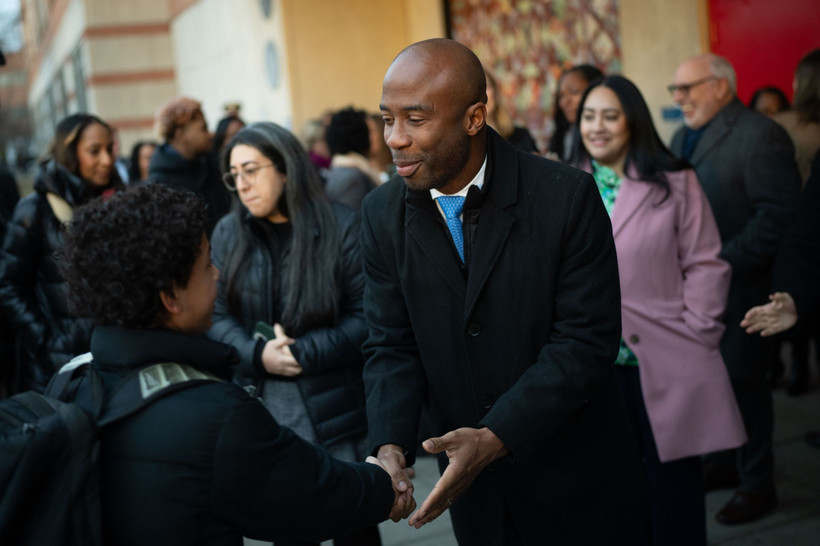
New York City Public Schools Chancellor Kamar Samuels traveled to Albany on Tuesday to press lawmakers to approve a four-year extension of mayoral control; in turn, lawmakers pressed him on the class size law. | Photo: Michael Appleton/NYC Mayor's Office

Sign up for Staying Focused, our newsletter keeping readers up to speed on New York politics.

The Mamdani administration will soon send a plan to state legislators for coming into compliance with a law requiring New York City to cap class sizes — and selling them on it could determine whether Mayor Zohran Mamdani maintains control over the city’s school system. The plan could include a request to push the law’s deadline back by two years.

New York City Public Schools Chancellor Kamar Samuels traveled to Albany on Tuesday to press lawmakers to approve a four-year extension of mayoral control; in turn, lawmakers pressed him on the class size law.

“A lot of the conversation today was about class size,” Samuels told New York Focus after the private meetings. “But I would say we are making significant progress, and I think that hopefully puts us in a really good position.” He said the city is working on a plan to submit before the state budget is finalized.

The 2022 state law requires New York City to cap class sizes at 20 to 25 students by 2028 and sets several interim requirements, one of which the city met this school year by exceeding 60 percent compliance. But at a City Council hearing on Monday, Samuels admitted that it will be “very difficult” to meet the next benchmark: 80 percent by September.

During the meetings with lawmakers, Samuels shared some details of the plan and floated the possibility of a two-year extension to comply with the mandate.

Senator John Liu, chair of the Senate’s New York City Education Committee and sponsor of the 2022 law, said he had a productive meeting with Samuels. Liu said his support for mayoral control depends in part on the city’s ability to make good on the mandate, and that while the new administration has consistently said it intends to comply, it was “all words, no clear action” until Tuesday.

Samuels “was able to show a very specific inventory of where the shortages are and what the plan is to address those shortages, where and how they intend to build out more classroom space, and very specific progress that speaks well to what this administration is doing,” Liu said.

“It does make a strong case for giving them more time to comply with class size reduction as well as extending mayoral control,” he said.

Research has shown that smaller class sizes can have a positive influence on academic achievement, especially for lower-income students in early grades, but experts debate whether the benefits are worth the cost.

The city has already invested $640 million in class size reductions, and estimates suggest billions more will be needed to fully implement the law. An Urban Institute report released this week found that schools serving low-income students are more likely to already meet the caps — meaning that the extra funds required by the law will disproportionately go to schools that serve wealthier students.

Earlier this month, the Assembly proposed allocating $600 million to help New York City meet the mandate. Samuels told New York Focus it would be “virtually impossible” to do so without an extension of mayoral control.

Mayoral control has been a topic of debate since it was implemented in 2002. Under the governance system, the mayor appoints the city’s schools chancellor and a majority of the members to the Panel for Educational Policy, which acts as a de facto school board. The state legislature has reauthorized mayoral control seven times. The city has not received an extension longer than three years in over a decade.

Supporters say the centralized governance streamlines decision-making and ensures consistent, efficient management of city schools, while critics argue it limits community input and applies a one-size-fits-all approach that can deepen inequities.

Mamdani had pledged to end mayoral control on the campaign trail, but reversed course in December. Samuels appears to have had some influence on that decision. He said he told Mamdani that “if you want to have universal child care, you can’t have 32 districts doing different things.”

“If you have an ambitious agenda in the city, the way to do it is through mayoral control and accountability,” Samuels said on Tuesday, adding that he plans to increase opportunities for community input.

In January, Governor Kathy Hochul proposed a four-year extension of mayoral control in her executive budget, but neither the state Senate nor the Assembly one-house budgets released this month included an extension.

“It’s unlikely that there will be a four-year extension,” Liu said. “Whether or not there’s an extension and for how long will always hinge upon the actions of the administration with regards to the public schools in the eyes of my colleagues in the legislature.”

Liu said that lawmakers need to take action before mayoral control expires on June 30, but that it “doesn’t make a difference” whether that happens in the budget or through post-budget legislation.

“The jury is still out on mayoral control being truly the best system for New York City kids,” Liu said. “But the immediate issue we have at hand is how we can empower this current administration.”

At New York Focus, our central mission is to help readers better understand how New York really works. If you think this article succeeded, please consider supporting our mission and making more stories like this one possible.

New York is an incongruous state. We’re home to fabulous wealth — if the state were a country, it would have the tenth largest economy in the world — but also the highest rate of wealth inequality. We’re among the most diverse – but also the most segregated. We passed the nation’s most ambitious climate law — but haven’t been meeting its deadlines and continue to subsidize industries hastening the climate crisis.

As New York’s only statewide nonprofit news publication, our journalism exists to help you make sense of these contradictions. Our work scrutinizes how power works in the state, unpacks who’s really calling the shots, and reveals how obscure decisions shape ordinary New Yorkers’ lives.

In the last two decades, the number of local news outlets in New York has been nearly slashed in half, allowing elected officials and powerful individuals to increasingly operate in the dark — with the average New Yorker none the wiser.

We’re on a mission to change that. Our work has already shown what can happen when those with power know that someone is watching, with stories that have prompted policy changes and spurred legislation. We have ambitious plans for the rest of the year and beyond, including tackling new beats and more hard-hitting stories — but we need your help to make them a reality.

If you’re able, please consider supporting our journalism with a one-time gift or a monthly gift. We can't do this work without you.

Thank you,

Akash Mehta
Editor-in-Chief
A photo of Akash Mehta.
A photo of Melissa Manno.
Melissa Manno is a reporter at New York Focus, covering the state’s school system and education politics. She was previously an education reporter for the San Antonio Express-News, where she reported on discipline, special education, school funding and other issues impacting students in… more
Also filed in New York State

At a Board of Regents meeting Monday, state officials proposed eliminating credit-based diploma requirements.

The last-minute influx, the biggest ever for a legislative primary, is boosting her opponent, Jessica González-Rojas.

City budget gaps and an ambitious affordability agenda may require pressing Albany again for taxes and aid.

Also filed in New York City

A lawsuit accuses federal officials of ignoring evidence that the boy, born in Mexico, held US citizenship through his mother.

We’ve compiled information for the 450,000 New Yorkers who will lose health care coverage on July 1.

The citizens assembly model, used for public decision-making around the world, is gaining traction in New York.

Also filed in Education

In May, state lawmakers passed a $269 billion budget after haggling for months over thousands of line items and policies affecting New Yorkers.

Advocates welcomed the additional funding but said it falls short of need and doesn’t do enough to support workers.

Some of the city’s new aid will be canceled out by pension boosts.