$170 Million in State Pre-K Funds Went Unused by New York School Districts

Amid growing spending on universal pre-K, school districts failed to spend millions earmarked for the 2024-25 school year.

Melissa Manno   ·   July 7, 2026
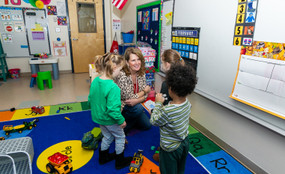
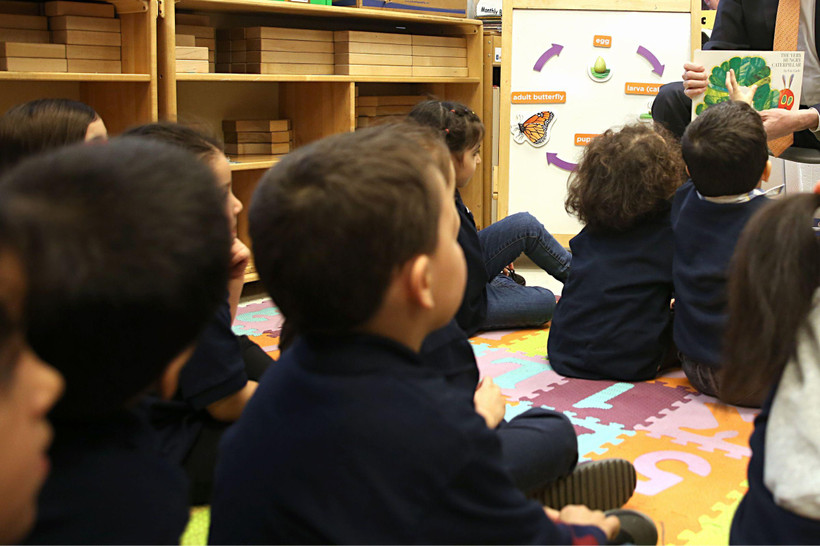
Preschool-aged children sit facing away from the camera on a colorful puzzle mat of numbers, while an adult at the front of the room shows them a page from The Very Hungry Caterpillar.
During the 2024-25 school year, roughly $170 million of the $1.2 billion the state earmarked for public pre-K went unused. | Rob Bennett / NYC Mayor's Office

Sign up for Staying Focused, our newsletter keeping readers up to speed on New York politics.

After spending $28,000 on two years of daycare, Brookhaven resident Kayla Muglia was eager to enroll her son in her Long Island school district’s free pre-K program for 4-year-olds. But last May, months after submitting an application, Muglia received disappointing news: He had been waitlisted.

New York school districts with state-funded pre-K are required to hold a random lottery when the number of applicants exceeds available seats. In Suffolk County, where Muglia is a school social worker, universal pre-K access and enrollment has long lagged behind the rest of the state. Unable to gamble on an uncertain opening, she shelled out another $14,000 for private daycare. 

“If there is such a desire for the pre-K program, why is the district not looking to expand it?” she asked. “Why are we not exploring opportunities to widen the scope of this program and make it available to more families?” 

It’s not simply a lack of state funding. New York state allocated $1.4 million for pre-K in the district during the 2024-25 school year. The total funding available to a district is based on a target enrollment number set by the state when it first establishes a pre-K program. But like most state school districts, Muglia’s left a significant amount of those funds — over $580,000 — on the table.

During the 2024-25 school year, roughly $170 million of the $1.2 billion the state earmarked for public pre-K went unused, according to a State Education Department report prepared for the governor and state legislature and obtained through a FOIL request. 

“Understanding why allocations remain underutilized is critical,” the report reads. “Every dollar left unused represents a lost opportunity to expand access, enhance program quality, and advance equity for New York’s four-year-olds.” 

A New York Focus analysis found that of the 658 school districts allocated funding for the school year, over half left more than $100,000 on the table. The most extreme case was in the Hudson Valley’s Monroe-Woodbury Central School District where more than $4.7 million in available state funding went unspent. The district did not respond to requests for comment.

The reasons for that underspending vary. The report highlights administrative burdens, demographic shifts that have led to lower enrollment, and insufficient funding per seat.

Districts contacted by New York Focus largely echoed those concerns. Some said it was difficult to find space and staff for the program, thanks in part to the low reimbursement rate, which in recent years has been set at a minimum of $5,400 per child. 

In 2024, the Corning-Painted Post Area School District in the Southern Tier of the state sent out a request for proposals to more than 30 community-based providers, but with a reimbursement rate of just over $6,400, it received a response from only two. Limited seats meant 24 applicants missed out on the program. 

The state budget passed last month could change things significantly. As part of a sweeping $4.5 billion child care investment, it nearly doubles the reimbursement rate for schools to $10,000 per preschooler. 

But responses from more than a dozen districts suggest that money alone is unlikely to overcome barriers to universal access.

Several districts — including Arlington, Clarkstown, Garden City, Longwood, Ossining, Port Chester Rye, Syracuse, Suffern, and White Plains — said they simply had more open seats than applicants. In some cases, families may be opting for private care, which often has longer hours that better align with working parents’ schedules. Unlike older children who can ride a school bus, small children typically require options close to home.

Marina Marcou-O’Malley, co-executive director of education nonprofit Alliance for Quality Education, said the boost in funding is a good starting point — but the state must also address other obstacles that could impede districts as they work toward universal access. 

By the 2028–29 school year, school districts will be required by a new state law to offer a full-day pre-K seat to every eligible 4-year-old whose family applies.

“Yes, we’re putting money into the system, but we also need to go back often to see what is working, what is good enough, and what this funding actually produces,” she said. 

Guilderland County School District in the Capital District of New York had to waitlist 50 families and turn down more than $1.1 million last year because it couldn’t recruit enough partners to serve every family who applied. Rachel Anderson, the district’s assistant superintendent of curriculum and instruction, said the mandate will require the district to double its current capacity from seven classrooms to at least 15. A higher per-pupil rate will help, she said, but “it may be difficult to secure enough partners to fully meet that need.” 

State law does not require school districts to dip into their budgets to fund pre-K, but Marcou-O’Malley said school districts should be expected to use part of their local budgets to fund high-quality pre-K programs, just as they do to fund K–12. She pointed to an October report co-published by the Alliance for Quality Education, which recommended that the state require wealthier districts to make a mandatory minimum local contribution to guarantee all families have access to high-quality universal pre-K.

State Senator James Skoufis, who represents several Hudson Valley school districts that used only part of their allotment, said that districts need to make pre-K a priority and agreed that school districts should help cover the cost. He said districts should be held accountable when state funding doesn’t translate into actual seats. He has continued to call out the Hudson Valley districts he represents for leaving millions of dollars unused.

“Those unspent funds mean families are having to choose between spending $15,000 to educate their child or not educating their child at all,” Skoufis said. “That lies squarely at the feet of school districts, their administrators, and their boards.” 

At New York Focus, our central mission is to help readers better understand how New York really works. If you think this article succeeded, please consider supporting our mission and making more stories like this one possible.

New York is an incongruous state. We’re home to fabulous wealth — if the state were a country, it would have the tenth largest economy in the world — but also the highest rate of wealth inequality. We’re among the most diverse – but also the most segregated. We passed the nation’s most ambitious climate law — but haven’t been meeting its deadlines and continue to subsidize industries hastening the climate crisis.

As New York’s only statewide nonprofit news publication, our journalism exists to help you make sense of these contradictions. Our work scrutinizes how power works in the state, unpacks who’s really calling the shots, and reveals how obscure decisions shape ordinary New Yorkers’ lives.

In the last two decades, the number of local news outlets in New York has been nearly slashed in half, allowing elected officials and powerful individuals to increasingly operate in the dark — with the average New Yorker none the wiser.

We’re on a mission to change that. Our work has already shown what can happen when those with power know that someone is watching, with stories that have prompted policy changes and spurred legislation. We have ambitious plans for the rest of the year and beyond, including tackling new beats and more hard-hitting stories — but we need your help to make them a reality.

If you’re able, please consider supporting our journalism with a one-time gift or a monthly gift. We can't do this work without you.

Thank you,

Akash Mehta
Editor-in-Chief
A photo of Akash Mehta.
A photo of Melissa Manno.
Melissa Manno is a reporter at New York Focus, covering the state’s school system and education politics. She was previously an education reporter for the San Antonio Express-News, where she reported on discipline, special education, school funding and other issues impacting students in… more
Also filed in New York State

New York City has no plans to opt into NY HELPS, which has been extended to 2028 after filling 60,000 government jobs.

New York’s free air conditioner program ran out of funding before summer, even as extreme heat becomes a deadlier threat.

Fiscal watchdog says independent oversight is needed to avoid waste and fraud.

Also filed in Budget

City budget gaps and an ambitious affordability agenda may require pressing Albany again for taxes and aid.

In May, state lawmakers passed a $269 billion budget after haggling for months over thousands of line items and policies affecting New Yorkers.

State leaders are expected to pass a bill that avoids resolving how much Resorts World New York City needs to pay.

Also filed in Education

On the heels of a “Back to Basics” reading effort, New York is launching a similar initiative for math.

At a Board of Regents meeting Monday, state officials proposed eliminating credit-based diploma requirements.

Advocates welcomed the additional funding but said it falls short of need and doesn’t do enough to support workers.