Mamdani World Readies for Next Year’s Tax-the-Rich Push

City budget gaps and an ambitious affordability agenda may require pressing Albany again for taxes and aid.

Nick Garber   ·   June 17, 2026
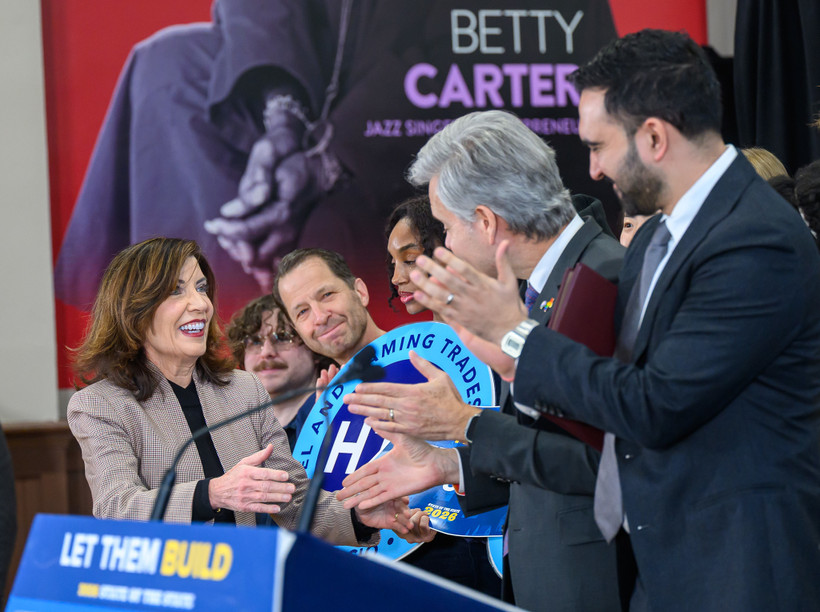
Mamdani and Hochul at a rally together
Mamdani joins Hochul at a rally in February, 2026. | Susan Watts/Office of Governor Kathy Hochul

Sign up for Staying Focused, our newsletter keeping readers up to speed on New York politics.

Mayor Zohran Mamdani claimed victory after this year’s state budget sent New York City billions of dollars in aid and a new tax on luxury second homes. But the good vibes between the city and Albany may be short-lived.

Mamdani and his allies have already begun to discuss another big push for aid and new taxes. The reason is twofold: Mamdani would need more money from Albany to implement big-ticket campaign promises like universal child care. More urgently, the city faces big budget gaps in the coming years that will need to be closed — and could get larger after the city negotiates new labor contracts.

Albany’s bailout for the city is nothing to sneeze at, totaling $2.4 billion — not including the $500 million-a-year pied-à-terre tax. But two-thirds of that aid is set to end after next year, according to an analysis by the Citizens Budget Commission — meaning the city will need to either cut spending or bring in more revenue.

“Even though we passed the pied-à-terre tax, we have lots of work left to do,” said Gustavo Gordillo, co-chair of the Democratic Socialists of America’s New York City chapter. “We’re looking to next session to pass a tax on the rich and corporations that actually meets the needs of New Yorkers.”

Mamdani has spoken to progressive groups about what next year’s campaign might look like, a person familiar with the discussions said. Although the strategizing is still in its infancy, there’s likely to be one clear difference: The campaign could ramp up as soon as this fall, rather than waiting until the legislative session starts in January.

“I’m certainly committed to starting earlier, and strategizing with the mayor’s administration to maximize state policy that’s good for the city — including new taxes on the rich,” said State Senator Julia Salazar, one of nine DSA-endorsed lawmakers in Albany.

Favorable terrain?

Conventional wisdom at the start of this year was that 2026 would be a golden opportunity for progressives to pass corporate and income tax hikes in Albany. Mamdani had unspent political capital, and Hochul, seeking re-election, needed New York City voters for both her Democratic primary and the November general election. That was before Mamdani endorsed Hochul in February, leading Lieutenant Governor Antonio Delgado to drop his primary challenge.

Another Mamdani victory was also a paradoxical setback for the broader movement. Hochul’s January pledge to fund free child care for the city’s two-year-olds and expand free pre-K statewide undercut the DSA, which had planned to center its tax-the-rich campaign on child care.

Some of those involved in the tax-the-rich campaign expect 2027 to be different.

All major tax hikes in New York in recent decades have happened in years without state elections.

“We hear that next session the terrain will be more hospitable to raising taxes on the rich, because it’s not an election year,” Gordillo said.

Hochul was this year’s main obstacle, given her steadfast opposition to raising income or corporate taxes — even as the state Senate and Assembly reiterated their longstanding support for both. By next year, presumably, she will have been freshly re-elected — she currently holds a wide polling lead over Republican Bruce Blakeman — lessening any fear that tax hikes could spur an electoral backlash. (Polling has consistently shown strong support for raising taxes on wealthy people in New York.)

Jon Paul Lupo, a Democratic political consultant who led intergovernmental affairs for former Mayor Bill de Blasio, agreed that 2027 could be more opportune.

“A whole host of Albany actors were limited in what they were willing to do this year, because it’s an election year,” said Lupo. “There’s a much better chance that you see movement on taxes in Albany than there was this year.”

Recent history supports that view. All major tax hikes in New York in recent decades have happened in odd-numbered years without state elections, including in 2003, when lawmakers hiked city and state taxes in the wake of 9/11 and an economic recession; and in 2009, when the state raised income taxes during the Great Recession. The state’s last big income and corporate tax hike happened in 2021, amid the pandemic and shortly before Hochul took office.

Others in Albany see little reason to expect Hochul will soften her stance. State Senator Andrew Gounardes, who represents parts of Brooklyn and chairs the Budget and Revenue committee, said this year’s city bailout will make it hard to justify another one next year, especially as upstate municipalities face their own fiscal challenges.

“I’m not under the illusion that next year it becomes easier,” he said. “It might become more difficult.”

Looming gaps

Mamdani himself has said little about next year’s plans, and his office declined to comment on whether he’ll take an active role in the campaign. This year, he stayed largely on the sidelines while his allies rallied for taxes — a strategy that may have helped preserve his relationship with Hochul, but appeared to sap some energy from the movement.

Jen Goodman, a spokesperson for Hochul, said she could not speak to hypothetical questions about next year’s budget. She pointed to Hochul’s comments to Politico last week, in which the governor called on Mamdani to “look hard at spending” after this year’s infusion from the state.

Next year’s tax push could center on child care; Hochul has only committed to funding the city’s “2-Care” program for two years, leaving future funding in question. But the city may also need more state help just to backstop its own budget — a potential replay of this year, when Mamdani’s forward-looking agenda took a backseat as he rushed to close an unexpectedly large gap.

The city projects budget gaps totaling $7.1 billion, $9.1 billion and $9.8 billion for fiscal years 2028 through 2030, according to Mamdani’s May budget proposal, which accounted for the influx of state aid. As a share of the city’s total spending, those are bigger than nearly all of the out-year gaps the city has faced in the last decade, according to an analysis provided by the Citizens Budget Commission.

Those gaps will likely shrink on their own if the city’s tax revenues remain strong, said Andrew Perry, director of fiscal research at the Fiscal Policy Institute. But the bigger-than-usual gaps mean that next year’s budget will, at a minimum, be “tight,” he said.

Just $780 million of the city’s $2.4 billion rescue package will recur after 2027, the Citizens Budget Commission found. Watchdogs including City Comptroller Mark Levine and credit-rating agencies have said the city needs more recurring revenue to stabilize its finances. Moody’s, which downgraded the city’s outlook in March, wrote that “state-level proposals to enhance revenue” — such as new taxes — “could have a stabilizing effect” on the city.

A few additional wild cards could strain both the city and state’s budgets next year. An economic downturn, projected by some economists, could depress tax revenues. And federal cuts to food stamps and Medicaid, included in last year’s “One Big Beautiful Bill Act,” will hit harder next year.

By November, the city must also negotiate a new contract with the large labor union DC37, which represents municipal workers. Any pay raises in that deal will likely be applied to other unions under the system known as pattern bargaining, which could worsen the city’s budget holes and make state aid all the more valuable.

“There’s every reason to believe it’ll be a significant push next year, because he’s going to have a significant budget problem and has not really embarked on major restructuring and savings programs,” said Andrew Rein, president of the Citizens Budget Commission. “Will [state leaders] have the stomach to do this again in a second year? That’s both a political question as well as a state fiscal question.”

Mamdani and his allies will have a menu of options to choose from if they make another big push. Besides income and corporate tax hikes, the city’s official Albany wishlist for 2026 included taxes on all-cash real estate sales and shrinking a tax credit used by high-income business owners, both of which could resurface next year.

City Hall has made some efforts to cut costs. At Hochul’s urging, Mamdani’s administration announced plans last month to curb billions of dollars in spending on rental aid and special education, which have been among the city’s fastest-growing expenses. And the “chief savings officers” Mamdani appointed within city agencies have found $1.8 billion in savings through next year — a relatively modest total compared to some past mayors’ gap-closing programs.

Budget officials told the City Council this month that the savings officers are looking for additional cuts.

At New York Focus, our central mission is to help readers better understand how New York really works. If you think this article succeeded, please consider supporting our mission and making more stories like this one possible.

New York is an incongruous state. We’re home to fabulous wealth — if the state were a country, it would have the tenth largest economy in the world — but also the highest rate of wealth inequality. We’re among the most diverse – but also the most segregated. We passed the nation’s most ambitious climate law — but haven’t been meeting its deadlines and continue to subsidize industries hastening the climate crisis.

As New York’s only statewide nonprofit news publication, our journalism exists to help you make sense of these contradictions. Our work scrutinizes how power works in the state, unpacks who’s really calling the shots, and reveals how obscure decisions shape ordinary New Yorkers’ lives.

In the last two decades, the number of local news outlets in New York has been nearly slashed in half, allowing elected officials and powerful individuals to increasingly operate in the dark — with the average New Yorker none the wiser.

We’re on a mission to change that. Our work has already shown what can happen when those with power know that someone is watching, with stories that have prompted policy changes and spurred legislation. We have ambitious plans for the rest of the year and beyond, including tackling new beats and more hard-hitting stories — but we need your help to make them a reality.

If you’re able, please consider supporting our journalism with a one-time gift or a monthly gift. We can't do this work without you.

Thank you,

Akash Mehta
Editor-in-Chief
A photo of Akash Mehta.
A photo of Nick Garber.
Nick Garber covers politics for New York Focus. He previously worked for Crain’s New York Business, where he covered city and state government, housing and real estate, and money in politics. He also covered neighborhood news in Manhattan and Queens for Patch, and got… more
Also filed in New York State

A bill awaiting the governor’s signature would relax restrictions on who can qualify for victim compensation.

We’ve compiled information for the 450,000 New Yorkers who will lose health care coverage on July 1.

A lobbyist who has been romantically linked to Assembly Speaker Carl Heastie led a rally opposing the legislation a week before the speaker declined to bring it to a vote.

Also filed in Budget

In May, state lawmakers passed a $269 billion budget after haggling for months over thousands of line items and policies affecting New Yorkers.

State leaders are expected to pass a bill that avoids resolving how much Resorts World New York City needs to pay.

Resorts World is floating legislation to avert more than $500 million in payments to the horseracing industry.

Also filed in New York City

The citizens assembly model, used for public decision-making around the world, is gaining traction in New York.

Some of the city’s new aid will be canceled out by pension boosts.

The Department of Justice has terminated more than 100 immigration judges since last year as it has pressured courts to order more deportations.