
Thousands of 4-Year-Olds Couldn’t Apply to Universal Pre-K Last School Year

Dozens of school districts have opted out of the state’s program. Will the governor’s proposed funding boost be enough to help school districts close the gaps?

Melissa Manno   ·   March 9, 2026
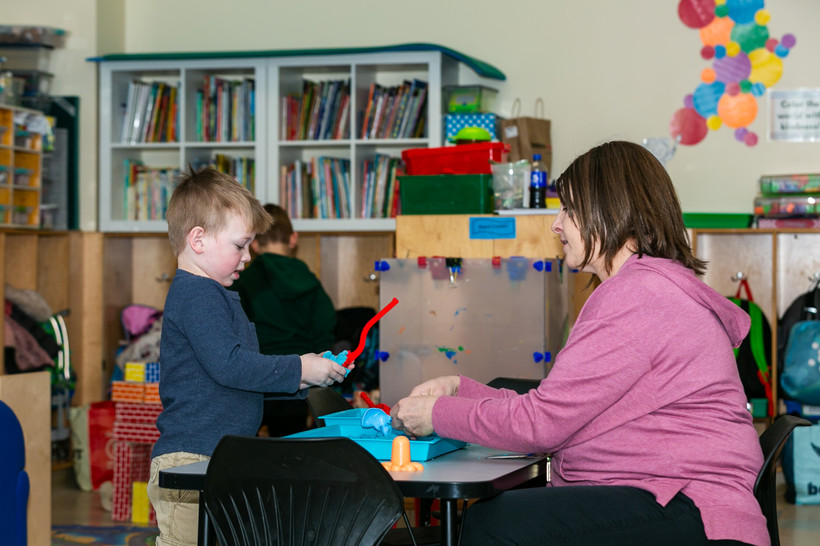
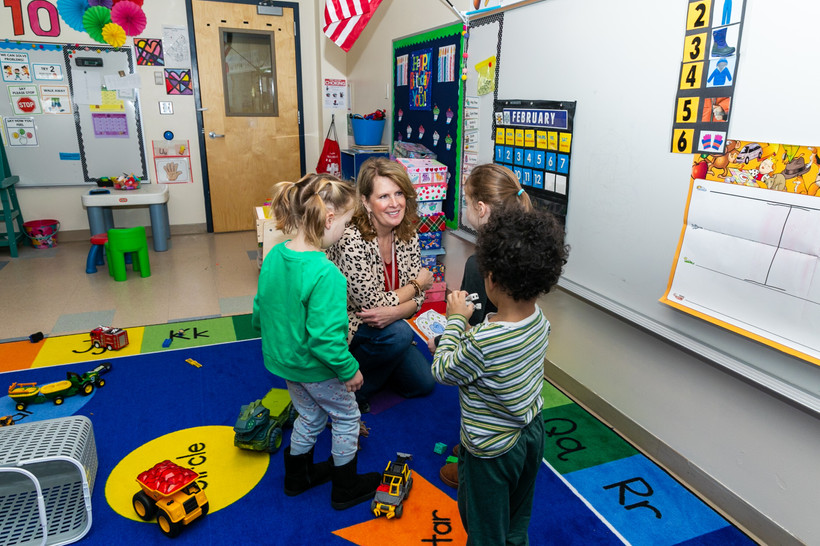
Teacher Assistant Maryann Campagnano works with students at Schalmont Central School District's newly launched universal pre-K program in Schenectady County, February 12, 2026. | Turgay Dakak/New York Focus

Sign up for Staying Focused, our newsletter keeping readers up to speed on New York politics.

When Mariel Posner’s daughter was born three years ago, the New York City pre-K teacher faced a difficult decision: devote nearly half her salary to child care, as she’d done with her older son, or take an unpaid leave from work to stay home with her. After crunching the numbers with her husband, she settled on the latter.

School district policy requires Posner to return to work once her child turns 4 next year, a transition that should theoretically be easy, thanks to the city’s universal pre-K program that roughly 90 percent of eligible children attend. But Posner lives in Westchester County, where her children’s school district, Byram Hills, does not offer universal pre-K.

As a result, Posner is weighing whether to resign.

“On some days, I feel so lucky that I can be home with my daughter but on others, I think it’s not right that I felt like I had to pause my career,” Posner said. “[Universal pre-K] would definitely take the burden off our backs.”

New York state has long subsidized public pre-K with the goal of making it available to all 4-year-olds. But roughly 4,600 eligible kids didn’t have the option to apply for a state-funded seat last school year. That year, of 673 eligible school districts, 37 only offered half-day pre-K programs, and 49 — including Byram Hills — offered no state-supported pre-K at all, according to a New York Focus analysis of state data.

New York Focus reached out to all 49. Some superintendents said they launched a program this school year or plan to next year, and several said they fund pre-K using only local money because of state funding rules. A dozen said they still do not offer pre-K. (Byram Hills and 22 others did not respond to requests for comment or declined to comment on the data.) Many of those superintendents said the same thing: There’s not enough state money, space, or private providers to share the load.

The highest concentrations of nonparticipating districts are in affluent suburbs on Long Island and in Westchester, but some are in lower-income communities in the Capital Region, Central New York, and the North Country. Parents in those districts said they’ve had to pay out of pocket for private care, rely on family members, or leave the workforce to stay home with their children. Some are leaving the state altogether because of high child care costs.

This year’s budget could reshape pre-K access across New York. In January, Governor Kathy Hochul proposed a $470 million plan to nearly double the state’s minimum per-pupil contribution to at least $10,000. The plan would require school districts to serve all interested 4-year-olds in full-day pre-K by the 2028–29 school year.

Progressive lawmakers and advocates have largely applauded the plan, but some superintendents who don’t offer the program say the funding boost still may not be enough to foot the cost of a mandate.

Others think school districts should be able to make it work. State Senator James Skoufis, who has long pushed for a pre-K mandate, said Hochul’s proposed funding boost would be more than enough to enable every district to serve every 4-year-old seeking a seat.

“The state does not pay for the full expenses associated with any grade,” he said. “I think any school district that expects us to pay the full cost of UPK is living on another planet.”

While Posner has a difficult decision ahead of her, she said, she’s lucky that she was able to stay home with her child, thanks to her husband’s support. Her neighbors may not have the same option.

“I think it’s best for the whole community,” said Posner. “I want my daughter to be surrounded by peers who are also adequately prepared, and not just people of privilege who can afford to ensure that they’re getting the best education possible.”

Public pre-K is far more widespread than it was 25 years ago, soon after the state launched its universal program, when 162 school districts served fewer than 53,000 students. 

Enrollment has grown as state funding has increased. New York City, where most of the additional funds have gone, now guarantees a free, full-day pre-K seat to every 4-year-old who applies. But the rest of the state is lagging: Last school year, more than a third of eligible children outside the city were not enrolled, either because their district did not offer a program, they did not secure a seat through the lottery system, or they did not apply.

James Kaishian, the superintendent of Briarcliff Manor Union Free School District in Westchester, said that with how much the state currently contributes to the program, his district would need to spend at least $284,000 in local funds to open one pre-K class. Hochul’s proposed increase would make the district “much more interested” in moving forward, he said, but would cover just half of the cost of launching a program.

Kaishian added that other mandates the legislature has imposed on districts in recent years have driven up the overall cost of educating students.

Finding local money for those new initiatives can be tough, some superintendents said, because districts’ fundraising mechanisms are constrained by the state’s cap on how much they can increase property taxes each year. Wealthier districts like Briarcliff receive less state funding overall and rely heavily on property taxes to generate revenue.

He said that even with more state money, he would likely only be able to create a universal pre-K program if voters approve a tax increase above the state-imposed cap, something residents have previously rejected — or if the district makes cuts to existing programs. 

“Do we want to offer something that is going to borrow from Peter to pay Paul?” Kaishian asked.

There’s also the matter of space, said Assemblymember Michaelle Solages. She has advocated for universal pre-K across Long Island, where participation rates have long lagged behind other parts of the state. With limited infrastructure available to house programs, achieving truly universal pre-K will require districts to partner with private daycares; a larger per-pupil allotment will make those partnerships more affordable, she said.

Some superintendents in wealthier districts noted that many parents there are able to afford widely available private day care, which results in lower community demand. But that can leave their less well-off neighbors without options.

“In every school district on Long Island, there are families who can’t afford to pay for it privately,” said Jennifer Rojas, executive director of the Child Care Council of Suffolk. “We think that we all live in these isolated bubbles … but there are always people in a district that need this service, or who don’t have access.”

“If you don’t really think it’s important, then you’re not going to work really hard to figure out how to make it work in your district.”

—Jennifer Rojas, the Child Care Council of Suffolk
Superintendents aren’t prioritizing the issue, she said: “If you don’t really think it’s important, then you’re not going to work really hard to figure out how to make it work in your district. So that’s part of the battle that we have to fight.”

Many poorer districts have opted out as well, including Schroon Lake Central School District in Essex County and Worcester Central School District in Otsego County, where, about 60 and 50 percent of students, respectively, are from low-income families.

Nearly half the students in Mohonasen School District, in Schenectady, are economically disadvantaged, and families often cannot afford private pre-K, said superintendent Shannon Shine. But limited state funding and past financial pressures have made launching an in-district universal pre-K program infeasible, he said.

Neither Hochul spokesperson Nicolette Simmonds, nor Department of Education spokesperson Karen Male answered questions about superintendents’ claims about state funding or whether the governor’s proposals would make it possible for all districts to opt in. Simmonds noted that during Hochul’s tenure, the state has increased its investment in pre-K by $685 million and wrote that the governor “looks forward to working with partners in government to meet the needs of every community and deliver child care to every family across New York.”

Hochul’s proposal appears to have broad support in the legislature. Assemblymember Amy Paulin, who represents several Westchester school districts that do not offer universal pre-K, has been advocating to increase the state’s minimum per-pupil allotment to $10,000 for over a decade. While she welcomes a bigger investment, Paulin noted that $10,000 had significantly more purchasing power then than it does today.

In testimony for last month’s joint education hearing, a coalition of daycares wrote that the per-pupil cost for private pre-K on Long Island often exceeds $17,000 a year.

“I don’t think there’s been a thorough enough analysis of whether $10,000 per child is enough,” said Jacob Dixon, the director of a Long Island pre-school technical assistance center that has helped boost local enrollment from 10 to 68 percent of local 4-year-olds over the last decade. “I think if you ask any state official or provider, everyone will say the answer is no.”

Skoufis, meanwhile, thinks the mandate should kick in sooner. Last month, he said he sent a letter to the Senate Democrats calling for the mandate to begin a year earlier. He declined to share the letter with New York Focus, but said 16 Democratic senators — including nine from outside New York City — had signed on in support.

Solages thinks a mandate is premature.

“I want to make sure that we’re fully funding and implementing a good pre-K program, and then down the line, if it is necessary, we can impose a mandate.” she said. “I’m a believer that mandating something without first fixing or mitigating the challenges around it is not good policy.”

Skoufis told New York Focus that while financial constraints and limited space may have justified delays in the past, districts have had ample time to develop a plan — and that families deserve to know why school leaders are “choosing, after years of runway, not to figure out how to use this money and create slots.”

Some have tried. Skaneateles Central School District, in the Finger Lakes, launched a public pre-K program at the start of the 2022–23 school year, but was only able to offer 14 seats. Superintendent Eric Knuth said the district had to cut the program after two years because costs quickly outpaced funding.

Knuth said it’s encouraging to see momentum for more state funding, but worries a mandate will put the district back in a similar budget position. “Each community has very different needs, and to potentially add an entire grade level in every district in NYS is a monumental task,” he wrote in an email.

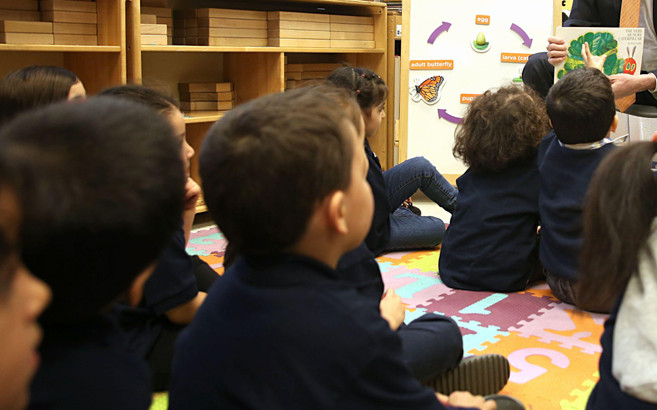
Pre-K teacher and coordinator Carrie Fiske works with a class at Schalmont Central School District's universal pre-K program in Schenectady County, February 12, 2026. | Turgay Dakak/New York Focus
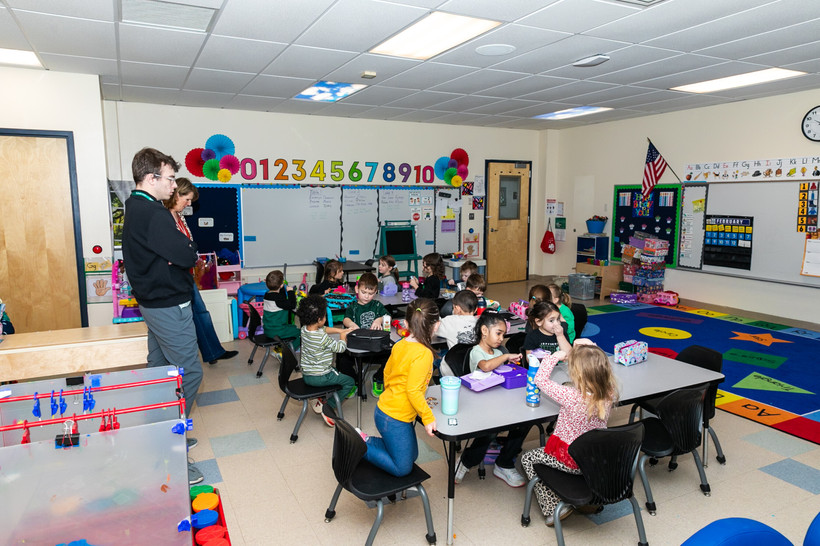
Schalmont Central School District's newly launched universal pre-K program is located in a former elementary school on the outskirts of Schenectady County, February 12, 2026. | Turgay Dakak/New York Focus

Schenectady resident Jennifer Staucet was relieved when she learned her local school district was about to launch public pre-K at an old elementary school on the outskirts of Schenectady County. When her 4-year-old lost his vision almost two years ago, she worried about finding child care options equipped to support his disability. 

After more than a year of hospital stays and caring for him at home, Staucet enrolled him in the program Schalmont Central School District opened last fall. There, he receives hands-on support from a visual impairment teacher who ensures learning materials are accessible to him.

“If we didn’t have this, I don’t know if I would have ever been able to find somewhere that could fully accommodate his needs,” Staucet said.

It took Schalmont three years to come up with enough funding to launch the program, Superintendent Thomas Reardon said. He and other officials did so by identifying overstaffed areas, shifting positions to fill vacancies internally, and reallocating the budget accordingly. Reardon serves as the pre-K’s principal, which saves even more money, he said. To open three classrooms, he had to hire a custodian, a nurse, a secretary, a security guard, three teaching assistants, and two aides.

It ended up costing around $1.1 million. The district is slated to receive just a quarter of that cost in state reimbursement. Under Hochul’s proposal, that would increase to just over half.

“To almost double the pre-K allocation is in no way not appreciated, but I wish legislators, not in a superficial 10-cent tour, really sat down with districts and asked what it really costs to educate a child,” Reardon said. “The idea of doubling something would work amazingly in an economy where things weren’t triple the cost now.”

“The idea of doubling something would work amazingly in an economy where things weren’t triple the cost now.”

—Thomas Reardon, Schalmont Central School District superintendent

With more funding on the horizon, Mohonasen Superintendent Shine hopes his district can join Schalmont in offering pre-K to families. He is exploring a regional approach: partnering with the neighboring Scotia-Glenville School District to convert a soon-to-close elementary school into a public pre-K site for hundreds of 4-year-olds across four districts.

Shine and the other superintendents are still figuring out the structure and funding for the program. He said it would offer a lifeline to low-income parents and help address learning gaps exacerbated by the pandemic.

“I want better prepared students, and we’ve had less prepared students for years,” Shine said. “It’s another service to the community, and everybody wins as long as there’s money, space — and we can afford it.”

At New York Focus, our central mission is to help readers better understand how New York really works. If you think this article succeeded, please consider supporting our mission and making more stories like this one possible.

New York is an incongruous state. We’re home to fabulous wealth — if the state were a country, it would have the tenth largest economy in the world — but also the highest rate of wealth inequality. We’re among the most diverse – but also the most segregated. We passed the nation’s most ambitious climate law — but haven’t been meeting its deadlines and continue to subsidize industries hastening the climate crisis.

As New York’s only statewide nonprofit news publication, our journalism exists to help you make sense of these contradictions. Our work scrutinizes how power works in the state, unpacks who’s really calling the shots, and reveals how obscure decisions shape ordinary New Yorkers’ lives.

In the last two decades, the number of local news outlets in New York has been nearly slashed in half, allowing elected officials and powerful individuals to increasingly operate in the dark — with the average New Yorker none the wiser.

We’re on a mission to change that. Our work has already shown what can happen when those with power know that someone is watching, with stories that have prompted policy changes and spurred legislation. We have ambitious plans for the rest of the year and beyond, including tackling new beats and more hard-hitting stories — but we need your help to make them a reality.

If you’re able, please consider supporting our journalism with a one-time gift or a monthly gift. We can't do this work without you.

Thank you,

Akash Mehta
Editor-in-Chief
A photo of Akash Mehta.
A photo of Melissa Manno.
Melissa Manno is a reporter at New York Focus, covering the state’s school system and education politics. She was previously an education reporter for the San Antonio Express-News, where she reported on discipline, special education, school funding and other issues impacting students in… more
Also filed in New York State

At a Board of Regents meeting Monday, state officials proposed eliminating credit-based diploma requirements.

The last-minute influx, the biggest ever for a legislative primary, is boosting her opponent, Jessica González-Rojas.

City budget gaps and an ambitious affordability agenda may require pressing Albany again for taxes and aid.

Also filed in Budget

In May, state lawmakers passed a $269 billion budget after haggling for months over thousands of line items and policies affecting New Yorkers.

State leaders are expected to pass a bill that avoids resolving how much Resorts World New York City needs to pay.

Resorts World is floating legislation to avert more than $500 million in payments to the horseracing industry.

Also filed in Education

Advocates welcomed the additional funding but said it falls short of need and doesn’t do enough to support workers.

Some of the city’s new aid will be canceled out by pension boosts.

The Hochul administration now has a chance to relax New York’s child care staffing ratios — among the country’s strictest — after 26 years. But will it?

Also filed in Affordability

We’ve compiled information for the 450,000 New Yorkers who will lose health care coverage on July 1.

We’ve compiled information for SNAP recipients in New York on the changing work requirements.

Despite last-ditch efforts by a coalition of lawmakers, the state failed to avert a health coverage cliff coming this summer.