Child Care Promises Leave Funding Questions Open: State of the State 2026

Hochul has proposed a multibillion-dollar plan that she says would ultimately deliver free child care to every New York family — without tapping additional revenue sources.

Melissa Manno   ·   January 14, 2026
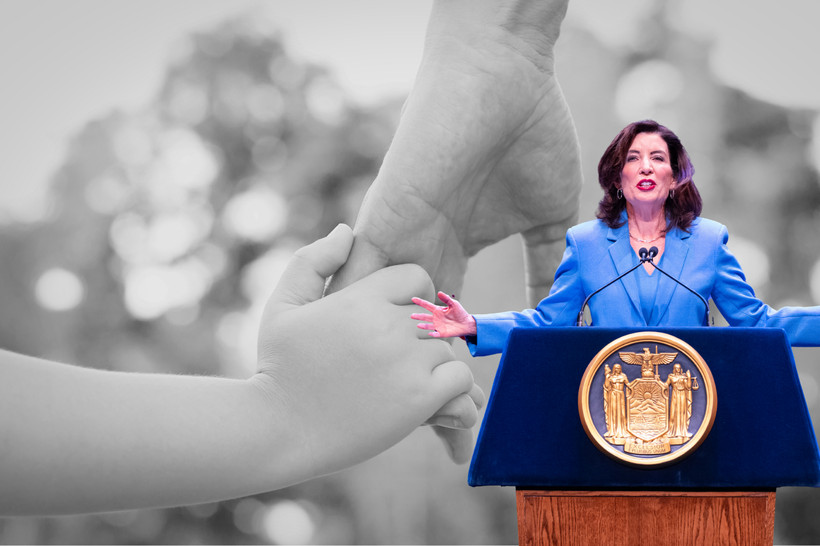
After pledging last year to put New York state “on a pathway” to universal child care, Governor Kathy Hochul used this year’s State of the State address to lay out the roadmap to get there. | Photos: Office of Governor Kathy Hochul; Chirila Sofia/Canva | Illustration: New York Focus

Sign up for Staying Focused, our newsletter keeping readers up to speed on New York politics.
After pledging last year to put New York state “on a pathway” to universal child care, Governor Kathy Hochul used this year’s State of the State address to lay out the roadmap to get there.

“We want New York to be the number one place for anyone about to start a family and build their future,” she said. “When we do that, we all win.”

The governor reiterated the plan she announced last week, alongside New York City Mayor Zohran Mamdani, to fully fund the first two years of free child care for 2-year-olds across New York City. The program would launch with 2,000 seats in high-need areas this fall, and expand to more than 30,000 over the next four years.

Hochul also announced plans to shore up the city’s existing 3-K program, which began in 2017 but has faced significant implementation challenges, including uneven seat distribution, accessibility gaps for students with disabilities, and funding cuts under former Mayor Eric Adams.

Her plan extends beyond New York City, too. She unveiled a $470 million investment to ensure universal pre-K for 4-year-olds statewide by the start of the 2028–29 school year. Although New York’s “universal” pre-K program has existed for decades, school districts are not currently required to participate. Many districts have opted out because of insufficient state funding, said Melinda Person, president of New York State United Teachers union. Others outsource the program to local private schools or community-based organizations, which may offer only a few hours of child care each day.

The additional resources could motivate more school districts to offer on-site pre-K, Person noted.

“The program was originally designed to be another grade in the public school system,” she added. “Four-year-olds were supposed to be getting an educational program rather than just daycare.”

Some lawmakers don’t want to leave the decision up to school districts.

“Just like we don’t provide the option to public schools to offer an education to first-graders or second-graders or third-graders,” State Senator James Skoufis said at a child care rally in Albany last week, “we need to require our public schools to educate the 4-year-olds.”

The governor’s proposal would also pour an additional $1.2 billion into the state’s child care voucher program, allowing most eligible families to access child care for no more than $15 per week. The new funding would ease the strain on struggling counties, many of which had stopped enrolling eligible parents last summer because of a funding shortfall.

The self-proclaimed “mom governor” said she also wants to pilot affordable daycare programs for children under 3, including newborns. On Wednesday, she announced that the state would provide Dutchess, Monroe and Broome counties with $20 million each to support up to 1,000 new child care seats. The pilot programs would be overseen by a new Office of Child Care and Early Education, which Hochul proposed establishing to manage the rollout of universal child care throughout New York.

It’s still unclear how the multibillion-dollar plan would be funded. Last week, Hochul said it would be financed through “existing state revenues,” but she did not provide details on long-term funding. In Tuesday’s speech, she said that the state already has the revenue “to get these initiatives off the ground.”

The announcement comes amid uncertainty surrounding federal child care and family assistance funding. On Friday, a federal judge temporarily blocked the Trump administration from freezing billions in federal funding for child care and social services in five Democratic-led states, including New York.

New York State Department of Labor Commissioner Roberta Reardon, who also co-chairs the state’s Child Care Availability Task Force, applauded another facet of the governor’s plan: expanding access to early childhood education, funding, and credentials.

“It’s a very tough job, and very essential,” said Reardon. “There’s a whole build-out to make sure that the workforce also gets supported, because you can’t do it without skilled workers.”

Still, absent from Hochul’s agenda was any proposal to raise wages for child care providers, who are among some of the lowest-paid workers in the state, with an average annual salary of $38,000 in 2023. Advocates have pushed for the establishment of a workforce compensation fund as one way to support such raises.

Education accounts for the second-largest portion of state spending, but neither Hochul’s speech nor briefing materials mentioned any changes to Foundation Aid, the state’s main school funding mechanism. Last year, after commissioning the Rockefeller Institute of Government to conduct a study on how to modernize the formula, lawmakers revised the poverty metric and approved additional support for English language learners. Advocates are calling for more revisions to include pre-K allocations, and better support students with disabilities and those experiencing homelessness.

Hochul’s agenda does include a myriad of education-related proposals to advance student learning, mental health, and online safety. She hopes, for instance, to build on the success of the “Back to Basics” reading initiative — which requires school districts to align literacy instruction with evidence-based Science of Reading principles — by applying the teaching model to math classrooms.

Hochul also wants to invest in “high-impact tutoring” during school hours to improve math and literacy skills. According to the National Assessment of Educational Progress, often referred to as the nation’s report card, only 28 percent of New York City fourth-graders were proficient in reading and 33 percent in math last year.

“We have kids who can’t get on grade level, kids who can’t do math in eighth grade,” said Assemblymember Brian Cunningham, who has pushed for high-impact tutoring programs. “This is about making sure we focus our efforts on drilling down where kids need support and help.”

Update: January 14, 2026 — A paragraph on affordable daycare pilot programs was updated with new information released on Wednesday.

At New York Focus, our central mission is to help readers better understand how New York really works. If you think this article succeeded, please consider supporting our mission and making more stories like this one possible.

New York is an incongruous state. We’re home to fabulous wealth — if the state were a country, it would have the tenth largest economy in the world — but also the highest rate of wealth inequality. We’re among the most diverse – but also the most segregated. We passed the nation’s most ambitious climate law — but haven’t been meeting its deadlines and continue to subsidize industries hastening the climate crisis.

As New York’s only statewide nonprofit news publication, our journalism exists to help you make sense of these contradictions. Our work scrutinizes how power works in the state, unpacks who’s really calling the shots, and reveals how obscure decisions shape ordinary New Yorkers’ lives.

In the last two decades, the number of local news outlets in New York has been nearly slashed in half, allowing elected officials and powerful individuals to increasingly operate in the dark — with the average New Yorker none the wiser.

We’re on a mission to change that. Our work has already shown what can happen when those with power know that someone is watching, with stories that have prompted policy changes and spurred legislation. We have ambitious plans for the rest of the year and beyond, including tackling new beats and more hard-hitting stories — but we need your help to make them a reality.

If you’re able, please consider supporting our journalism with a one-time gift or a monthly gift. We can't do this work without you.

Thank you,

Akash Mehta
Editor-in-Chief
A photo of Akash Mehta.
A photo of Melissa Manno.
Melissa Manno is a reporter at New York Focus, covering the state’s school system and education politics. She was previously an education reporter for the San Antonio Express-News, where she reported on discipline, special education, school funding and other issues impacting students in… more
Also filed in New York State

At a Board of Regents meeting Monday, state officials proposed eliminating credit-based diploma requirements.

The last-minute influx, the biggest ever for a legislative primary, is boosting her opponent, Jessica González-Rojas.

City budget gaps and an ambitious affordability agenda may require pressing Albany again for taxes and aid.

Also filed in Budget

In May, state lawmakers passed a $269 billion budget after haggling for months over thousands of line items and policies affecting New Yorkers.

State leaders are expected to pass a bill that avoids resolving how much Resorts World New York City needs to pay.

Resorts World is floating legislation to avert more than $500 million in payments to the horseracing industry.

Also filed in Education

Advocates welcomed the additional funding but said it falls short of need and doesn’t do enough to support workers.

Some of the city’s new aid will be canceled out by pension boosts.

The Hochul administration now has a chance to relax New York’s child care staffing ratios — among the country’s strictest — after 26 years. But will it?

Also filed in Social Services

We’ve compiled information for the 450,000 New Yorkers who will lose health care coverage on July 1.

New York state has pumped millions of taxpayer dollars into an online portal that vowed to make life easier for Rochester’s neediest, but critics say it’s fallen short.

We’ve compiled information for SNAP recipients in New York on the changing work requirements.

Also filed in Affordability

Despite last-ditch efforts by a coalition of lawmakers, the state failed to avert a health coverage cliff coming this summer.

Governor Kathy Hochul was successful in her bid to upend the Climate Leadership and Community Protection Act after legislators caved to finalize an overall budget deal.