More Subway Cops, No Prison Reforms: State of the State 2026

On criminal justice, there were notable omissions in the governor’s address.

Chris Gelardi   ·   January 14, 2026
| Photos: Office of Governor Kathy Hochul; Miv Piv/Canva | Illustration: Leor Stylar

Sign up for Staying Focused, our newsletter keeping readers up to speed on New York politics.
When it comes to criminal justice, the story of this year’s State of the State address is just as much about what Governor Kathy Hochul didn’t mention as what she did.

While largely ignoring the state’s ongoing prison crisis, Hochul focused much of the public safety portion of the flagship annual speech on policies that would provide additional support to police.

She extolled her prior policing initiatives, calling attention to record-low reported crime rates in areas across the state — including in the New York City subway system, to which the governor has deployed the National Guard and state funding for more police. Despite a 16-year low in reported subway crime last year, the governor recently announced that she’ll be pushing for $77 million in additional funding to add up to 750 New York City Police Department subway patrols.

“We’ll never be satisfied,” Hochul said Tuesday of dropping reported crime rates.

Her plan speaks to both perception and enforcement, said Joseph Popcun, executive deputy commissioner of the Division of Criminal Justice Services, the state’s law enforcement administrative agency.

“After 9/11, having the National Guard being deployed in mass transit provided New Yorkers with that sense of safety,” he said. “You compare New York’s mass transit safety with almost any other, it’s on the numbers much safer, so I think the governor wants to sustain the strategy and never say ‘mission accomplished.’”

Hochul is channeling the post-9/11 era with another policy as well: For the fourth year in a row, the governor is proposing to beef up the state’s regional Crime Analysis Center Network, which analyzes data and intelligence for retail theft investigations, illegal gun tracing, and aggressive “hot spot” policing, among other initiatives. Crime analysis centers are New York’s state-level version of fusion centers, the regional hubs created during the post-9/11 domestic surveillance boom to facilitate intelligence-sharing between federal, state, and local law enforcement. While fusion centers have come under fire for monitoring protesters, surveilling journalists, and propagating false intelligence, the state’s Crime Analysis Center Network has garnered less scrutiny.

This year, Hochul is proposing creating a crime analysis center in Westchester County, the only area not currently included in the state’s network.

“We’re building on what works,” she said.

Her policy book also includes a proposal to improve police training by launching an optional accreditation program for the state’s 30 police academies.

Hochul did not use her State of the State address to call for rolling back criminal justice reforms, as she did in 2022, 2023, and 2025.

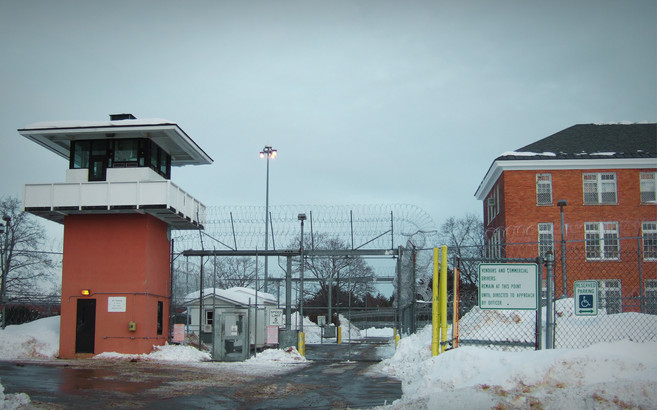
Her speech and accompanying policy book also didn’t include any proposals to reform state prisons. Last year was arguably the toughest for the prison system in decades. Prison guards’ caught-on-video murder of Robert Brooks, an incarcerated man, in December 2024 led to nationwide outcry. Two months later, corrections officers launched a three-week wildcat strike, aftershocks of which incarcerated people continue to feel in the form of lockdowns and neglect.

In response to the crisis, state legislators proposed an ambitious suite of prison reform initiatives. Legislative leadership pared down the package and passed an omnibus reform bill, which Hochul watered down a second time last month through an amendment process. Legislators who pushed for the bill describe it as a limited, insufficient win.

“We left a lot undone,” said Assemblymember Emily Gallagher, who led the push to expand a powerful yet underutilized oversight agency. She said her reform-minded colleagues, as well as New York’s extensive network of criminal justice reform advocacy organizations, will resume their campaign to pass more ambitious reforms this year.

A key part of that campaign launched Monday, a day ahead of Hochul’s State of the State speech. State Senator Julia Salazar, head of the Senate’s corrections committee and the legislature’s lead prison reformer, published an extensive report lambasting a prison system “built on brutality.” The report describes inaccessible health care in the prisons, the system’s “refusal” to implement reform laws, and “endemic” violence and racism. It calls on the state to take a kitchen sink approach to improving conditions and reducing the incarcerated population. Among the reform movement’s priorities are a bill to make elderly people with long sentences eligible for parole, one to make it easier for the state Board of Parole to release people from prison, and one to allow incarcerated people to more easily earn time off their sentences.

On the anniversary of Brooks’s killing last month, Hochul “committed to further action to ensure our [prisons] are safer.” She included none of the priority reform bills in her State of the State proposals, nor any other prison legislation.

“I’m not surprised,” said Gallagher. “One of the core issues with the way that Albany does business is that we’ll say we’re done with a whole topic of reform when really we’ve only skimmed the surface.”

BEFORE YOU GO, consider: If not for the article you just read, would the information in it be public?

Or would it remain hidden — buried within the confines of New York’s sprawling criminal-legal apparatus?

I started working at New York Focus in 2022, not long after the outlet launched. Since that time, our reporters and editors have been vigorously scrutinizing every facet of the Empire State’s criminal justice institutions, investigating power players and the impact of policy on state prisons, county jails, and local police and courts — always with an eye toward what it means for people involved in the system.

That system works hard to make those people invisible, and it shields those at the top from scrutiny. And without rigorous, resource-intensive journalism, it would all operate with significantly more impunity.

Only a handful of journalists do this type of work in New York. In the last decades, the number of local news outlets in the state has nearly halved, making our coverage all the more critical. Our criminal justice reporting has been cited in lawsuits, spurred legislation, and led to the rescission of statewide policies. With your help, we can continue to do this work, and go even deeper: We have endless ideas for more ambitious projects and harder hitting investigations. But we need your help.

As a small, nonprofit outlet, we rely on our readers to support our journalism. If you’re able, please consider supporting us with a one-time or monthly gift. We so appreciate your help.

Here’s to a more just, more transparent New York.

Chris Gelardi
Justice Bureau Chief
A photo of Chris Gelardi
As New York Focus’s justice bureau chief, Chris Gelardi reports and edits work on the state’s criminal-legal and immigration systems. His writing on cops, jails, ICE, and the US military has appeared in more than a dozen other outlets, most frequently The Intercept… more
Also filed in Criminal Justice

It’s unclear whether the Correctional Association of New York will have to scale back its nascent reform initiatives.

The legislation comes after months of haggling over how best to protect New Yorkers from President Trump’s immigration crackdown.

Footage published by New York Focus sparked a debate over deputies’ practice of calling Border Patrol on Spanish-speaking drivers.

Also filed in New York State

State leaders are expected to pass a bill that avoids resolving how much Resorts World New York City needs to pay.

New York state has pumped millions of taxpayer dollars into an online portal that vowed to make life easier for Rochester’s neediest, but critics say it’s fallen short.

Resorts World is floating legislation to avert more than $500 million in payments to the horseracing industry.

Also filed in Budget

Our searchable database breaks down the most consequential decisions Albany politicians made on climate, immigration, housing, schools, taxes, and more.

Advocates welcomed the additional funding but said it falls short of need and doesn’t do enough to support workers.

Despite last-ditch efforts by a coalition of lawmakers, the state failed to avert a health coverage cliff coming this summer.