On Energy and Climate, Hochul Goes Nuclear: State of the State 2026

Hochul outlined a slew of proposals on Tuesday to curb energy bills and clean up the grid, but her push for a nuclear energy renaissance looms over them all.
Colin Kinniburgh   ·   January 14, 2026
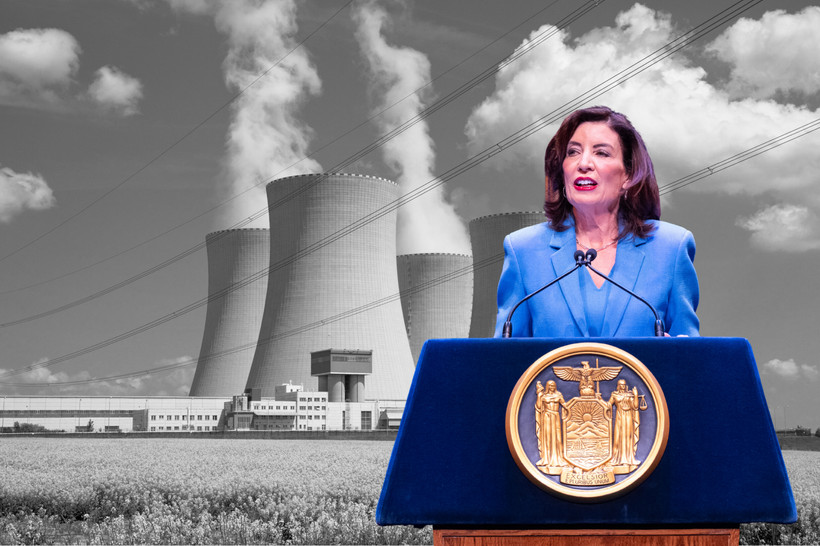
Governor Kathy Hochul is making nuclear energy her signature energy policy as she seeks reelection. | Photos: Office of Governor Kathy Hochul; Aflo Images | Illustration: New York Focus

Sign up for Staying Focused, our newsletter keeping readers up to speed on New York politics.

If 2025 was the year Governor Kathy Hochul embraced “abundance” as the solution to New York’s woes — above all, the rising cost of living — 2026 is her year to show that she was just getting started.

That is, at least, what Hochul vowed in her State of the State address on Tuesday, putting the promise to “build, build, build” at the center of her agenda. And it is increasingly her answer to the conundrum facing New York’s energy system: how to keep the lights on while meeting growing demand for electricity, keeping utility bills in check, and fighting climate change.

Nowhere is this clearer than with nuclear energy, which she’s making her signature energy policy as she seeks reelection. On Tuesday, the governor announced efforts to build four gigawatts’ worth of new reactors in the state. Combined with the one gigawatt she tasked the state power authority with building last year, that would be slightly more than the entire United States has built in the last three decades, and rival the total amount New York has ever built.

“If there’s one thing I believe, it’s this: Go big or go home,” Hochul said of the nuclear plans.

In her accompanying policy book, Hochul outlined a number of other proposals to curb energy bills and clean up the grid, but none come close to matching her ambitions for the nuclear buildout. She did not mention any new funding for climate initiatives — whether rebooting cap and invest, as many green groups are still calling for, or renewing the $1 billion climate action fund she introduced last year. (Asked about additional climate funding, spokesperson Ken Lovett said only that “the governor will be outlining her budget next week.”)

Hochul likewise kept mum about whether or how she might seek to amend the climate law, as she suggested she wanted to last fall, after a judge ruled her administration was breaking it by failing to issue rules to cut emissions. She could still attempt such a maneuver in the state budget; she’s due to present her first draft of it in less than a week.

Instead, she proposed a wide range of less flashy items: an additional $50 million for the Empower+ energy efficiency program, which, along with a separate funding boost announced in December, will help rescue the program from drastic cuts; a package of reforms aimed at reining in utility rate hikes; customer incentives to participate in programs that reduce strain on the grid; and a sales tax exemption for electric vehicle charging stations, among others.

She also proposed a measure to help schools add more solar energy and create “cooler schoolyards,” apparently in line with New York City Mayor Zohran Mamdani’s plans to green hundreds of city schools. And she vowed to make data centers “pay their fair share” for grid upgrades so that, the policy book says, “every-day New Yorkers do not subsidize” the industry.

The data center proposal could be an island of bipartisan consensus in what promises to be another year of bruising climate fights. The policy echoes calls from green groups as well as from a growing number of Republicans across the country, as artificial intelligence and its colossal demands on the grid face a mounting popular backlash.

But Liz Moran, New York policy advocate at the environmental law group Earthjustice, warned that much depends on the details: Will Hochul stipulate, for example, that data centers be required to provide their own clean power? Or will they be allowed to rely on gas?

Few climate advocates are in the mood to give Hochul the benefit of the doubt. Still fuming from Hochul’s repeated backtracking on climate policies last year — including her approval of a thrice-rejected gas pipeline after talks with President Donald Trump — they largely panned her agenda as insufficient, if not a betrayal of New York’s climate mandates.

“Under Governor Hochul’s watch, New York has shifted from being a national climate leader to a state where the fossil fuel industry status quo holds New Yorkers hostage,” said Stephan Edel, executive director of the NY Renews coalition, in a statement.

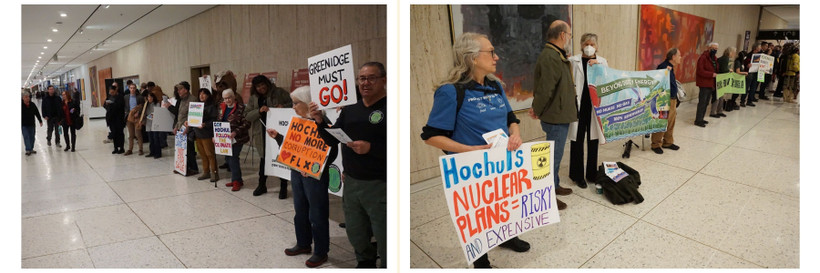
Dozens of environmentalists rallied outside the entrance to Albany’s Egg theater before Hochul’s speech, denouncing the pipeline decision and her leap to nuclear power while the state continues to lag on building solar, wind, and batteries.

Two photos showing a few dozen environmentalists rallying outside the entrance to the Egg theater in Albany's indoor Empire State Plaza.
Environmentalists rallied outside the entrance to Albany’s Egg theater before Hochul’s speech, denouncing her recent approval of a gas pipeline and her push for new nuclear power. | Colin Kinniburgh / New York Focus


The renewable energy industry is striking a more bullish tone. Marguerite Wells, executive director of the trade group Alliance for Clean Energy New York, said Hochul’s proposals to cut red tape for housing and infrastructure — notably by reforming the 50-year-old State Environmental Quality Review Act — could pay dividends for clean energy, too.

“We’ve seen a lot of movement to clear the way for nuclear power plant development. We need equal movement for renewables,” Wells said in a statement. “New Yorkers need affordable electrons now, not in the decade-plus it will take until new nuclear could be operational.”

State officials insist the two go hand in hand. “We see nuclear as essential toward meeting the future energy needs in a way that pairs well with our existing renewable energy ambitions,” Public Service Commission Chair Rory Christian told New York Focus on Tuesday.

The state energy plan published in December envisions New York building at least two to three gigawatts’ worth of new nuclear alongside roughly 40 gigawatts of solar and wind by 2040.

Many Democratic lawmakers are lukewarm on Hochul’s nuclear plan. State Senate energy committee chair Kevin Parker said it was “not the optimal answer” to rising demand and prices. Senate environment committee chair Pete Harckham said he was “not wild” about the proposal. Senator Rachel May said she was “not a fan, but I understand why she’s doing it, I guess.”

Even some Republicans, who tend to prefer nuclear energy to renewables, are wary. “The benefits [Hochul] promises from her energy policies are years away, while families are struggling to afford their utility bills today,” said Assemblymember Matt Simpson in a statement.

Like so many debates in New York energy policy today, the nuclear fight will likely be won by the side that convinces the public it represents affordability. The pro-renewable Public Power New York this week blasted Hochul’s agenda as an “anti-affordability plan that will send already unaffordable utility bills skyrocketing,” citing a new analysis from a University of Pennsylvania researcher. 

NYSERDA President Doreen Harris countered that, according to state modeling, even five gigawatts of new nuclear “was still a more affordable option than some of the alternatives” when considering the reliability of the grid overall.

Christian, the Public Service Commission chair, said he sees New York’s history of building massive hydroelectric dams as a roadmap. More than half a century later, those dams still provide some of the cheapest electricity in the country.

“New York has a history of going big and making those big investments pay off in the long run,” he said. “This is no different.”

I hope this article helped you better answer the question that guides all of our journalism: Who runs New York? Before you click away, please consider supporting our work and making more stories like this one possible.

New York state is standing at a crossroads for climate action. After passing one of the nation’s most ambitious climate laws in 2019, the state is lagging far behind on its targets, struggling to meet deadlines to build renewable energy and clean up its buildings and roads. Other states are closely watching our progress, making decisions about their own climate plans based on New York’s ability to implement this legislation.

As New York’s only statewide nonprofit news publication, we’ve been scrutinizing the state’s climate progress. Our journalism exists to unpack how power works in New York, analyze who’s really calling the shots, and reveal how obscure decisions shape ordinary New Yorkers’ lives.

But we can't do this work without your help. We rely on reader donations to help sustain our outlet, and every gift directly allows us to publish more pieces like this.

Our work has already shown what can happen when those with power know that someone is watching, with my reporting prompting a state investigation and fine for a major corporation. I have more story ideas than I can count, but only limited resources to pursue all the leads that come across my desk.

If you’re able, please consider supporting our journalism with a one-time or monthly gift. Even small donations make a big difference.

Thank you for reading.

Colin Kinniburgh
Climate and Environmental Politics Reporter
A photo of Colin Kinniburgh.
Colin Kinniburgh is a reporter at New York Focus, covering the state’s climate and environmental politics. He has worked in media for more than a decade, across print, television, audio, and online news, and participated in fellowship programs at CUNY’s Graduate School of Journalism… more
Also filed in New York State

The legislation would make it easier for currently and formerly incarcerated people and child victims to sue the state over allegations of past abuse.

State leaders are expected to pass a bill that avoids resolving how much Resorts World New York City needs to pay.

New York state has pumped millions of taxpayer dollars into an online portal that vowed to make life easier for Rochester’s neediest, but critics say it’s fallen short.

Also filed in Budget

Resorts World is floating legislation to avert more than $500 million in payments to the horseracing industry.

Our searchable database breaks down the most consequential decisions Albany politicians made on climate, immigration, housing, schools, taxes, and more.

It’s unclear whether the Correctional Association of New York will have to scale back its nascent reform initiatives.

Also filed in Climate and Environment

Governor Kathy Hochul was successful in her bid to upend the Climate Leadership and Community Protection Act after legislators caved to finalize an overall budget deal.

The leader of Reinvent Albany discusses a data center subsidy in Rockland County that flew under the radar for years.

No other project in the country has gotten such a large subsidy to create so few jobs, according to watchdogs.

Also filed in Affordability

We’ve compiled information for SNAP recipients in New York on the changing work requirements.

Despite last-ditch efforts by a coalition of lawmakers, the state failed to avert a health coverage cliff coming this summer.

The Hochul administration now has a chance to relax New York’s child care staffing ratios — among the country’s strictest — after 26 years. But will it?