New York Approves Trump-Backed Gas Pipeline

The Northeast Supply Enhancement pipeline had been rejected by environmental regulators three times but was revived this spring after talks between Hochul and Trump.

Colin Kinniburgh   ·   November 7, 2025
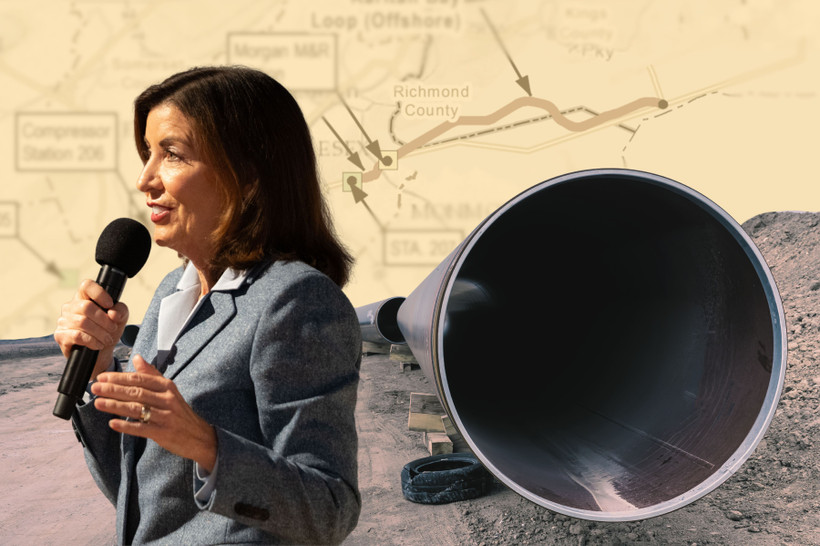
NESE is set to be New York’s first new gas pipeline in at least a decade, and by far the state’s largest expansion of fossil fuel infrastructure since passing its flagship climate law. | Photo: Courtesy of Governor Kathy Hochul | Illustration: New York Focus

Sign up for Staying Focused, our newsletter keeping readers up to speed on New York politics.

New York environmental regulators on Friday approved a major Trump-backed underwater gas pipeline in a U-turn for state energy policy. 

The state Department of Environmental Conservation issued crucial water permits for the Northeast Supply Enhancement project, which it had rejected three times in the past.

At the same time, the DEC announced that the even larger Constitution pipeline, slated to cross New York into New England, would not move ahead. Both pipelines were priorities for President Donald Trump, who railed against Governor Kathy Hochul on social media earlier this week for moving too slowly on the projects.

Hochul said she stood by the DEC’s decisions.

“We need to govern in reality,” she said in a statement Friday. “We are facing war against clean energy from Washington Republicans, including our New York delegation, which is why we have adopted an all-of-the-above approach that includes a continued commitment to renewables and nuclear power to ensure grid reliability and affordability.”

She said that DEC’s approvals followed the review standard she had spelled out to Trump in May during talks that many credited with reviving the two pipeline projects. (Hochul has denied any quid pro quo.)

“While I have expressed an openness to natural gas, I have also been crystal clear that all proposed projects must be reviewed impartially by the required agencies to determine compliance with state and federal laws,” Hochul said, noting that the Constitution pipeline failed to meet the bar.

NESE is set to be New York’s first new gas pipeline in at least a decade, and by far the state’s largest expansion of fossil fuel infrastructure since passing its flagship climate law in 2019. 

Climate advocacy groups pounced on the decision, calling it a betrayal.

“Hochul has shown New Yorkers she’d prefer to do Trump’s dirty work rather than protect our waterways from pollution,” said Laura Shindell, New York state director at Food & Water Watch. “She hasn’t kept her promises to fight against skyrocketing energy bills or the climate crisis. But New Yorkers will fight Hochul’s dirty pipeline every step of the way — alongside our communities — until it is stopped for good.”

“Governor Hochul is turning her back on the same agency scientists that determined the NESE pipeline would cause unacceptable degradation of water quality and marine life to NY waters just a few years ago,” said Roger Downs, conservation director of the Sierra Club’s Atlantic Chapter.

Environmental groups are likely to sue.

The DEC’s cover letter for the NESE permits did not detail how the pipeline’s construction would meet state water standards when the agency found the opposite five years ago, except noting that burying the pipeline two feet shallower than previously planned would dredge up less toxic sediment. The main permit requires Williams, the pipeline builder, to pay about $24 million to compensate for damages to fish and clam habitats.

The DEC stated outright that the project is “inconsistent” with the emissions requirements of the state’s climate law, but said that mandate was overridden by energy regulators’ September finding that the pipeline was needed to maintain a reliable gas system downstate. 

New Jersey environmental regulators swiftly followed DEC’s lead and issued their own approvals for the pipeline on Friday, allowing for its construction to begin.

The pipeline is projected to cost upwards of $2 billion, adding an extra $7.50 per month to average gas bills for National Grid customers in New York City and Long Island, the utility has estimated.

The Independent Power Producers of New York, a power plant trade group, cheered the decision.

“New York’s energy landscape is at a pivotal moment,” said the group’s president Gavin Donohue. “I commend the DEC for recognizing that natural gas will continue to play a key role in the State’s energy future.”

Close to 100 business, labor, and civic groups signed a letter this week backing the pipeline.

“Increased gas supply from the NESE pipeline will bolster reliability for essential energy needs in Brooklyn, Queens, and on Long Island, while freeing existing gas supplies to better serve our customers on Staten Island and in Suffolk County,” said Sally Librera, president of National Grid New York, in a statement announcing the letter on Friday, shortly before DEC issued its decision. She said the pipeline would help meet growing energy demand and save all New Yorkers money on their electric bills.

Chad Zamarin, CEO of the pipeline company Williams, said in a statement that the company was “proud to move NESE forward and do our part in providing New Yorkers access to clean, reliable and affordable natural gas.”

Williams also said it plans to keep pursuing the Constitution pipeline, and would reapply to DEC after withdrawing its current water permit application.

Update: November 7, 2025 — This story has been updated to include New Jersey’s permit approvals and a comment from National Grid and Williams.


I hope this article helped you better answer the question that guides all of our journalism: Who runs New York? Before you click away, please consider supporting our work and making more stories like this one possible.

New York state is standing at a crossroads for climate action. After passing one of the nation’s most ambitious climate laws in 2019, the state is lagging far behind on its targets, struggling to meet deadlines to build renewable energy and clean up its buildings and roads. Other states are closely watching our progress, making decisions about their own climate plans based on New York’s ability to implement this legislation.

As New York’s only statewide nonprofit news publication, we’ve been scrutinizing the state’s climate progress. Our journalism exists to unpack how power works in New York, analyze who’s really calling the shots, and reveal how obscure decisions shape ordinary New Yorkers’ lives.

But we can't do this work without your help. We rely on reader donations to help sustain our outlet, and every gift directly allows us to publish more pieces like this.

Our work has already shown what can happen when those with power know that someone is watching, with my reporting prompting a state investigation and fine for a major corporation. I have more story ideas than I can count, but only limited resources to pursue all the leads that come across my desk.

If you’re able, please consider supporting our journalism with a one-time or monthly gift. Even small donations make a big difference.

Thank you for reading.

Colin Kinniburgh
Climate and Environmental Politics Reporter
A photo of Colin Kinniburgh.
Colin Kinniburgh is a reporter at New York Focus, covering the state’s climate and environmental politics. He has worked in media for more than a decade, across print, television, audio, and online news, and participated in fellowship programs at CUNY’s Graduate School of Journalism… more
Also filed in Climate and Environment

The citizens assembly model, used for public decision-making around the world, is gaining traction in New York.

A lobbyist who has been romantically linked to Assembly Speaker Carl Heastie led a rally opposing the legislation a week before the speaker declined to bring it to a vote.

In May, state lawmakers passed a $269 billion budget after haggling for months over thousands of line items and policies affecting New Yorkers.