Climate Hawks Vow Election Showdown If Hochul Greenlights Gas Pipeline

Pipeline opponents say that approving NESE could bite Hochul in next year’s elections.

Colin Kinniburgh   ·   September 26, 2025
One activist group recently released a pledge not to vote for Governor Kathy Hochul in her reelection bid if she allows the NESE gas pipeline to be built. | Photo: Office of Governor Kathy Hochul | Illustration: Leor Stylar

Sign up for Staying Focused, our newsletter keeping readers up to speed on New York politics.

The Reporters’ Notebook features bite-sized stories and updates from New York Focus reporters on the topics they cover.

New York energy regulators gave their blessing last week to the Northeast Supply Enhancement Project, a Trump-backed gas pipeline that would serve New York City and Long Island. 

With the approval process now in its 11th hour, opponents are doing everything they can to step up pressure on the governor.

The seven-member Public Service Commission, which oversees the state’s utilities, found that the pipeline is needed to ensure the reliability of the downstate gas system. The ruling does not seal the pipeline’s fate; the commission does not have a formal role in approving the project. That will be up to the state Department of Environmental Conservation, which has promised a decision by the end of November. But the commission’s ruling helps pave the way for a final green light.

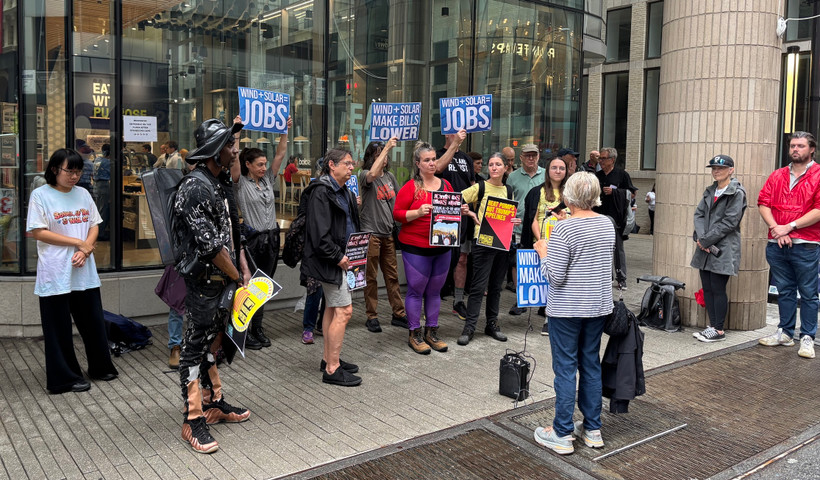
Anti-pipeline protesters outside a Climate Week event in New York City on Thursday, September 25, 2025.
Anti-pipeline protesters awaited DEC Commissioner Amanda Lefton at a Climate Week event in New York City on Thursday, and repeatedly interrupted her remarks once inside. | Colin Kinniburgh

The DEC has repeatedly rejected NESE in the past, mainly over concerns that its construction would churn up toxic heavy metals in the New York Bay. The project, along with the even larger Constitution pipeline, was revived this spring after Governor Kathy Hochul and President Donald Trump held talks. The White House lifted a stop-work order on a major offshore wind project off Long Island, while Hochul signaled her openness to “new energy projects that meet the legal requirements under New York law.” In the case of the pipeline, that judgment is up to the DEC, and Hochul has said she will respect it.

Not everyone is convinced that the governor is staying out of the process.

“This decision will have nothing to do with the substance. It will have everything to do with the politics,” said Pete Sikora, who leads climate campaigns at the advocacy group New York Communities for Change.

The PSC ruling came less than two weeks after the close of a public comment period during which opponents lodged thousands of complaints about the pipeline.

Last week, in the lead-up to the vote, Sikora’s group released a pledge not to vote for Hochul in her reelection bid if she allows the project to be built. It garnered about 1,000 signatures in its first week. Pipeline opponents have also been regularly confronting the governor at her public appearances, reviving a tactic that helped turn former governor Andrew Cuomo against fracking a decade ago.

Sikora said it was just a taste of the kind of “blowback” Hochul would face if her administration approves the pipeline.

“It’s going to mess up her central narrative, which is that she’s a Democrat standing up to Donald Trump,” he said. “It’s not true on this issue. And that’ll be vividly clear if she approves it.”

Hochul’s Democratic primary opponent, Lieutenant Governor Antonio Delgado, is becoming a fixture at anti-pipeline events, including a march across the Brooklyn Bridge in August and a climate town hall set for today. He seized on the PSC decision as further evidence that Hochul “cut a dirty deal with Donald Trump to force this project through.”

“We need a governor who will stand up for our communities, lower energy bills, and lead us into a clean energy future — not one who caves to polluters and leaves people behind,” Delgado said in a statement about the ruling last week.

Hochul has denied any wind-for-pipeline deal with Trump, and her campaign pointed to other issues the governor has fought the White House on, including congestion pricing and gerrymandering. New York is also battling the Trump administration in court over wind energy, electric vehicles, and the state’s Climate Superfund law.

“While some politicians do nothing but tweet, Governor Hochul is delivering real-world wins for New Yorkers to lower their costs, fight back against Donald Trump as he jacks up prices, and move New York towards a future where energy is affordable, reliable, and sustainable,” Hochul campaign spokesperson Sarafina Chitika told New York Focus.

What Does the PSC Order Actually Say?

New York’s Public Service Commission has little direct say over the Williams Northeast Supply Enhancement project, or NESE pipeline. The project needs approvals from federal energy regulators (received in early September), from state environmental regulators, and from neighboring states. So how did the state utility regulator get involved — and what did it actually say?


In 2024, the commission started reviewing a long-term gas plan from National Grid, the utility that serves gas to most of the downstate region. At that point, the pipeline was off the table after other state regulators had repeatedly rejected it. This summer, after the project was revived, National Grid filed a major supplement to its gas plan outlining why it wanted the project. (National Grid would be the pipeline’s sole customer.)


On September 18, the PSC voted 6–1 to approve an order on the gas plan. It did not approve funding for NESE or even explicitly approve National Grid’s plan. Instead, it asked the utility to provide more updates on gas demand and other key data points.


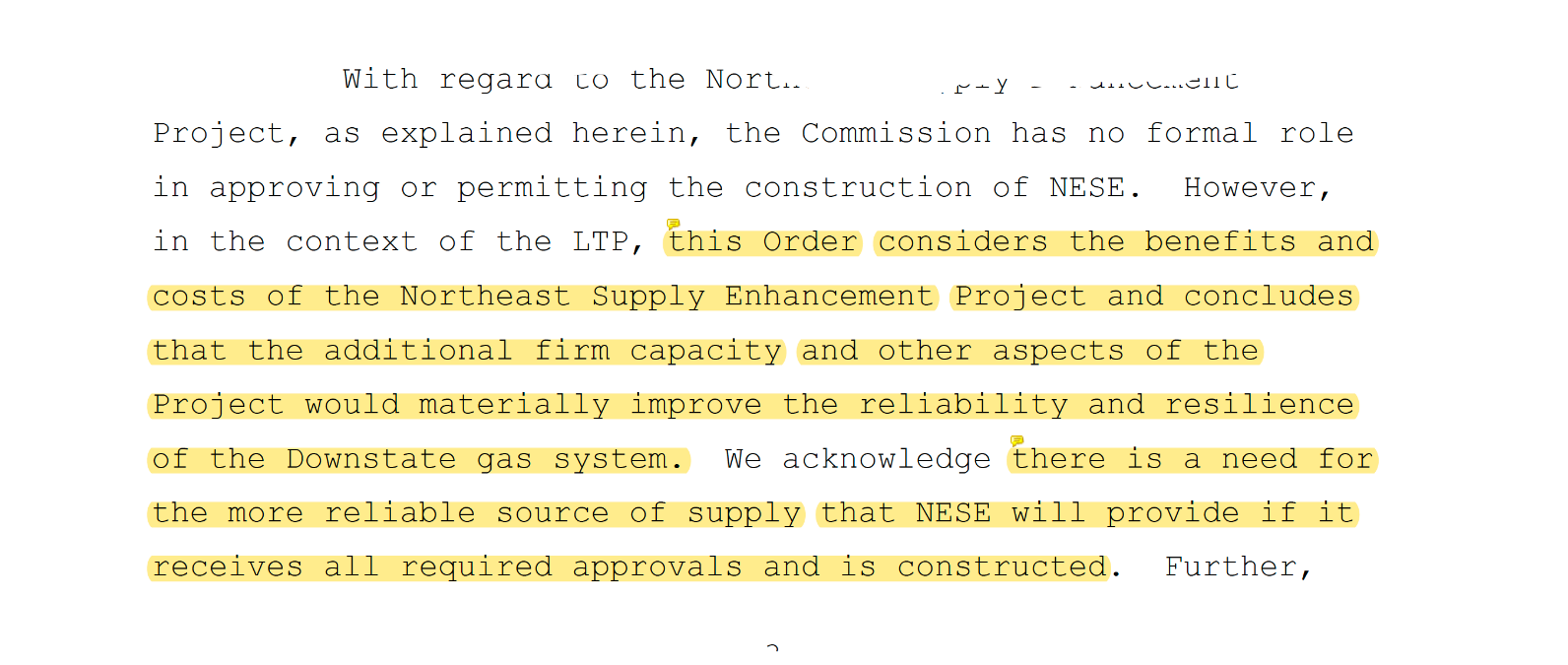
The order did, however, say that the NESE pipeline would help ensure reliable gas service and is the best option to guard against outages during severe winter weather.

It also directed National Grid to study whether, if approved, the pipeline could allow the company to shut down portions of a controversial Brooklyn gas storage facility and reduce its reliance on compressed natural gas brought in by diesel trucks.


In short, while the PSC did not directly advance the pipeline’s construction, its decision vouching for the project’s need could be influential as the clock ticks down to the key permitting deadline.


State regulators, for their part, insist that their decisions remain free of political interference.

“Since it was founded 118 years ago, the PSC has remained an independent regulatory body,” said commission spokesperson James Denn. Just one member, commission chair Rory Christian, serves directly under the governor; he leads the state agency that works alongside the PSC and sets the agenda for the monthly sessions. The other six members consult with the chair and staff but act independently.

The DEC said that it subjects all permit applications to a “rigorous review process” and that this one is no different. Commissioner Amanda Lefton, speaking to the Capitol Pressroom podcast on the day of the PSC vote, stressed that her agency’s “only authority” in reviewing the permits was over water quality.

But other state laws could enter the equation, Lefton recognized.

Last time the DEC rejected the pipeline, in 2020, it dedicated pages of its decision to climate and reliability concerns. It said the project would increase greenhouse gas emissions and appeared “inconsistent” with New York’s then-fresh climate law. It also said that the pipeline did not appear necessary to meet gas demand.

The PSC’s new finding that the pipeline would protect reliability, helping to prevent potentially catastrophic outages in severe winter weather, will likely weigh on environmental regulators as they reconsider the pipeline. This February, DEC explicitly set aside the climate law when it approved New York’s first major fossil fuel project in years, because energy regulators said it was needed for reliability.

PSC member John Maggiore, the only one to vote against last week’s order, said that backdrop was a key reason for his vote.

“This request comes to us within a larger set of policy contexts,” he said during the commission session. “While this order does not approve a new pipeline, it could result in the approval of a new pipeline to bring more gas into New York state.”

I hope this article helped you better answer the question that guides all of our journalism: Who runs New York? Before you click away, please consider supporting our work and making more stories like this one possible.

New York state is standing at a crossroads for climate action. After passing one of the nation’s most ambitious climate laws in 2019, the state is lagging far behind on its targets, struggling to meet deadlines to build renewable energy and clean up its buildings and roads. Other states are closely watching our progress, making decisions about their own climate plans based on New York’s ability to implement this legislation.

As New York’s only statewide nonprofit news publication, we’ve been scrutinizing the state’s climate progress. Our journalism exists to unpack how power works in New York, analyze who’s really calling the shots, and reveal how obscure decisions shape ordinary New Yorkers’ lives.

But we can't do this work without your help. We rely on reader donations to help sustain our outlet, and every gift directly allows us to publish more pieces like this.

Our work has already shown what can happen when those with power know that someone is watching, with my reporting prompting a state investigation and fine for a major corporation. I have more story ideas than I can count, but only limited resources to pursue all the leads that come across my desk.

If you’re able, please consider supporting our journalism with a one-time or monthly gift. Even small donations make a big difference.

Thank you for reading.

Colin Kinniburgh
Climate and Environmental Politics Reporter
A photo of Colin Kinniburgh.
Colin Kinniburgh is a reporter at New York Focus, covering the state’s climate and environmental politics. He has worked in media for more than a decade, across print, television, audio, and online news, and participated in fellowship programs at CUNY’s Graduate School of Journalism… more
Also filed in New York State

At a Board of Regents meeting Monday, state officials proposed eliminating credit-based diploma requirements.

The last-minute influx, the biggest ever for a legislative primary, is boosting her opponent, Jessica González-Rojas.

City budget gaps and an ambitious affordability agenda may require pressing Albany again for taxes and aid.

Also filed in New York City

The Department of Housing Preservation and Development has vowed to go after negligent landlords, but it’s wrestling with a huge backlog of complaints.

A lawsuit accuses federal officials of ignoring evidence that the boy, born in Mexico, held US citizenship through his mother.

We’ve compiled information for the 450,000 New Yorkers who will lose health care coverage on July 1.

Also filed in Climate and Environment

The citizens assembly model, used for public decision-making around the world, is gaining traction in New York.

A lobbyist who has been romantically linked to Assembly Speaker Carl Heastie led a rally opposing the legislation a week before the speaker declined to bring it to a vote.

In May, state lawmakers passed a $269 billion budget after haggling for months over thousands of line items and policies affecting New Yorkers.