
Could Hydropower Credits Undermine New York City’s Climate Law?

Mayor Mamdani is facing pressure to limit an avenue for large building owners to buy credits instead of cutting emissions.
Benjy Sachs   ·   June 30, 2026
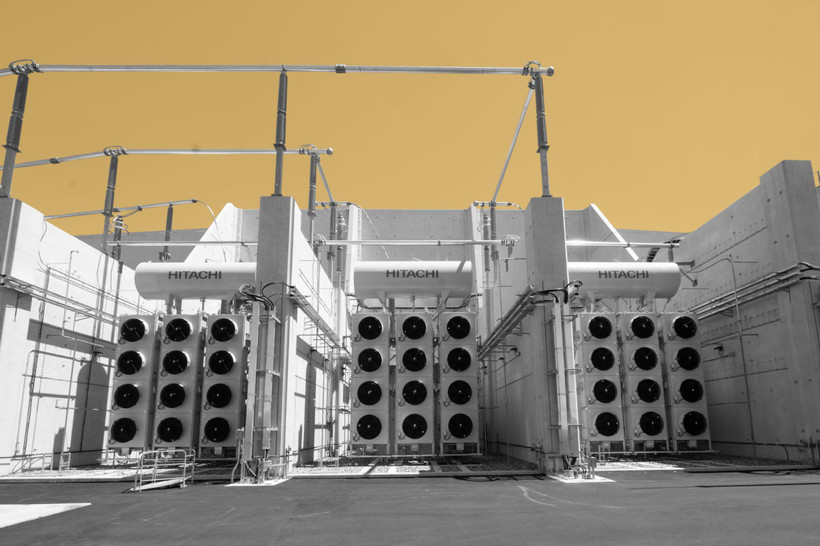
A photo of part of the Camplain Hudson Power Express Converter station, a towering white structure featuring three blocks of twelve fans each.
Part of the Champlain Hudson Power Express converter station. CHPE is expected to deliver 10.4 terawatt-hours of clean energy per year to the New York Metro area. | Photo: Office of Governor Kathy Hochul | Illustration: Leor Stylar

Sign up for Staying Focused, our newsletter keeping readers up to speed on New York politics.

When renewable energy credits hit the market as soon as next month, New York City building owners will for the first time be able to support a clean energy project rather than cleaning up their own properties.

Climate advocates and some city legislators are urging Mayor Zohran Mamdani’s administration to limit the use of credits to comply with Local Law 97, the landmark statute that requires owners of large buildings to ratchet down their emissions. Mamdani said he would do so on the campaign trail last year, but hasn’t indicated his position since he took office.

In June, the Champlain Hudson Power Express, a 339-mile transmission line, began delivering Canadian hydropower to New York City. Its abundant clean energy will be translated into the credits, known as RECs, that companies or organizations can buy from the New York State Energy Research and Development Agency, with the proceeds helping pay for the transmission line.

That’s where the advocates’ concerns come in. The RECS are expected to cost significantly less than the penalty for not complying with the city law, and some fear they will be used too liberally.

“We’ve got to start by asking what’s the risk here,” said Chris Halfnight, CEO of the Urban Green Council, a nonprofit focused on decarbonizing buildings in New York City. “Without a reasonable limit, RECs could become a substitute for building upgrades rather than a complement to them.”

RECs can only be used to offset emissions from electricity use, not from on-site oil or gas usage. Still, they could reduce the incentive to make buildings more energy efficient through retrofits and upgrades. The Urban Green Council calculated that as much as half of the emissions over the law’s 2030 limits could be offset by RECs — including 85 percent of excess emissions from office properties.

Asked at a mayoral forum last year, Mamdani said he would eliminate the use of RECs to offset emissions. He lambasted Mayor Eric Adams for slow-walking Local Law 97’s implementation and deferring to the real estate lobby in allowing the sale of RECs as a clean energy compliance option.

“It is cheaper for some New Yorkers to be out of compliance than in compliance,” Mamdani said, in response to a question about RECs. “That is a ridiculous state of affairs.”

As mayor, however, Mamdani has yet to publicly support any limit on the use of RECs to comply with the law. A bill now pending before the City Council would limit the volume of emissions that can be offset by RECs to 10 percent of a building’s emissions from electricity, but the mayor has not yet endorsed it.

“As we review Intro 159,” said a City Hall spokesperson, referring to the bill, “we will continue to support those who are taking concrete steps to come into compliance with the law.”

Councilmember Carmen De La Rosa, the main sponsor of the bill, said she and her co-sponsors hope the mayor will sign on. “It does seem consistent with positions he advocated as both an assemblymember and a mayoral candidate,” she said.

De La Rosa said she introduced the bill to ensure the benefits of Local Law 97 flow to the city’s residents, especially those in marginalized communities.

“CHPE is a huge victory for Local Law 97.”

—Ben Furnas, Former NYC Climate Official

“Climate change is already affecting us,” De La Rosa said. “In recent years, we’ve seen major brush fires in my district. Communities of color and environmental justice communities are bearing the impacts.”

Several climate organizations signed a memo in support of De La Rosa’s bill, and note that Mamdani could also enact an offset limit through rulemaking at the Department of Buildings.

The department formalized the use of RECs as a compliance option in 2022, under then-Mayor Adams. “Eric Adams ripped a giant loophole into Local Law 97,” said Pete Sikora, who directs climate advocacy at New York Communities for Change. Closing that loophole “would ensure energy efficiency investments that lead to thousands of jobs, millions of tons of air pollution reductions, and lower utility bills,” he said.

But not everyone sees the RECs as a handout to property owners. Because they provide revenue to energy developers, they can also spur energy investment, said Ben Furnas, a former top climate official in the Bill de Blasio administration.

“I think CHPE is a huge victory for Local Law 97 in a lot of ways,” he said, since its RECs can “help catalyze a political coalition for a much lower emission grid.”

Another alum of the de Blasio climate team, Daniel Zarrilli, said it would have been hard to fund the transmission line without it.

CHPE actually getting built was far from guaranteed,” Zarrilli said. “If part of the tradeoff was allowing some offsetting of electricity emissions, I think that was a worthwhile compromise.”

The sale of RECS will help defray some of the cost of building and operating the transmission line, which otherwise will be absorbed by ratepayers across the state. In a statement, the Department of Buildings said purchasing RECs “cuts down on pollution and supports a cleaner grid for our city.” 

New York City itself has already committed to buying a substantial portion of RECs. Utility customers will see their monthly bills rise by a few dollars per month to help pay for CHPE; the exact amount may vary slightly, depending how many RECs building owners buy.

Most large buildings are already in compliance with the law’s earliest requirements. By the time stricter requirements take effect in 2030, RECs may well be more expensive. Their prices fluctuate each month — rising when power prices are low and increasing when power prices are high. Starting in 2030, the law starts to treat New York City’s electricity as much cleaner, anticipating the grid’s continued shift towards carbon-free energy sources. At that point, building owners will have to buy twice the number of RECs to cover the same amount of emissions.

Halfnight said the shifting calculus of REC prices could eventually help encourage building owners to actually lower their properties’ emissions rather than relying on the offsets. In the meantime, he said, a cap on the RECs would provide a “straightforward fix.” 

“These countervailing factors say ‘Okay, it’s some risk, but it’s not a five-alarm fire,’” he said.

I hope this article helped you better answer the question that guides all of our journalism: Who runs New York? Before you click away, please consider supporting our work and making more stories like this one possible.

New York state is standing at a crossroads for climate action. After passing one of the nation’s most ambitious climate laws in 2019, the state is lagging far behind on its targets, struggling to meet deadlines to build renewable energy and clean up its buildings and roads. Other states are closely watching our progress, making decisions about their own climate plans based on New York’s ability to implement this legislation.

As New York’s only statewide nonprofit news publication, we’ve been scrutinizing the state’s climate progress. Our journalism exists to unpack how power works in New York, analyze who’s really calling the shots, and reveal how obscure decisions shape ordinary New Yorkers’ lives.

But we can't do this work without your help. We rely on reader donations to help sustain our outlet, and every gift directly allows us to publish more pieces like this.

Our work has already shown what can happen when those with power know that someone is watching, with my reporting prompting a state investigation and fine for a major corporation. I have more story ideas than I can count, but only limited resources to pursue all the leads that come across my desk.

If you’re able, please consider supporting our journalism with a one-time or monthly gift. Even small donations make a big difference.

Thank you for reading.

Colin Kinniburgh
Climate and Environmental Politics Reporter
A photo of Colin Kinniburgh.
Benjy is a data intern and student at the Newmark Graduate School of Journalism at CUNY, where he is focusing on investigative and data reporting. He is interested in covering climate change, local politics, and mass incarceration. He has written for Heatmap, Capital… more
Also filed in New York City

Under Trump, a status for young immigrants who have experienced abuse or neglect no longer offers much protection.

The Department of Housing Preservation and Development has vowed to go after negligent landlords, but it’s wrestling with a huge backlog of complaints.

A lawsuit accuses federal officials of ignoring evidence that the boy, born in Mexico, held US citizenship through his mother.

Also filed in Climate and Environment

The citizens assembly model, used for public decision-making around the world, is gaining traction in New York.

A lobbyist who has been romantically linked to Assembly Speaker Carl Heastie led a rally opposing the legislation a week before the speaker declined to bring it to a vote.

In May, state lawmakers passed a $269 billion budget after haggling for months over thousands of line items and policies affecting New Yorkers.

Also filed in Housing

The Knights Inn, profiled by New York Focus and ProPublica last year, had received health and safety complaints for years.

Some of the city’s new aid will be canceled out by pension boosts.

A law designed to protect the environment will be partially rolled back to pave the way for much-needed homes.