New York City’s Most Serious Housing Violations Stay Open for Months or Even Years

The Department of Housing Preservation and Development has vowed to go after negligent landlords, but it’s wrestling with a huge backlog of complaints.
Keenan Chen   ·   June 22, 2026
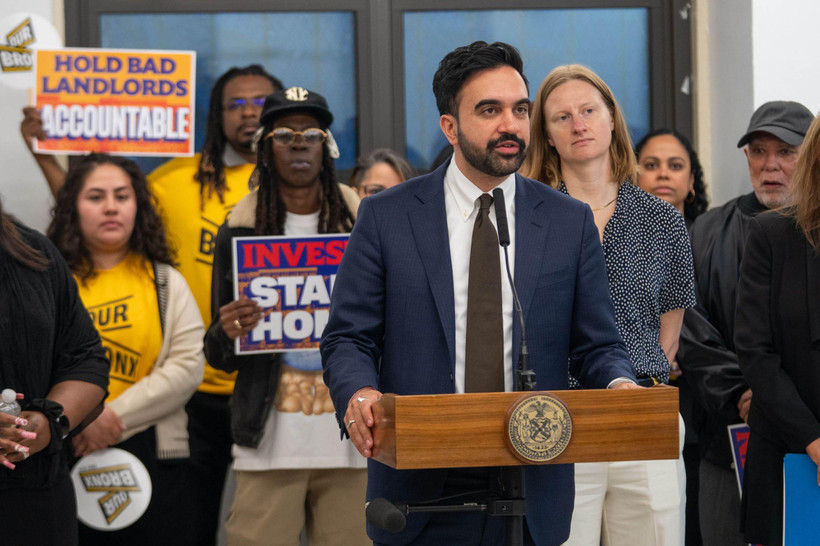
At a press conference, Mayor Zohran Mamdani stands speaking at a podium, behind and to his left stands Cea Weaver, director of the New York City Mayor's Office to Protect Tenants. Behind them stand people holding signs bearing the words "Hold bad landlords accountable" and "Invest in stables homes."
Mayor Zohran Mamdani announces a record $31 million in penalties against the owners of Robert Fulton Terrace and Fordham Towers in the Bronx, the largest penalty ever obtained by HPD, at a press conference on May 6, 2026. | Ed Reed/Mayoral Photography Office

Sign up for Staying Focused, our newsletter keeping readers up to speed on New York politics.

Flanked by his top legal and housing officials in a mid-March press conference, New York City Mayor Zohran Mamdani touted the city’s lawsuit against the landlord of 919 Prospect Avenue, a rent-stabilized building in the Bronx with a history of housing code violations, including leaks, mold, and heat outages.

“Let the scale of this penalty show how seriously we take the threat of building mismanagement that puts residents’ and neighbors’ health at risk,” Mamdani said, referencing the over $2 million fine the court agreed to impose on the owner of the dilapidated building. 

But the tenants living there aren’t celebrating yet. For one thing, tenants say, many of the repairs weren’t done or done well. And the city has sometimes been slow to step in.

Their fight against heat and hot water outages, rodent infestations, leaky pipes, and collapsed bathroom ceilings has stretched back more than a decade. The city’s legal win took nearly four years.

The mayor, whose election was fueled by renters, has promised to “freeze the rent” and go after bad landlords. Yet clearing all of the existing dangerous housing code violations and holding landlords accountable poses a major challenge for the city’s housing department.

The number of health-threatening housing code violations in New York City sharply increased in recent years, and a significant number of them are going unrepaired, according to a New York Focus analysis of city inspection data from January 2016 through the end of May 2026. 

Known as Class C violations, they include lack of heat or hot water, lead paint hazards, and leaks deemed “immediately hazardous” to tenants. There were 278,000 such violations in 2025, down slightly from 2024, but more than double the number in 2018.

These violations are verified by HPD and require landlords to make repairs promptly — within 24 hours or 21 days, depending on the violation — but that usually doesn’t happen. More than 70 percent of the more than 450,000 active Class C violations in privately owned buildings have been outstanding for over a year. As of the end of May 2026, 26 percent of the violations issued in 2024 and 34 percent of those from 2025 remained unresolved.

The Department of Housing Preservation and Development, or HPD, is the city’s primary housing code enforcement agency. The agency has several enforcement tools at its disposal, including the ability to impose civil penalties, initiate emergency repairs and bill landlords for them, or even strip landlords of their management rights over buildings.

Tenant advocates and attorneys say the enforcement of these laws sometimes falls short. The enormity of the task was exposed this winter, when HPD claimed to have resolved 99 percent of heat and hot water problems, only to later admit that many were closed without an inspection. 

In response to New York Focus’s findings, Natasha Kersey, a spokesperson for HPD, said the agency has ramped up inspections, collected tens of millions of dollars in civil penalties since 2022, and closed hundreds of thousands of violations through lawsuits it has initiated. Between April 2016 and April 2026, the agency said, it issued 1.8 million Class C violations and closed 1.4 million.

“The agency refuses to stand by while bad actors ignore their responsibilities,” she said. “The message is clear: Neglect is not acceptable, and landlords must make necessary repairs or face the consequences.”

In May, the Mamdani administration released its first major housing plan, which includes measures to improve how the city responds to violations and tenant complaints.

For example, starting in October, HPD will no longer bundle reports of no heat or hot water across multiple units in a building. Under this practice, the agency currently closes multiple complaints after resolving just one tenant’s case. The housing blueprint also includes a new online system, launching this fall, for renters to more easily reschedule inspections if they’re not home when an HPD inspector stops by.

In addition to addressing tenants’ issues, the plan details more aggressive enforcement against negligent landlords, including “an expedited litigation process” in housing court for building-wide Class C violations.

For tenants at 919 Prospect Avenue, those changes are long overdue. Tenants first sued Seth Miller, the building’s owner, in 2016. Miller tried to use bankruptcy to halt the tenants’ case, a maneuver that was blocked in court. A judge then temporarily barred Miller from managing the building.

“I would love for HPD to seek these civil penalties more frequently. But you just don’t see them do it very often.”

—Anna Luft, New York Legal Assistance Group

“We didn’t get heat or hot water most of the time. I had to use my oven for heat. It was just unbearable,” recalled Carrie Maldonado, who lived at the time in a two-bedroom unit on the first floor. In 2022, Maldonado finally decided to move out of her rent-stabilized apartment, where she had lived since 1988.

Two months after Mamdani’s press conference, Miller has yet to correct all the outstanding violations or pay the judgment fine, a spokesperson for the Law Department told New York Focus. Instead, court filings show he is appealing the ruling. 

In an email to New York Focus, Ethan Cohen, an attorney for Miller, argued the ruling  stemmed from the city’s “misleading narrative” and failures by Miller’s previous attorney to respond to key court filings.

“The City appears more focused on making an example of this property owner than on upholding the fundamental principles of due process and fairness. In doing so, it continues to defend a judgment built on distortion, silence, and procedural gamesmanship rather than truth,” Cohen said.

Landlords have attributed the number of distressed buildings to rising insurance costs and to the state’s 2019 rent reforms, which they say limit their ability to raise revenue in order to make necessary repairs. Tenant advocates point to some landlords’ neglect and to the city’s lax code enforcement

In January, Mamdani appointed the veteran housing official Dina Levy to lead HPD. In a March city council hearing, Levy told lawmakers that the agency “need[s] to do better” and that it “cannot let the shortcomings of our past limit our vision for what is possible for our future.”  

“We must be the ones to end this cycle, to ensure that future generations of tenants will not have the same stories to tell 20 years from now,” Levy said.

The agency she took over had closed over 800,000 violations and initiated emergency repairs on more than 170,000 apartment units in 2025, the most in the past five years. At the same time, however, HPD became slower to take landlords to court. Prior to 2020, the agency opened between 500 and 600 so-called “comprehensive litigation” cases each year. But despite a surge in violations issued, HPD initiated just 134 such cases in 2025.

“I would love for HPD to seek these civil penalties more frequently. But you just don’t see them do it very often,” said Anna Luft, associate director for Housing Policy and Advocacy at New York Legal Assistance Group, an advocacy and legal nonprofit that successfully sued the city to make housing code violations more transparent.  

One reason the city and HPD may have been reluctant to aggressively pursue civil penalties in the past is that doing so could lead landlords to abandon buildings and ultimately force the city to take them over, along with their mortgages and unpaid bills, a senior housing attorney at a major legal nonprofit said. 

“[HPD is] sort of walking this line because it doesn’t want to bankrupt landlords, who might just walk away from these buildings,” said the attorney, who requested anonymity to discuss private conversations with HPD officials.

But the agency’s attitude may be changing. In May, the city announced it had secured a record-breaking penalty against another negligent Bronx landlord to the tune of $31 million. In the press release, the mayor called for a “preservation buyer” to purchase and maintain the two large towers, which are in the midst of foreclosure proceedings.

A large share of the most serious housing violations now involve pest infestations. This trend emerged after a 2018 law reclassified mice and other rodent infestations as Class C violations, citing their role in triggering asthma, and mandated that infestations be cleared within 21 days.

But more than 140,000 pest violations — 35 percent of the total number issued since January 2019, when the law took effect — have remained active.

Brooklyn Borough President Antonio Reynoso, who co-sponsored the asthma bill while serving on the City Council, said the city must uphold its commitments. 

“New York City needs to follow through on that accountability,” Reynoso, who is now running for Congress, said in a statement to New York Focus. “That means providing HPD with the funding it needs to conduct inspections and imposing real consequences on landlords who fail to protect their tenants.”

The city also passed legislation to mandate faster repairs of self-closing fire-rated doors following the 2022 Twin Parks fire, which claimed 17 lives in the high-rise Belmont neighborhood in the Bronx. Investigators later determined that the deaths were caused by smoke inhalation from hallways and apartment doors that failed to close automatically. 

When the new laws were passed, Oswald Feliz, a New York City councilmember representing the Belmont area and chair of the then newly formed fire prevention task force, said that the city “cannot allow another similar tragedy to ever happen again. These fire safety bills will ensure that self-closing door laws are scrupulously followed and enforced.” 

Yet more than 53,000 — nearly one in five — self-closing door and other egress violations issued since the Twin Parks fire remain outstanding. Feliz did not respond to requests for comment from New York Focus. 

In fact, the number of egress violations more than tripled from 2019 to 2025, becoming the most commonly reported type of Class C violation last year.

HPD said the agency has dedicated resources to ramp up inspections and re-inspections, and that 75 percent of the self-closing door violations issued between 2024 and 2026 have been resolved.

A majority of city council members signed onto a bill this year that they say would allow HPD to more effectively foreclose on properties with a high number of violations or unpaid taxes. Kersey, the HPD spokesperson, said the agency would support such a bill.

Some advocates are calling for a formal legal framework that would allow tenants in apartments with excessive violations to withhold rent without risking eviction. A bill allowing tenants to do so passed in the state Senate last year, though the state Assembly has yet to take it up. 

Luft, of New York Legal Assistance Group, said that tenants should ideally be able to seek rent relief proactively when landlords refuse to make meaningful repairs — “because ultimately that is speaking the language that landlords speak, which is money.”

The city may also help tenants put pressure on negligent landlords in another way.

Cea Weaver, director of the Mayor’s Office to Protect Tenants, highlighted a city plan to add more Class C violations to those already considered “rent-impairing,” meaning a landlord can’t collect rent if the issue persists for more than six months.

That list hasn’t been updated since 1992, Weaver said.

“Since then,” she added, “we have a much deeper understanding of the hazards of living with mold, the hazards of living with lead paint, and other types of toxins that are found in deteriorated New York City apartment buildings.”

Benjy Sachs contributed reporting.

At New York Focus, our central mission is to help readers better understand how New York really works. If you think this article succeeded, please consider supporting our mission and making more stories like this one possible.

New York is an incongruous state. We’re home to fabulous wealth — if the state were a country, it would have the tenth largest economy in the world — but also the highest rate of wealth inequality. We’re among the most diverse – but also the most segregated. We passed the nation’s most ambitious climate law — but haven’t been meeting its deadlines and continue to subsidize industries hastening the climate crisis.

As New York’s only statewide nonprofit news publication, our journalism exists to help you make sense of these contradictions. Our work scrutinizes how power works in the state, unpacks who’s really calling the shots, and reveals how obscure decisions shape ordinary New Yorkers’ lives.

In the last two decades, the number of local news outlets in New York has been nearly slashed in half, allowing elected officials and powerful individuals to increasingly operate in the dark — with the average New Yorker none the wiser.

We’re on a mission to change that. Our work has already shown what can happen when those with power know that someone is watching, with stories that have prompted policy changes and spurred legislation. We have ambitious plans for the rest of the year and beyond, including tackling new beats and more hard-hitting stories — but we need your help to make them a reality.

If you’re able, please consider supporting our journalism with a one-time gift or a monthly gift. We can't do this work without you.

Thank you,

Akash Mehta
Editor-in-Chief
A photo of Akash Mehta.
Keenan Chen is a freelance data journalist. Previously, he was a senior researcher at The Information Futures Lab at Brown University and First Draft News. You can follow him at @kcinbk.bsky.social
Also filed in New York City

A lawsuit accuses federal officials of ignoring evidence that the boy, born in Mexico, held US citizenship through his mother.

City budget gaps and an ambitious affordability agenda may require pressing Albany again for taxes and aid.

We’ve compiled information for the 450,000 New Yorkers who will lose health care coverage on July 1.

Also filed in Housing

In May, state lawmakers passed a $269 billion budget after haggling for months over thousands of line items and policies affecting New Yorkers.

Some of the city’s new aid will be canceled out by pension boosts.

A law designed to protect the environment will be partially rolled back to pave the way for much-needed homes.