How Renters Fueled Zohran Mamdani’s Victory

Andrew Cuomo won 11 out of 13 majority-homeowner districts — but Mamdani swept the floor in renter-heavy areas, where turnout surged.

Charlie Dulik   ·   July 4, 2025
Mamdani won seven of the 10 districts with the most rent-stabilized units. | New York State Tenant Bloc

Sign up for Staying Focused, our newsletter keeping readers up to speed on New York politics.

This article is published in our Perspectives section. Charlie Dulik works as a tenant organizer for Housing Conservation Coordinators; he wrote this article in an independent capacity.

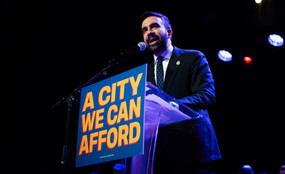
Last week’s New York City Democratic mayoral primary saw a dramatically reshaped electorate power state Assemblymember Zohran Mamdani to victory.

Multiple factors may have contributed to the surge in turnout — Mamdani’s innovative social media strategy, his volunteer army, his personal charisma, and his platform centered on delivering a more affordable city. That platform is composed of three major planks: creating free universal childcare, making buses fast and free, and freezing rents for around 2.4 million rent-stabilized tenants.

That last point may have been particularly important. Analysis of first round election results shows that areas with the most rental units, many of which supported Eric Adams four years ago, proved decisive to Mamdani’s victory. The districts with the most homeowners, meanwhile, swung heavily for former Governor Andrew Cuomo.

Two-thirds of city residents rent their homes. About 44 percent of rental units are rent-stabilized. But tenants are in crisis. Evictions remain relatively high, and in 2023, homelessness reached its highest point since the Great Depression. A majority of tenants are rent burdened, paying more than 30 percent of their income toward rent. Last year, according to a survey of nearly 2,500 New Yorkers, 22 percent of rent-stabilized tenants were behind on rent, and 17 percent reached the end of a month with no money left at least once in the previous year. In contrast, landlords of rent-stabilized units saw their net operating incomes rise 12.1 percent in 2023 (the city’s most recent data) and more than 10.4 percent the year before.

Mamdani’s housing platform activated tenants facing these struggles and they played a pivotal role in his victory.

Of the city’s 65 state Assembly districts, which all contain about 130,000 residents, 52 are made up of majority rental units. Mamdani won 45 percent of the first-round popular vote across these districts, dwarfing Cuomo’s 33 percent. Turnout in these renter-heavy areas spiked 7.5 percent. Mamdani also won eight of the 10 districts with the largest number of rental units, all of which are in Manhattan. (All voting data in this article refers to the top choices on voters’ ballots.)

Mamdani performed well in districts that would be most affected by his proposal to freeze rents on rent-stabilized tenants. He won seven of the 10 districts with the largest amount of rent-stabilized units, including his own in Astoria and Long Island City, which ranks sixth on the list. These areas have not always been progressive strongholds. Four years ago, Kathryn Garcia and Maya Wiley each won one (AD 75, containing Chelsea, Hell’s Kitchen, and Midtown Manhattan, and Mamdani’s AD 36, respectively), and the rest voted for Adams. Mamdani remarkably won five rent-stabilized former-Adams districts in Crown Heights, Flatbush, Harlem, Washington Heights, and Inwood. Across these districts, turnout rose an average of more than 3 percent over 2021.

Mamdani also won eight of the 10 districts with the highest number of market-rate units. (Only one district, AD 75, ranks in the top 10 for both rent-stabilized and market-rate units). Mamdani won three such districts that Wiley won four years ago, encompassing Greenpoint, Williamsburg, Bushwick, and Ridgewood, as well as three won by Garcia, including the East and West Village, Soho, and central Manhattan’s AD 75. He also flipped two former Adams-supporting, market rate–heavy districts in Bedford-Stuyvesant, Bushwick, and Cypress Hills. These 10 districts saw voter turnout jump by an average of nearly 19 percent.

Market-rate units tend to vary more than rent-stabilized ones, from new luxury towers in Manhattan to old row homes in the outer boroughs, making generalizations more difficult. Cuomo won two market rate–dominant districts, both on the Upper East Side, with median household income well above city averages. Most of Mamdani’s market rate–heavy districts lie closer to the city’s median household income, with a median age well below. Perhaps these districts, with much weaker protection against rent hikes, responded to their relative precarity by gravitating toward the candidate most boldly pledging to confront the power of landlords, even if they would not be directly impacted by his calls for a rent freeze.

Cuomo received strong support from areas with the highest concentration of homeowners. There are 13 majority-owner Assembly districts in the city; he won 11 of them. He also won nine of the 10 districts with the most owner units, with a combined popular vote of 50.6 percent to Mamdani’s 31.5 percent. (Only one district, AD 73 on the Upper East Side, ranks in the top 10 for both market-rate rental units and owner units). Voter turnout in these districts dropped just over 1 percent from 2021, a far cry from the increase in renter-majority districts.

While analyzing data at the Assembly district level cannot show which voters turned out for which candidates, demographic data suggests Mamdani united a broad coalition behind a shared identity as tenants. Rent-stabilized apartments are the most common form of housing for low-income New Yorkers, as well as for Black and Latino New Yorkers. Over 40 percent of rent-regulated tenants are immigrants, and about 75 percent are people of color. In 2022, the median income for rent-stabilized tenants was $60,000, compared to just over $90,000 for market-rate tenants and $122,000 for property owners, according to city surveys.

Mamdani could not have captured his level of support in tenant-majority districts without overwhelming support from across the spectrum of this tenant class. Take, for example, Assembly District 72, a 45 percent foreign-born, 74 percent Hispanic district with more rent-stabilized units than any other in the city. Despite the local political machine lining up behind Cuomo, Mamdani won over 1,400 more votes than the former governor and over 2,400 more votes than Adams four years prior.

In another sign of tenant frustration, areas with the highest rates of non-family roommates voted overwhelmingly for Mamdani. He won 17 of the top 20 districts by roommate rate, five of which previously supported Adams. On average, turnout increased in these 20 districts and was more than double that across the city as a whole. With much of the city’s communal civic life decimated, sharing a home — in many cases because one can’t afford one’s own — is one of the most potent social networks for spreading political support.

Homeowners often vote, and are registered to vote, at higher rates than tenants. A Cornell University research center recently found tenants to be a large but underactivated voting bloc capable of swinging elections to the left, but only when candidates make expanding tenant protections a key part of their campaigns. Mamdani’s overwhelming victory, built in large part around his demand for a rent freeze as well as a thorough “kitchen sink” approach to combating the housing crisis, appears to have done just that.

At New York Focus, our central mission is to help readers better understand how New York really works. If you think this article succeeded, please consider supporting our mission and making more stories like this one possible.

New York is an incongruous state. We’re home to fabulous wealth — if the state were a country, it would have the tenth largest economy in the world — but also the highest rate of wealth inequality. We’re among the most diverse – but also the most segregated. We passed the nation’s most ambitious climate law — but haven’t been meeting its deadlines and continue to subsidize industries hastening the climate crisis.

As New York’s only statewide nonprofit news publication, our journalism exists to help you make sense of these contradictions. Our work scrutinizes how power works in the state, unpacks who’s really calling the shots, and reveals how obscure decisions shape ordinary New Yorkers’ lives.

In the last two decades, the number of local news outlets in New York has been nearly slashed in half, allowing elected officials and powerful individuals to increasingly operate in the dark — with the average New Yorker none the wiser.

We’re on a mission to change that. Our work has already shown what can happen when those with power know that someone is watching, with stories that have prompted policy changes and spurred legislation. We have ambitious plans for the rest of the year and beyond, including tackling new beats and more hard-hitting stories — but we need your help to make them a reality.

If you’re able, please consider supporting our journalism with a one-time gift or a monthly gift. We can't do this work without you.

Thank you,

Akash Mehta
Editor-in-Chief
A photo of Akash Mehta.
Charlie Dulik is a tenant organizer and lives in Brooklyn. He has also written for the New Republic, GQ, the Baffler, and the New York Review of Architecture.
Also filed in Elections

The last-minute influx, the biggest ever for a legislative primary, is boosting her opponent, Jessica González-Rojas.

Millions in outside spending was a boon to Gov. Kathy Hochul’s 2022 opponent, Lee Zeldin, and influenced down-ballot races.

Hakeem Jeffries urged Albany to avoid maps that aggressively boosted Democrats, sources told New York Focus.

Also filed in New York State

At a Board of Regents meeting Monday, state officials proposed eliminating credit-based diploma requirements.

City budget gaps and an ambitious affordability agenda may require pressing Albany again for taxes and aid.

A bill awaiting the governor’s signature would relax restrictions on who can qualify for victim compensation.

Also filed in Housing

In May, state lawmakers passed a $269 billion budget after haggling for months over thousands of line items and policies affecting New Yorkers.

Some of the city’s new aid will be canceled out by pension boosts.

A law designed to protect the environment will be partially rolled back to pave the way for much-needed homes.