New York Homeless Families Placed in Hotels Weren’t Guaranteed Social Services. New Regulations Could Change That.

The proposal follows a New York Focus and ProPublica investigation that found counties had placed thousands of adults and children in often-dilapidated hotels as the main response to homelessness.

Spencer Norris   ·   January 28, 2026
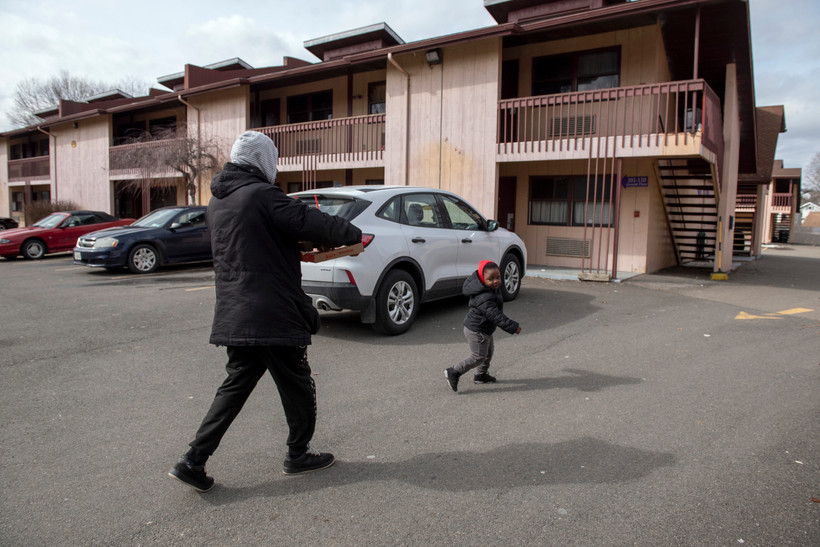
An adult and child wearing winter coats walk across a motel parking lot with three cars parked in it. The child is smiling and turns back to look at the adult, who is facing away from the camera.
New York state has been moving unhoused families into hotels and motels instead of shelters. Shatara Cook and her 2-year-old son, Chance, stayed in the Knights Inn in Endwell last February when they were unhoused. | Michelle Gabel/ProPublica

This article was produced in partnership with ProPublica.

Sign up for Staying Focused, our newsletter keeping readers up to speed on New York politics.

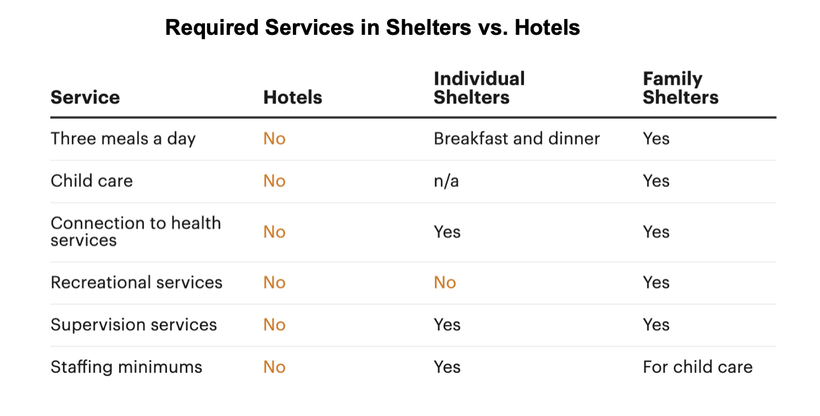
New York state may soon guarantee homeless families placed in hotels the same services as those in shelters, including help finding housing, meals and child care.

The proposal from the Office of Temporary and Disability Assistance follows a New York Focus and ProPublica investigation that found hotels have become the state’s predominant response to homelessness outside of New York City. Counties had placed tens of thousands of adults and children in often-dilapidated hotels, the investigation found, and many people have been cut off from the services promised by the shelter system.

The proposed regulations, published Wednesday, will go through a 60-day public comment period before OTDA, which oversees county social services offices, decides whether to adopt, change or drop them. Each county would be required to submit plans for delivering the support services as soon as the rules are adopted. Counties would also have to enforce limits on overcrowding and ensure that children don’t have to share beds with adults.

“Everyone placed in emergency housing really should have a fair shot at stability no matter where they’re staying. And so I definitely believe that the state needs to consider and make [the rule change] a priority,” said Democratic Assemblymember Michaelle Solages, chair of her chamber’s committee on local governments and a member of the social services committee.

OTDA first outlined new rules for hotel placements on its agenda about five years ago, but they languished there. In response to questions from New York Focus and ProPublica last year, OTDA Commissioner Barbara Guinn said she couldn’t “provide insight” on why the agency never formally proposed the rules.

New York Focus and ProPublica interviewed families placed in hotels across the state who said that they weren’t receiving the services that they needed to get out of homelessness. None of the families said that they had received child care, not even those who have children with special needs. Many struggled to feed themselves and were placed in decrepit locations where children and parents slept four or more to a bed.

Note: Requirements are for hotels outside of New York City. New York regulations state that hotels can be considered shelters, and thus mandated to provide services. But there aren't any that are currently required to do so, Office of Temporary and Disability Assistance spokesperson Anthony Farmer said. Source: New York Codes, Rules, and Regulations. | Lucas Waldron/ProPublica


Despite the lack of services, hotels and motels frequently charged rates far exceeding market rent. Statewide spending on hotel stays outside of New York City topped $110 million in 2024, the investigation found, and more than tripled over six years as the number of hotel placements went up. Counties often shoulder the majority of the bill for families.

An OTDA spokesperson said that many counties already provide services to people in hotels.

Robert Henke, chairman of the Washington County Board of Supervisors, said his upstate county was one of them. The greater burden, he said, is the cost of hotel stays, which contributed to a county budget crisis and funding cuts. Due to an overwhelming surge in homelessness, spending on hotels leaped from $579,000 to over $1.9 million between 2023 and 2024, according to data obtained through public records requests.

While the new rules don’t directly address these costs or how they’re split among government agencies, OTDA’s proposal noted that with additional support, families may not have to stay in the hotels as long, potentially cutting down on expenses.

The agency also said it should cost counties less than $120,000 each to implement the new rules if they haven’t already. Brian Kavanagh, a Democratic state senator representing lower Manhattan and a member of the social services committee, said that he would work to pull together whatever resources are needed to implement the regulations, if they are adopted.

Solages said she hopes the new rules will connect families to the help they need. “I hope that we can start expediting this,” she said, “because it’s not only very expensive to do temporary housing via hotels, but a hotel is not a proper place for a family.”

At New York Focus, our central mission is to help readers better understand how New York really works. If you think this article succeeded, please consider supporting our mission and making more stories like this one possible.

New York is an incongruous state. We’re home to fabulous wealth — if the state were a country, it would have the tenth largest economy in the world — but also the highest rate of wealth inequality. We’re among the most diverse – but also the most segregated. We passed the nation’s most ambitious climate law — but haven’t been meeting its deadlines and continue to subsidize industries hastening the climate crisis.

As New York’s only statewide nonprofit news publication, our journalism exists to help you make sense of these contradictions. Our work scrutinizes how power works in the state, unpacks who’s really calling the shots, and reveals how obscure decisions shape ordinary New Yorkers’ lives.

In the last two decades, the number of local news outlets in New York has been nearly slashed in half, allowing elected officials and powerful individuals to increasingly operate in the dark — with the average New Yorker none the wiser.

We’re on a mission to change that. Our work has already shown what can happen when those with power know that someone is watching, with stories that have prompted policy changes and spurred legislation. We have ambitious plans for the rest of the year and beyond, including tackling new beats and more hard-hitting stories — but we need your help to make them a reality.

If you’re able, please consider supporting our journalism with a one-time gift or a monthly gift. We can't do this work without you.

Thank you,

Akash Mehta
Editor-in-Chief
A photo of Akash Mehta.
Spencer Norris is an investigative reporter covering homelessness for New York Focus and ProPublica’s Local Reporting Network. He has exposed deficiencies in opioid treatment in New York’s jails and prisons, as well as a treatment desert spanning most of upstate. Spencer previously worked… more
Also filed in New York State

At a Board of Regents meeting Monday, state officials proposed eliminating credit-based diploma requirements.

The last-minute influx, the biggest ever for a legislative primary, is boosting her opponent, Jessica González-Rojas.

City budget gaps and an ambitious affordability agenda may require pressing Albany again for taxes and aid.

Also filed in Housing

In May, state lawmakers passed a $269 billion budget after haggling for months over thousands of line items and policies affecting New Yorkers.

Some of the city’s new aid will be canceled out by pension boosts.

A law designed to protect the environment will be partially rolled back to pave the way for much-needed homes.

Also filed in Social Services

We’ve compiled information for the 450,000 New Yorkers who will lose health care coverage on July 1.

New York state has pumped millions of taxpayer dollars into an online portal that vowed to make life easier for Rochester’s neediest, but critics say it’s fallen short.

We’ve compiled information for SNAP recipients in New York on the changing work requirements.