New York Essential Plan Users Worry: Am I Losing Coverage?

Unclear notices have left participants unsure about the status of their insurance and what steps to take next.

Jie Jenny Zou   ·   June 26, 2026
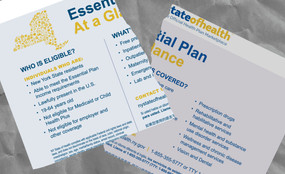
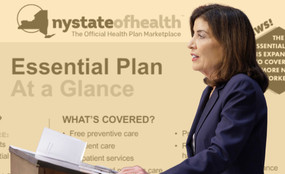
An illustration showing the New York State of Health logo and paperwork bearing several messages around essential plan eligibility and plan termination.
Health care advocates say the state’s delayed and unclear messaging strategy around the Essential Plan changes has fostered confusion and done little to prepare New Yorkers for the seismic shift in healthcare access. | Images: New York State of Health | Illustration: Leor Stylar

Sign up for Staying Focused, our newsletter keeping readers up to speed on New York politics.

Christina Hauptman felt relieved when her 19-year-old son, Cody, got approved for New York’s Essential Plan. The flagship program provides free or low-cost health care to over 1.7 million New Yorkers ineligible for Medicaid.

“This was wonderful,” she thought, when they received the welcome notice in March that said Cody would be covered through 2026. She had been scrambling to figure out a solution before he aged out of Child Health Plus, the state’s health care program for children who are 18 and under. 

But a month later, Hauptman logged into her state health account, where a message explained Cody would be among the hundreds of thousands of New Yorkers whose coverage would be terminated on July 1 as a result of federal cuts. Adding to the confusion, Cody’s insurance company hadn’t updated its system to reflect the upcoming change.

Similar situations have been playing out across New York as the state prepares to shed an estimated 450,000 residents who earn between 200 to 250 percent of the federal poverty level off the Essential Plan. Tightened eligibility criteria will also end coverage for some people defined by the federal government as lawfully present immigrants and who earn even less.

Health care advocates say the state’s delayed and unclear messaging strategy around the Essential Plan changes has fostered confusion and done little to prepare New Yorkers for the seismic shift in health care access.

Arlene Cruz Escobar, director of health programs at Make the Road New York, said the group was receiving many calls from recipients who seemed stressed and anxious. “It’s going to be a disaster,” she said.

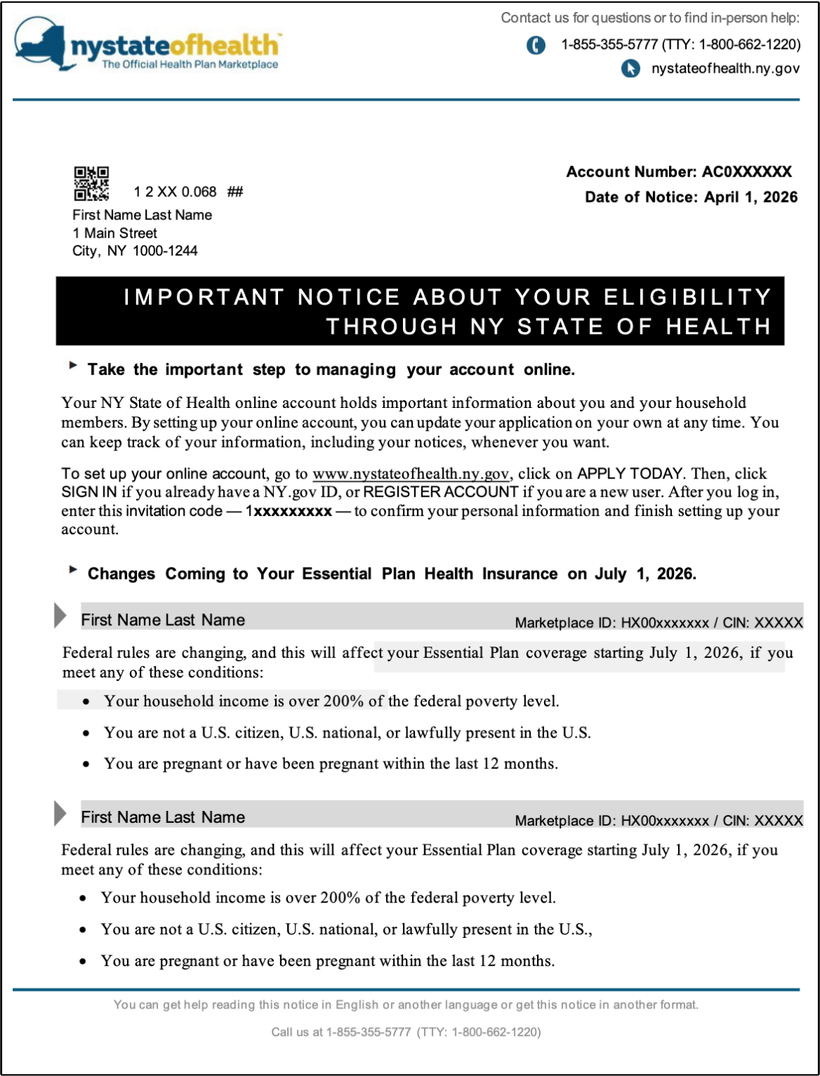
She said her staff is hearing from frantic families confused by the termination notices — some of them several pages long and filled with language that could be misleading. She pointed to a sentence in the first April notice which reads, “You don’t need to do anything unless your personal situation has changed,” which may have mistakenly given impacted users the impression that their coverage was not at risk or dissuaded them from seeking additional information.

Advocates like Cruz Escobar have been urging the state to act quickly to avert the coverage cliff since last summer, but top legislators tabled the issue — pledging to address the matter during annual budget negotiations that started in January. A delayed state budget was finally unveiled in late May, but failed to include proposals supported by a coalition of lawmakers to use state funds to keep these New Yorkers insured and make plans available for purchase on the state’s health care exchange more affordable. 

New Yorkers with questions about their coverage should contact the New York State of Health’s call center at 1-855-355-5777 to connect with an assistor. New York City residents who need help navigating the marketplace can also connect with a local enrollment counselor by calling 347-665-0214.

In an interview, Danielle Holahan, executive director at New York State of Health, the state-run insurance marketplace, acknowledged that the state’s messaging strategy could be improved. “We agree, they’re not written in plain language,” she said of plan notices that went out in April and May and were required to contain specific legal information. 

She said the department is continuing to work on simplifying additional notices and has been trying to ensure they reach impacted users on multiple platforms such as emails and text messages. The department also recently wrapped up training for their network of assistors who will be contacting impacted New Yorkers about how to buy insurance from the state’s health care exchange website.

Holahan also acknowledged that the overall timing of the notices has been complicated by delayed action from the federal government and a drawn-out state budget process. When the state first learned of the federal cutbacks last year, health officials devised a strategy to retool the Essential Plan — averting a worse-case scenario that could have ended the program entirely for all 1.7 million New Yorkers. After months of delay amid a federal government shutdown, the state finally secured approval to move forward with a scaled-back version of the Essential Plan in late March 2026

“It was making the best of a very bad situation for New York,” Holahan said of the now scaled-back Essential Plan. She also noted that health officials had been following the state budget process closely to see whether any changes would be made for the Essential Plan. “There’s been a lot of moving parts.”

Earlier this month, Hauptman was able to transfer Cody — who struggles with mental health issues — to Medicaid. She currently works as a family peer advocate on Long Island, helping other families navigate mental health challenges. 

“It’s going to be a disaster.” 

—Arlene Cruz Escobar, director of health programs, Make the Road New York

Hauptman, a single mother, said that adding Cody to her current employer-provided coverage or purchasing a plan on the state’s health care exchange are both out of reach financially. She is now considering relocating to a city with a lower cost of living or finding a new job that provides more affordable employer-sponsored health care plans. 

Cruz Escobar urged the state to ramp up its awareness campaign around Essential Plan terminations, use plain and easier-to-understand language, and include case-specific information in notices and other tools like state websites that clearly spell out how much marketplace plans could cost every month based on household income.

“This is a really big learning curve for families; there needs to be a lot more education,” said Cruz Escobar, who previously worked as a health care navigator and routinely spent hours with clients explaining concepts like deductibles, coinsurance and co-pays. “Many people are going to be caught off guard because, maybe for the first time, they’ll have to purchase private insurance. That’s a whole different experience on how to utilize that coverage.”

Getting the message fully across to impacted clients like Doris Velasquez has been a hurdle. Velasquez works as a home attendant and relies on the plan to manage her high blood pressure and migraines, chronic health conditions that have previously landed her in the emergency room. Her diabetic husband and college-age son are also covered by the Essential Plan — all three are slated to lose their coverage in July. 

Like many Essential Plan users, the family was previously covered under Medicaid and shifted to the Essential Plan three years ago as their household income grew. Speaking through a Spanish translator, Velasquez told Focus she understands their coverage is ending, but is unsure whether her family can afford to buy insurance and isn’t sure what to do next.

Cruz Escobar said her staff have been helping clients navigate the state’s marketplace, only for clients to be discouraged by costly monthly premiums and high deductibles. Eligibility for tax credits that reduce the cost of monthly premiums depends on projected household income — math that can get complicated for gig workers and later result in an IRS bill during tax season. “A lot of people in these income levels are people who have multiple jobs and multiple part-time jobs or who bounce around from job to job and their income is inconsistent,” she said.

A termination notice from New York State of Health regarding Essential Plan coverage. | New York State of Health


State health officials acknowledged that it is common for household income to fluctuate throughout the year for many on the Essential Plan, meaning a monthly premium can be hard to meet during specific months, and coverage might change when participants recertify their income if they shift across different tiers. They estimate impacted Essential Plan users will be eligible for a state exchange plan with an average monthly premium of $250 after tax credits and a deductible of $2,150. By comparison, the Essential Plan has no monthly premiums and no deductibles.

Holahan said that the department’s current projections indicate anywhere from 150,000 to 200,000 impacted Essential Plan users will be unable to buy insurance or get coverage through their employers and therefore will remain uninsured. But other estimates anticipate far more severe outcomes — the progressive think tank Fiscal Policy Institute predicts fewer than 70,000 of the roughly 450,000 impacted users will be able to buy insurance, leaving the vast remainder uninsured.

Sam, a 40-year-old artist and dog trainer in Queens, is still unclear on the status of her Essential Plan coverage. She received a notice last year from the state, warning that her coverage might be at risk in 2026 due to upcoming federal changes, but said she never received any follow-up message. When she called the state and her insurer earlier this year, she was told she would be unaffected by the July termination. 

Are you one of the hundreds of thousands of New Yorkers impacted by the coverage cliff for Essential Plan users? Our social services reporter wants to hear from you. Email Jie Jenny Zou at jenny@nysfocus.com

But Sam isn’t sure that’s true. Her health card, issued earlier this year, suggests she falls within the impacted income tier, but other notices from the state indicate she might be in the tier just below that, which would spare her from disenrollment. She asked that her last name not be published for fear of drawing the state’s attention to her case. 

“I didn’t have health insurance for pretty much my entire twenties,” said Sam. “That would be a real burden if that went away,” she said of her Essential Plan coverage, which helps her access preventative care and stay up-to-date on allergy appointments. 

Pete Tomao, communications director at Empire State Voices, a group that advocates for working New Yorkers, said he has encountered several people like Sam who are unclear where they stand. “We’re hearing from residents across the state who don’t know if they’ll keep their coverage — or how they’d afford care without it. Some have been told their Essential Plan remains intact, while others were warned just months ago they could lose it, leaving thousands of families in limbo.”

Holahan encourages all impacted New Yorkers to review their options on the state’s health care exchange as soon as possible. Impacted Essential Plan users will be able to purchase a plan on the New York State of Health website through the end of August. 

She also noted that any coverage purchased this summer will be retroactive and backdated to July 1, so New Yorkers who purchase a plan will not face a coverage gap and can take their time to sort through the myriad of options available.

At New York Focus, our central mission is to help readers better understand how New York really works. If you think this article succeeded, please consider supporting our mission and making more stories like this one possible.

New York is an incongruous state. We’re home to fabulous wealth — if the state were a country, it would have the tenth largest economy in the world — but also the highest rate of wealth inequality. We’re among the most diverse – but also the most segregated. We passed the nation’s most ambitious climate law — but haven’t been meeting its deadlines and continue to subsidize industries hastening the climate crisis.

As New York’s only statewide nonprofit news publication, our journalism exists to help you make sense of these contradictions. Our work scrutinizes how power works in the state, unpacks who’s really calling the shots, and reveals how obscure decisions shape ordinary New Yorkers’ lives.

In the last two decades, the number of local news outlets in New York has been nearly slashed in half, allowing elected officials and powerful individuals to increasingly operate in the dark — with the average New Yorker none the wiser.

We’re on a mission to change that. Our work has already shown what can happen when those with power know that someone is watching, with stories that have prompted policy changes and spurred legislation. We have ambitious plans for the rest of the year and beyond, including tackling new beats and more hard-hitting stories — but we need your help to make them a reality.

If you’re able, please consider supporting our journalism with a one-time gift or a monthly gift. We can't do this work without you.

Thank you,

Akash Mehta
Editor-in-Chief
A photo of Akash Mehta.
A photo of Jie Jenny Zou.
Jie Jenny Zou covers social services and public benefits for New York Focus. She previously worked as an investigative reporter at the Los Angeles Times and the Center for Public Integrity where she delved into topics ranging from environmental health and worker safety… more
Also filed in New York State

On the heels of a “Back to Basics” reading effort, New York is launching a similar initiative for math.

The DSA made gains in New York despite super PACs spending $9.6 million in state legislative races — nearly five times the total from 2024.

At a Board of Regents meeting Monday, state officials proposed eliminating credit-based diploma requirements.

Also filed in Health

In May, state lawmakers passed a $269 billion budget after haggling for months over thousands of line items and policies affecting New Yorkers.

160,000 injured New Yorkers seek workers’ compensation each year — but in recent years, regulators have tilted the scales towards employers and insurers.

Amid abortion bans and rising digital surveillance, Albany lawmakers are revisiting an effort to stop companies from selling sensitive health information.

Also filed in Social Services

New York state has pumped millions of taxpayer dollars into an online portal that vowed to make life easier for Rochester’s neediest, but critics say it’s fallen short.

We’ve compiled information for SNAP recipients in New York on the changing work requirements.

The Hochul administration now has a chance to relax New York’s child care staffing ratios — among the country’s strictest — after 26 years. But will it?

Also filed in Affordability

Governor Kathy Hochul was successful in her bid to upend the Climate Leadership and Community Protection Act after legislators caved to finalize an overall budget deal.

New rules could result in thousands of New Yorkers losing their food benefits this summer.