In Brief: New York’s Essential Plan

Massive changes are coming to the state’s comprehensive, low-cost healthcare plan.

Jie Jenny Zou   ·   September 26, 2025
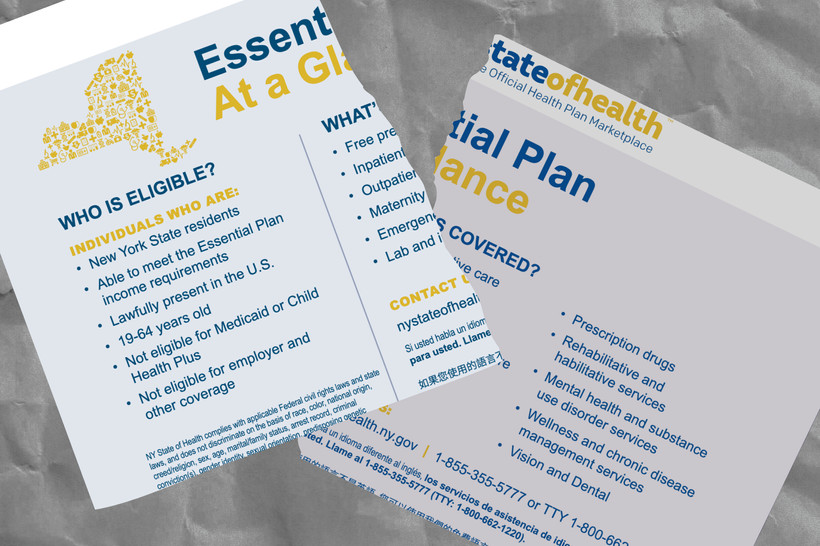
The Essential Plan has enabled New York to offer near-universal health insurance coverage — but hundreds of thousands of people on the plan could soon be dropped. | Card: NY State of Health | Illustration: Leor Stylar

Sign up for Staying Focused, our newsletter keeping readers up to speed on New York politics.

More than 95 percent of New Yorkers have health insurance. That’s thanks to the state’s aggressive efforts over the past 15 years to expand access to free or low-cost care with federal subsidies from the Affordable Care Act.

But starting next year, federal changes to Medicaid funding passed by President Donald Trump could result in hundreds of thousands of New Yorkers losing their coverage — including many enrolled in a program called the Essential Plan that has been key to the state’s success in near-universal coverage.

Governor Kathy Hochul’s administration has requested federal approval for a maneuver that could allow New York to keep offering health insurance to roughly three-quarters of those currently on the Essential Plan. But even if the effort succeeds, the remaining 450,000 people could still lose coverage.

Here’s what you need to know.

Who’s Covered Under the Essential Plan?

New York went farther than most states when it created the Essential Plan in 2016 with funding from the Affordable Care Act (ACA). The plan, with no monthly premiums and no deductibles, has grown to cover 1.7 million New Yorkers — including some 725,000 legal immigrants —who don’t get insurance through their employer and aren’t eligible for Medicare or Medicaid.

In 2024, the state received federal permission to expand eligibility for the Essential Plan to 450,000 New Yorkers in households making up to 250 percent of the federal poverty line ($39,125 a year for a single adult or $80,375 for a family of four). Before this change, the Essential Plan was limited to those earning up to 200 percent of the federal poverty level.

Medicaid covers an additional 7 million New Yorkers, but its income eligibility cutoff for most recipients is much lower. Federal law also limits Medicaid eligibility to citizens, permanent legal residents who have held their green cards for at least five years, and certain humanitarian immigrants like refugees, asylum seekers and trafficking victims.

The federal government picks up nearly all the costs for the Essential Plan, unlike Medicaid, whose costs are shared by local, state and federal government.

Contrary to a popular myth, undocumented immigrants are not eligible for either Medicaid or the Essential Plan. Legal immigrants, however, are estimated to make up more than 40 percent of the state’s 1.7 million Essential Plan enrollees.

What’s Changing?

In July, Congress cut federal funding for Medicaid by nearly $1 trillion over the next decade. One of the most immediate and expensive changes for New York takes effect January 1, when the federal government will eliminate an estimated $7.5 billion in annual support for certain legal immigrants enrolled in the Essential Plan.

New York has long offered health insurance to legal immigrants that aren’t eligible for federal Medicaid dollars. That’s because of a 2001 court case, Aliessa v. Novello, in which the state Court of Appeals ruled that denying Medicaid benefits to otherwise eligible legal aliens violated the state’s constitution. As a result, the state was required to provide Medicaid benefits to permanent residents who had held green cards for less than five years and those permitted to remain in the US through programs like the U Visa or DACA. However, since these immigrants weren’t eligible for federal funding, state and local governments had to pick up the tab.

That changed in 2016 with the creation of the Essential Plan, when federal funding became available for this group for the first time under the Affordable Care Act.

Now, impending federal budget cuts could force the state to pick up the tab again.

A host of other changes to Medicaid such as new work rule requirements, more frequent renewals, and out-of-pocket charges will roll out in phases starting in late 2026 and extend into 2028.

The new law is also expected to significantly increase the cost of healthcare plans available for purchase by individuals on the state marketplace. According to Governor Kathy Hochul, average premiums statewide are expected to rise by nearly 40 percent.

What Can the State Do?

The new federal law will ultimately force New York to make tough decisions about how much it’s willing to spend to keep near-universal coverage.

Earlier this month, Hochul filed a request seeking federal approval for the state to revert to the Basic Health Plan, which provides coverage to those earning up to 200 percent of the federal poverty level. This would undo the state’s recent 2024 expansion of the Essential Plan, which added 450,000 New Yorkers that earn up to 250 percent of the federal poverty level.

If approved, the maneuver would retain coverage for 1.3 million out of the 1.7 million New Yorkers currently enrolled in the Essential Plan, including 725,000 immigrants. Of those, 500,000 are “Aliessa immigrants,” covered by the 2001 court ruling.

This option would not only allow the state to avoid using its own funds to cover the Aliessa immigrants — which was estimated to cost the state $2.7 billion annually — but would also give it access to a trust fund containing up to $10 billion.

That trust fund grew from 2016 to 2023 as a result of a quirk in federal regulations governing reimbursement for the Essential Plan. With federal approval, the trust fund could be used to cover a wide array of eligible expenses and cushion the blow of other funding changes as a result of the new law.

If approved before the end of this calendar year, the request would also provide the state with a nine-month window to implement changes. This wind-down period means New Yorkers currently enrolled in the Essential Plan would remain covered on that plan through the end of June, buying the state time to adjust.

“What the governor has put forward would provide the state with a glide path,” said Elisabeth Wynn of the Greater New York Hospital Association, noting that the maneuver averts some of the most disastrous and immediate impacts of the new law.

But Wynn urged state leaders to do whatever they can to cover the 450,000 New Yorkers currently on the Essential Plan who will likely go uninsured next year, due to slightly higher income levels that make them ineligible for federal funding.

Wynn noted that those dropped from the Essential Plan will likely not earn enough to afford healthcare purchased through the state marketplace. New York’s monthly premiums for marketplace plans are among the most expensive nationwide, running from a low of $605 for a basic bronze-rated plan to over $1,000 for a more robust gold-rated option in 2025.

“This is the first of many hard decisions that are going to be forced upon the state,” Wynn said of the new law.

Editor's Note 10/16: A photo caption in this story has been updated to clarify the scope of pending changes to the Essential Plan.

At New York Focus, our central mission is to help readers better understand how New York really works. If you think this article succeeded, please consider supporting our mission and making more stories like this one possible.

New York is an incongruous state. We’re home to fabulous wealth — if the state were a country, it would have the tenth largest economy in the world — but also the highest rate of wealth inequality. We’re among the most diverse – but also the most segregated. We passed the nation’s most ambitious climate law — but haven’t been meeting its deadlines and continue to subsidize industries hastening the climate crisis.

As New York’s only statewide nonprofit news publication, our journalism exists to help you make sense of these contradictions. Our work scrutinizes how power works in the state, unpacks who’s really calling the shots, and reveals how obscure decisions shape ordinary New Yorkers’ lives.

In the last two decades, the number of local news outlets in New York has been nearly slashed in half, allowing elected officials and powerful individuals to increasingly operate in the dark — with the average New Yorker none the wiser.

We’re on a mission to change that. Our work has already shown what can happen when those with power know that someone is watching, with stories that have prompted policy changes and spurred legislation. We have ambitious plans for the rest of the year and beyond, including tackling new beats and more hard-hitting stories — but we need your help to make them a reality.

If you’re able, please consider supporting our journalism with a one-time gift or a monthly gift. We can't do this work without you.

Thank you,

Akash Mehta
Editor-in-Chief
A photo of Akash Mehta.
A photo of Jie Jenny Zou.
Jie Jenny Zou covers social services and public benefits for New York Focus. She previously worked as an investigative reporter at the Los Angeles Times and the Center for Public Integrity where she delved into topics ranging from environmental health and worker safety… more
Also filed in New York State

A bill awaiting the governor’s signature would relax restrictions on who can qualify for victim compensation.

We’ve compiled information for the 450,000 New Yorkers who will lose health care coverage on July 1.

A lobbyist who has been romantically linked to Assembly Speaker Carl Heastie led a rally opposing the legislation a week before the speaker declined to bring it to a vote.

Also filed in Health

In May, state lawmakers passed a $269 billion budget after haggling for months over thousands of line items and policies affecting New Yorkers.

Despite last-ditch efforts by a coalition of lawmakers, the state failed to avert a health coverage cliff coming this summer.

160,000 injured New Yorkers seek workers’ compensation each year — but in recent years, regulators have tilted the scales towards employers and insurers.

Also filed in Explainers

We’ve compiled information for SNAP recipients in New York on the changing work requirements.

We answer your questions on the state’s notoriously opaque budget process.

Amid abortion bans and rising digital surveillance, Albany lawmakers are revisiting an effort to stop companies from selling sensitive health information.

Also filed in Social Services

New York state has pumped millions of taxpayer dollars into an online portal that vowed to make life easier for Rochester’s neediest, but critics say it’s fallen short.

The Hochul administration now has a chance to relax New York’s child care staffing ratios — among the country’s strictest — after 26 years. But will it?

New rules could result in thousands of New Yorkers losing their food benefits this summer.