ICE and Border Patrol Are Picking Off These Tomato Plant Workers

Immigration agents charged with boosting arrests are targeting a Sungrow greenhouse and packing facility 20 miles outside of Rochester, prompting workers to flee.

Isabelle Taft   ·   July 27, 2026
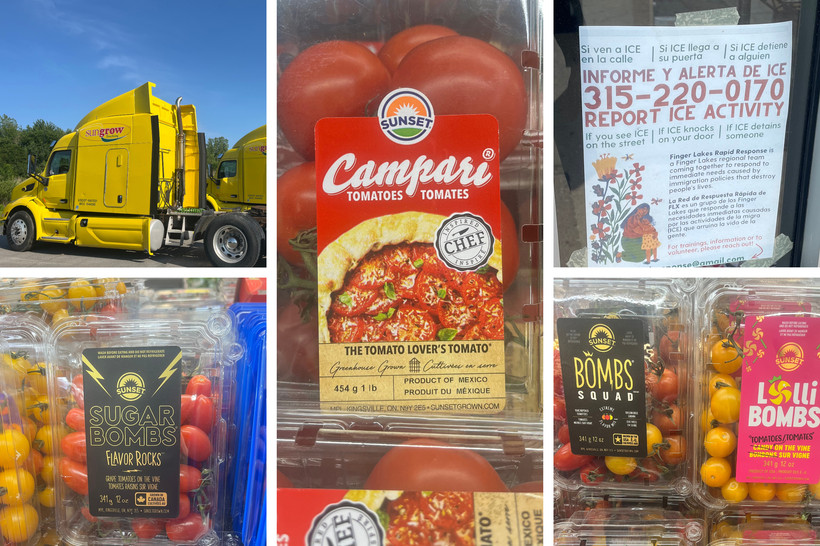
A photo collage shows multiple packages of tomatoes from the brand Mastronardi, as well as a yellow Sungrow truck and a flier taped in a window with a number to report ICE activity in Spanish and English.
A wave of immigration arrests has transformed life for agricultural laborers across western New York. | Photos: Isabelle Taft / New York Focus | Collage: Leor Stylar

Sign up for Staying Focused, our newsletter keeping readers up to speed on New York politics.

Immigration agents are stalking the workers of the Sungrow tomato greenhouse and packing plant in Ontario, New York. They have lurked in the parking lot in unmarked cars before dawn. They have shown up at the motel where many of the workers were staying. Since mid-June, they have arrested at least six people near the plant in a kind of slow-motion raid that has drawn little public outcry but upended life for dozens of immigrants who work in this corner of western New York, where the Rochester suburbs give way to farmland.

“They were like alligators. They swooped in and devoured them,” said one of the plant workers.

Area residents say the arrests are part of the largest wave of immigration enforcement activity they’ve seen in recent memory. For workers, driving is now a gamble. Even the five-minute trip from the plant to their motel has become risky.

Similar arrests have transformed life for agricultural laborers across western New York. Agents have ramped up operations in the region as Immigration and Customs Enforcement recently increased its national arrest target to 2,000 per day. They have searched farms, arrested dairy workers leaving Latin American grocery stores, and pulled over vans of roofers, in one case sending several men fleeing into the woods. Fear has prompted workers to either leave the area or go into hiding.

At the tomato plant, the most recent arrest took place on July 8, when Border Patrol agents trailed two cars of laborers to the motel after they left work. The occupants got out and fled, but agents arrested one of them, a Venezuelan man. A spokesperson for US Customs and Border Protection said he had been ordered deported in 2023 and had a “criminal record” but declined to share additional details.

Marialice Rodriguez, who was riding in one of the cars, said that after she got out, an agent pointed a pistol at her chest. “I said, ‘Please don’t shoot me, I am an American,’” she said.

The spokesperson confirmed that the agent pointed a gun at Rodriguez. “Once the individual was identified as a U.S. citizen and posed no threat, the agent lowered their weapon,” he said.

After the arrest, workers staying at the motel spent the rest of the night trying to figure out what to do. Some bought bus tickets out of Rochester. The next morning, the motel’s owner, Chandrakanth Patel, told New York Focus that most of the workers staying there had fled. Fewer than half of the plant’s roughly 120 workers showed up for their shift that day, said one employee, who asked to be identified as J to avoid retaliation by immigration authorities.

“They are targeting anyone,” he said.

“They were like alligators. They swooped in and devoured them.”

—Tomato plant worker

An ICE spokesperson said in a statement that its enforcement at workplaces targets “illegal employment networks that undermine American workers” and “remains a cornerstone of ICE’s efforts to protect public safety, national security, and economic stability.”

The targeted workers say authorities are harassing the lifeblood of the region’s agricultural economy. Many of those who remain are indignant.

“The engine of this company is the immigrant,” said a tomato plant worker in her 60s who said she has a work permit. “They make money for this country.”

The day after the most recent arrest, those who hadn’t fled worked from 5 am until 6 pm, praying they’d make it home at the end of their shifts. The tomato vines in the greenhouse had to be pruned. The newly ripe fruit had to be examined for blemishes and packaged into plastic containers labeled “FLAVOR BOMBS.” The containers had to be loaded onto trucks for distribution to Tops and Wal-Mart stores. If the work stopped, the tomatoes would rot.

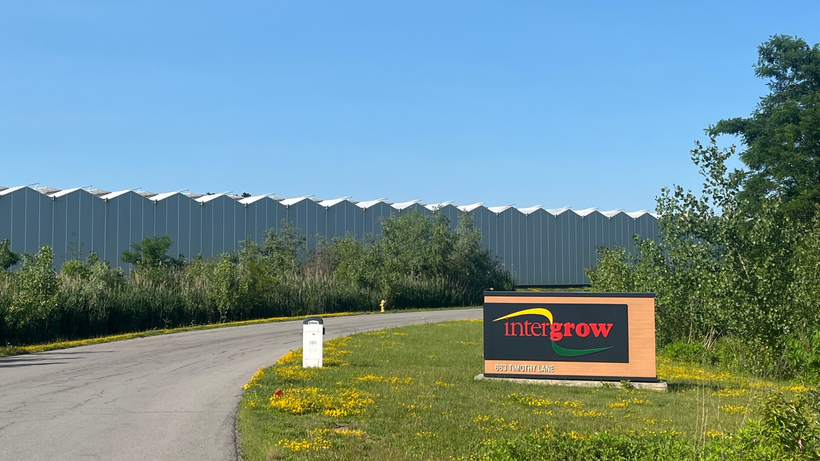
Entrance to the Sungrow tomato plant.
Entrance to the Sungrow tomato plant. | Isabelle Taft/New York Focus


To reach the tomato plant, turn off Route 104 and wind through a quiet industrial park, past a sheet metal manufacturer and a trucking depot where a Charlie Kirk memorial emblazoned on a big rig declares, “Legends Never Die.” At the end of the road, translucent, gabled greenhouses loom behind scrubby trees.

A company called Intergrow built the facility nearly a decade ago, and in 2023, Mastronardi Produce, the biggest greenhouse produce grower in the country, acquired it. Workers at the plant estimated that half or more of the employees are Latino immigrants from Venezuela, Guatemala, Mexico, Ecuador, and elsewhere. Many are hired through labor contractors that also coordinate their housing in local hotels or apartments.

Some tend the hydroponic plants in the greenhouse, harvesting cherry and beefsteak tomatoes in hot temperatures. Others work in the packhouse, preparing the tomatoes for delivery to grocery stores. They wear hairnets and thick black rubber gloves to shield their hands from chemicals. They weigh the tomatoes and set them on trays to be vacuum sealed, with the vines still attached to signal their freshness to supermarket browsers.

J, who has worked at the plant for about five years, said he couldn’t recall ICE arresting its workers before this year. Then, in mid-June, agents arrested a man as he was heading home from work for the day. They soon arrested two other workers nearby.

Supervisors at the plant assured the workers that ICE was only targeting those three laborers and wouldn’t return, a former worker named Nando told New York Focus. So Nando kept going to work, though he didn’t have legal authorization to do so. During his 15 months at the company, he had moved up from working as a packer to handling a machine that unloaded boxes of tomatoes from the greenhouse. He liked the work because he did it mostly on his own, and his machine ran at a set speed, so no one could tell him to hurry up.

About a week after the first arrests, Nando finished his shift and got in his car to head home with his wife and another couple. As he pulled out of the parking lot, he noticed unmarked vehicles idling near the exit. He suspected it was ICE. He drove the speed limit, he said, trying to stay calm as they followed him. When they flashed their lights, he pulled to the side of the road. A man in civilian clothes came up to the driver’s window.

“Just getting off work?” the agent asked in Mexican-accented Spanish, Nando recalled. “Yep, just fighting to make a living as always,” he replied. Then the agent asked: “Do you have permission to be here?”

Nando offered his New York driver’s license, but the agent said it was no good and told him to get out of the car. When he hesitated, the agent threatened to break the glass, Nando said. The agents arrested him and the other man and let their partners leave in the car.

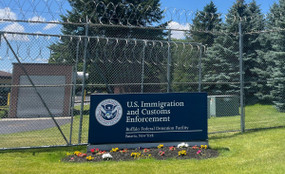
ICE took Nando to the Buffalo Federal Detention Facility, then to a detention center in Louisiana, before deporting him and the other man to Guatemala in early July.

Now home with his parents in a rural area without cell service, Nando is trying to keep in touch with his wife and figure out what to do next. His WhatsApp profile picture still shows him smiling in front of a fountain in Rochester.

“I’m trying to adjust,” he said. “I haven’t managed to find a way to make a living here yet. I don’t feel that great, but I’m trying to find a way to adapt, since this is my country.”

The tomato plant arrests represent a small proportion of ramped-up ICE and Border Patrol activity in western New York and the Finger Lakes since late May, according to interviews with five immigrant rights advocates, all of whom described increased enforcement.

“They’re here, hiding, as if surveilling the Latinos who go out to the store, to cash a check, to send money to their families,” said a longtime community advocate who asked not to be identified to avoid drawing attention to the undocumented immigrants with whom he works. The advocate, who immigrated to upstate New York in the early 2000s, said the presence of federal immigration agents was more pronounced in June than at any point he could remember.

Melina Ivanchikova, a founding member of the Finger Lakes Rapid Response Network, which works to protect immigrants, said the recent arrests have largely involved ICE agents pulling people over as they drive major highways or leave Latin grocery stores. The pattern contrasts with one of the region’s highest-profile ICE raids, at a nutrition bar factory outside of Syracuse last year, which resulted in the detention of 57 people and drew condemnation from Governor Kathy Hochul.

Ivanchikova describes the recent activity as a different tactic. “Maybe they’re trying to just pick people off in a way that won’t cause a ruckus, and not do a big flashy workplace raid that riles up the public, but just take people silently one by one,” Ivanchikova said.

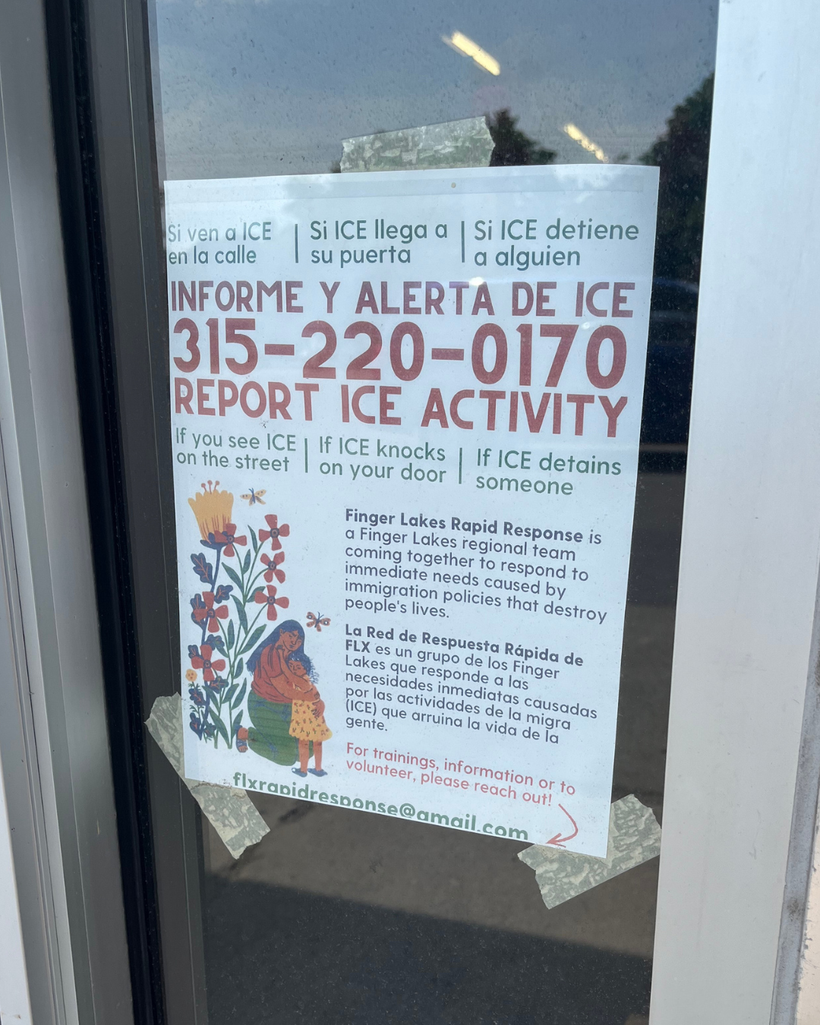
Immigrants and volunteers warn one another about potential ICE activity. | Isabelle Taft/New York Focus

The quiet operations have stoked anxiety among immigrants and volunteers, who try to warn one another about potential ICE activity. They now see any vehicles, especially US-made SUVs and pickup trucks, as potential threats.

“They’re afraid to leave here,” one tomato plant worker said on a recent evening as he waited near the facility’s glass doors. He gestured across the parking lot toward the road, where ICE had pulled over and arrested several of his fellow workers.

The worker was waiting for Anthony Rosas, who works for a labor contractor and gives workers rides to and from the plant. He used to pick them up in a large white van, but immigration agents began targeting white vans, he said, so he swapped it out for a more discreet passenger vehicle. Rosas said he now keeps an eye out for cars with tinted windows. He makes extra turns if another car follows behind him for too long.

“It’s literally like Jason Bourne-type mode,” he said. “You gotta be on the lookout.”

As Rosas pulled up to the tomato plant, about 10 workers rushed toward him, all hoping to claim a seat. The new vehicle didn’t have enough room for everyone, so four workers trudged back across the parking lot, clutching backpacks and lunch boxes, some still wearing their hairnets. They sat down at picnic tables in the late June evening sun and settled in for the hour it would take for Rosas to return.

“Maybe they’re trying to just pick people off in a way that won’t cause a ruckus.”

—Melina Ivanchikova, Finger Lakes Rapid Response Network

One woman whose brother was recently detained as he left a Latin grocery store in Cayuga County insisted that the men who arrested him were not federal agents but bounty hunters. From detention, he told her that the men followed him in his car, then flashed their lights to get him to pull over. When he did, they asked for his ID and social security card. He was reluctant to give them his driver’s license, because they didn’t look like law enforcement.

ICE told New York Focus that “all immigration arrests are made by sworn federal law enforcement,” not private contractors. The spokesperson said agents always wear a badge and verbally identify themselves as law enforcement, even when wearing civilian clothes.

The ICE activity has led many immigrants in the region to limit their travel as much as possible. Volunteers are dropping off groceries and escorting people to medical appointments

“Workers don’t really leave much anymore,” said Jessica Maxwell, executive director of the Workers’ Center of Central New York, a nonprofit that organizes low-wage, mostly immigrant workers. Some farm owners have even asked their employees not to leave the property, she said.

At the Hernandez Mexican Store in Sodus, about 20 minutes east of the tomato plant, an employee named Melissa said there had been days recently when almost no one came to shop. She pulled up a video on her phone showing several men frantically sprinting out of a white van and across a grassy slope toward a forest, federal agents in green chasing behind them.

“It was all over social media,” she said. That same day, June 23, she heard about arrests at a farm, along Highway 88, and at the tomato plant.

Wayne County Sheriff Robert Milby said that ICE told him they arrested at least four people in the county that day. Milby said the agency gives him a heads-up when they plan to work in the county.

What happened to the men who ran into the forest is unclear. ICE told New York Focus it would need more information about the incident to provide a response. Milby said he had received no information from ICE that any of them were detained.

Western New York’s agricultural companies have mostly been silent as ICE arrests have escalated in the region. Mastronardi, the New York State Vegetable Growers Association, and the Wayne County Farm Bureau did not respond to requests for comment.

One of the county’s core agricultural industries — apple farms — are unlikely to be affected by the immigration arrests because they have nearly all joined the H-2A visa program, which allows them to hire temporary workers from other countries for seasonal jobs, especially during the harvest from August to November, with federal approval. That move happened in part because previous rounds of enforcement, particularly during the Obama administration, ensnared undocumented farmworkers and led farm owners to join the program. Melissa said the store is also counting on the arrival of H-2A workers from Mexico in a few weeks to lift sales.

When the Finger Lakes Rapid Response Network coordinated volunteers to patrol the Sungrow tomato plant parking lot and surrounding streets in the late afternoons, looking out for signs of ICE, the plant’s leaders were initially supportive, the advocates said. But they soon asked the volunteers to stay out of their parking lot, citing advice from their lawyers, members of the group said.

Sungrow has struggled to fully staff its shifts since the arrests began, but workers keep coming, thanks in part to the recruiting efforts of labor contractors.

On a recent Sunday — the only day the plant is closed — four young men kicked a blue soccer ball around the parking lot of their motel. They’d met shortly after they all arrived in the United States a few years ago. With their partners and children back home in Venezuela, Ecuador, and Honduras, they had formed a kind of family and often traveled to jobs together.

“If they tell us that tomorrow we have to be in New York doing whatever, and we have a job there, okay, we’ll be there,” said one of the men.

A few days earlier, a labor recruiter had messaged one of them on WhatsApp: Jobs available at a tomato packing plant in Ontario. Steady work, not seasonal. Lodging provided. Must have papers.

What she didn’t mention was that at least some of the openings were created by ICE arrests. The men didn’t learn about that until they showed up for work. And although they all had work permits, they didn’t know if those would protect them.

“They told me at work that the guys who got detained had their papers in order,” one said. “You know you’re in compliance, but with them coming after us, I don’t know how we’ll end up. I’m scared anyway.”

At New York Focus, our central mission is to help readers better understand how New York really works. If you think this article succeeded, please consider supporting our mission and making more stories like this one possible.

New York is an incongruous state. We’re home to fabulous wealth — if the state were a country, it would have the tenth largest economy in the world — but also the highest rate of wealth inequality. We’re among the most diverse – but also the most segregated. We passed the nation’s most ambitious climate law — but haven’t been meeting its deadlines and continue to subsidize industries hastening the climate crisis.

As New York’s only statewide nonprofit news publication, our journalism exists to help you make sense of these contradictions. Our work scrutinizes how power works in the state, unpacks who’s really calling the shots, and reveals how obscure decisions shape ordinary New Yorkers’ lives.

In the last two decades, the number of local news outlets in New York has been nearly slashed in half, allowing elected officials and powerful individuals to increasingly operate in the dark — with the average New Yorker none the wiser.

We’re on a mission to change that. Our work has already shown what can happen when those with power know that someone is watching, with stories that have prompted policy changes and spurred legislation. We have ambitious plans for the rest of the year and beyond, including tackling new beats and more hard-hitting stories — but we need your help to make them a reality.

If you’re able, please consider supporting our journalism with a one-time gift or a monthly gift. We can't do this work without you.

Thank you,

Akash Mehta
Editor-in-Chief
A photo of Isabelle Taft.
Isabelle Taft covers immigration for New York Focus. She’s also a corps member with Report for America, a national program that places reporters in local newsrooms. She previously covered national news as a fellow at the New York Times, worked on the health… more
Also filed in New York State

A governor-appointed board has approved dozens of charter schools over objections from state education officials. Proponents say that’s a good thing.

Larger questions remain about New York’s cash-strapped fund for compensating victims of attorney theft.

Paraquat is banned in more than 70 countries. In a small town that one resident calls “Parkinson’s Valley,” farmers and their families are demanding that New York follow suit.

Also filed in Labor

The delivery giant supplied almost all the funding for a campaign presented as a coalition of workers, small businesses, and national carriers.

Health care union 1199SEIU helped Public Partnerships LLC take over the state’s home care program, even as it warned some workers could see wage cuts.

New York City has no plans to opt into NY HELPS, which has been extended to 2028 after filling 60,000 government jobs.

Also filed in Immigration

Under Trump, a status for young immigrants who have experienced abuse or neglect no longer offers much protection.

We’ve compiled information for the 450,000 New Yorkers who will lose health care coverage on July 1.

In May, state lawmakers passed a $269 billion budget after haggling for months over thousands of line items and policies affecting New Yorkers.