These Kids Trekked Hundreds of Miles to Reunite With Their Parents. The Feds Kept Them Separated for Months.

Trump administration rules are keeping immigrant kids detained, even when their parents are available to care for them. Families are using a new legal tool to free them.

Isabelle Taft   ·   May 13, 2026
A zoomed-in silhouette of a child and adult holding hands. In the background, paperwork for habeas corpus petitions.
A growing number of families in New York and across the country are using habeas corpus petitions to fight the government to release their children from monthslong detentions in shelter facilities. | Graphic: South_agency/Getty Images; Paperwork: US Courts | Illustration: Leor Stylar

Sign up for Staying Focused, our newsletter keeping readers up to speed on New York politics.

Maria, a 34-year-old construction worker, learned last November that her 11-year-old son had crossed the southern border into the United States with his cousins. They’d traveled from Ecuador, wading through rivers and trudging through jungle, and ended up in a foster care facility in Manhattan. Maria figured she would soon be able to bring her son to her home in Corona, Queens.

She gave the federal Office of Refugee Resettlement (ORR), which had custody of her son, all the documents it requested  — identification, a letter from her employer, paystubs. She got fingerprinted and let federal workers inspect her home. Then she waited. In the interim, Maria was only able to visit her son, Maykel, for two hours roughly every 15 days. She felt like she was living for those two hours, she said.

Months passed, and Maria grew more and more concerned. Maykel’s clothes and shoes were always dirty, and he told her he was afraid of being deported, she said. In March, a caseworker called with an update.

“You know that paperwork you sent — the letters, the checks, all that?” she recalled him saying. “Now it’s all expired.” (ORR policies say certain required documents are only valid for 60 or 90 days.) He told her she’d have to submit new documents before getting her son back.

Maria reunited with Maykel in late March — after she sued. She hired an attorney, Reuben Kerben, whose firm filed a petition alleging that ORR’s refusal to release Maykel amounted to illegal detention. Before a judge could rule on the petition, the agency finally released him and his five cousins.

“I brought him home with me to hug him, feed him, buy him clothes — to do everything the way it should be done,” she said.

Maria and Maykel, whom New York Focus is identifying only by their first names to avoid jeopardizing their ongoing immigration cases, are among a growing number of families in New York and across the country fighting the government to release their children from monthslong detentions in shelter facilities.

In most of these cases, children give themselves up to immigration authorities after crossing the southern border without adults in the hopes of uniting with parents or other family already in the US. The reunification process used to take about a month, but President Donald Trump’s administration imposed new vetting procedures for guardians.

Now, reunification drags out for so long that families question whether the government intends to release their children at all: The average length of stay in ORR shelters hit about 200 days in March, up from 30 days in fiscal year 2024.  The Trump administration contends that stricter vetting protects children from abuse and trafficking, but advocates believe it’s intended to deter new arrivals, intimidate family members, and expose them to immigration enforcement.

Like Maria, desperate family members have turned to the courts to get their children out of government custody. They’ve started filing habeas corpus petitions, which allege that the prolonged shelter stays amount to unlawful detention. Such petitions have become adult immigrants’ best hope of escaping Immigration and Customs Enforcement detention since the second Trump administration all but eliminated bond hearings. Now, attorneys are using them to get unaccompanied immigrant kids out of ORR shelters — something that was almost unheard of prior to last year, several said.

Across the country, lawyers have filed habeas petitions for at least four dozen kids in ORR custody since last year, according to a New York Focus review of federal court documents and interviews with attorneys. For some of the kids, it was their second time in ORR custody: The agency re-detained them after a run-in with ICE and put their previously approved sponsor through additional vetting.

The tally includes at least six kids in ORR custody in New York City: Maykel and three of his cousins, as well as two siblings from Mexico, ages 9 and 17, who spent more than seven months in custody.

All of Maykel’s cousins have now been released to their parents.

“We completed everything they asked of us,” said Luis, one of Maria’s brothers, whose 3-year-old son was confined with Maykel. “Even then, we couldn’t get them out.” Like Maria, he only got his son home after his lawyer filed a habeas petition.

“With each passing day, it became more and more difficult,” he said.

The Trump administration’s new vetting procedures for guardians of unaccompanied kids have made lawsuits necessary, attorneys and advocates for immigrant youth say.

Family members trying to reunite with their children are required to submit to DNA testing and fingerprinting. Guardians also need to show identification documents that are difficult for undocumented immigrants to obtain. They must attend in-person appointments to verify their documents, sometimes at ICE offices — a risk for undocumented parents or those seeking asylum, as the Trump administration rescinded Biden-era rules blocking ORR from sharing sponsors’ information with immigration enforcement authorities. The California Newsroom reported that more than 100 people have been arrested while trying to get their kids out of ORR custody since last year.

The new policies also allow ORR, which falls under the federal Department of Health and Human Services, to disqualify potential sponsors based on their immigration status, making it potentially impossible for some families to qualify as sponsors for their children.

“When we were wading through the rivers, when we were most struggling, reaching our parents was the only thing on our minds.”

—Lizeth, 15

“It has come to the point where ORR is not functioning as it was intended,” said Becky Wolozin, senior attorney at the National Center for Youth Law. “It has in large part become an arm of immigration enforcement, and much like for adults, one of the only ways for a child to be released to their family is to bring a habeas at this point.”

The Trump administration has framed the new policies as a necessary corrective to its predecessor’s looser vetting standards. As the number of unaccompanied children traveling to the United States shot up after the Covid pandemic, the Biden administration pushed to speed up the sponsor vetting process to get kids out of crowded shelters more quickly. As a result, many minors wound up working in factories, slaughterhouses, hotels, and construction sites, The New York Times reported.

Immigration attorneys say the new vetting procedures are a pretext to gather information to potentially arrest sponsors. Maykel’s aunt, Blanca, was briefly detained by ICE at her identification check appointment in March as she sought to gain custody of her sons Stiven, eight, and Jhon, 13, she said. That incident spurred the family to hire their attorney, who decided to file the habeas petitions.

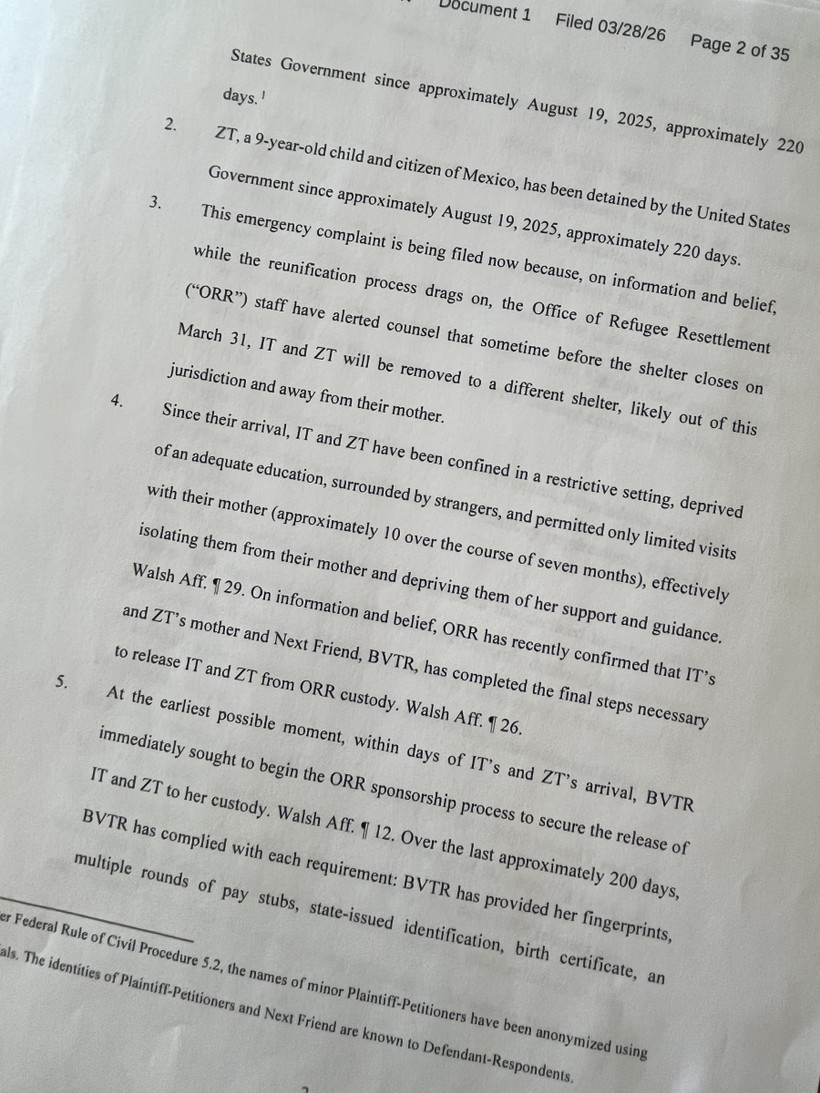
A page from a habeas corpus petition describes two children's separation from their mother. | Isabelle Taft / New York Focus

The six cousins, ranging in age from 3-year-old Eithan to 15-year-old Lizeth, left Ecuador last fall, after the home where they lived with their grandmother was robbed. They told New York Focus they decided to make the journey to join their parents — who arrived in New York City over the last several years — without telling them.

Lizeth, who stepped into the role of surrogate mother to her younger cousins, said the same hope motivated them as they trekked through the jungle and later as they spent months living with a foster mother.

“Our goal was simply to reach our parents,” Lizeth said. “When we were hungry, when we were wading through the rivers, when we were most struggling, reaching our parents was the only thing on our minds.”

When the children reached the southern border, immigration officials apprehended them and turned them over to ORR, as federal law requires. That agency houses kids by contracting with mostly state-licensed shelter and foster organizations, including more than a dozen in New York in recent years.

The kids traveled by plane to New York City and moved into a room in a foster mother’s apartment, only about 10 miles from their parents in Corona. That was when the adults started submitting paperwork, hoping to bring them home.

“Months passed, days, weeks,” said Luis. “As a father, I was in a state of desperation: What more can I do? Because we had given them all the documents they asked for and more.”

In court filings before the kids were released, ORR argued that the vetting process was still playing out and that the agency had agreed to expedite analysis of the DNA testing, after which it could reach a decision. The Department of Health and Human Services did not respond to questions about the case or about delays more broadly.

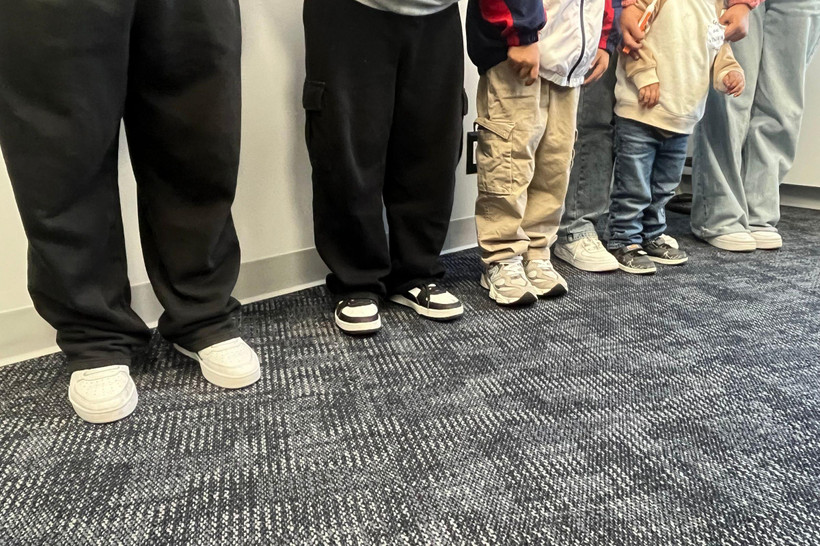
After four months, Maria was reunited with her son Maykel and his five cousins in March. | Isabelle Taft / New York Focus


As ORR scrutinizes their potential sponsors, kids must go to immigration court, sometimes without representation, to answer a judge’s questions about their experiences with the process. On a recent Tuesday morning, a teenage boy wearing headphones appeared on the screen inside Judge Lisa Ling’s courtroom on Varick Street in Manhattan. He sat at what appeared to be a well-used office cubicle, shifting his weight in the black desk chair as he waited. Ling asked what was going on with his reunification.

“It’s a bit slow,” he said in Spanish. 

Ling assigned him another hearing in three weeks.

Many kids who are released from ORR custody get out without a habeas petition. In March, 228 children and teens were released to sponsors around the country, according to federal data. But attorneys said they no longer trust the agency to handle the cases, after encountering unexplained delays, even when sponsors complete every step, and hearing about sponsors being arrested by ICE during the process.

The nonprofit Center for Family Representation in New York City has set up what it calls a “new family reunification project” to help parents navigate the process. Zoe Schonfeld, attorney-in-charge of the immigration practice, said the project is currently representing 10 parents with children in ORR custody. They talk parents through every step of the process, explain the risks, and push back on requirements like appointments at federal Department of Homeland Security offices.

“As a father, I was in a state of desperation: What more can I do?”

—Luis

“But we can’t assure them that as a result of working to get their kids back, they won’t face detention,” Schonfeld said. 

Knowing that their families are struggling or in danger of deportation worsens the toll the lengthy detentions take on children, said Emily Norman, East Coast regional director for Kids in Need of Defense, which provides legal representation for unaccompanied immigrant children.

“There’s anxiety and depression, I think a feeling of helplessness when it’s not clear why they’re not being let out,” Norman said. “Kids feel a lot of pressure and worry over risks that they’re putting their family members in.”

In sworn affidavits, Luis and the other parents said adults told their children that their parents would be deported if they didn’t obey the facility rules. The children told New York Focus they rarely went outside while in ORR custody, except to travel from their foster home to the foster facility, which was operated by the New York-based nonprofit Cayuga Centers. They cried during visits with their parents.

Cayuga Centers declined to comment for this story. 

One morning, about a week after their attorneys filed the habeas petitions, Maria got a call from Cayuga Centers: “Come get your son.” The results of her DNA test had come through, and ORR had approved the children’s release. That evening, all of the cousins and their parents celebrated over fish soup, ribs, and cake at an Ecuadorian restaurant in Queens.

The Trump administration has asked the court to dismiss their habeas cases on the grounds that they are now moot. Kerben, their attorney, is opposing that, aiming to keep fighting for a judgment against the government. The cases remain open.

“I wouldn’t want other kids to suffer like our kids suffered,” Maria said. “I want them to get out, to get help, to reunite with their families.”

At New York Focus, our central mission is to help readers better understand how New York really works. If you think this article succeeded, please consider supporting our mission and making more stories like this one possible.

New York is an incongruous state. We’re home to fabulous wealth — if the state were a country, it would have the tenth largest economy in the world — but also the highest rate of wealth inequality. We’re among the most diverse – but also the most segregated. We passed the nation’s most ambitious climate law — but haven’t been meeting its deadlines and continue to subsidize industries hastening the climate crisis.

As New York’s only statewide nonprofit news publication, our journalism exists to help you make sense of these contradictions. Our work scrutinizes how power works in the state, unpacks who’s really calling the shots, and reveals how obscure decisions shape ordinary New Yorkers’ lives.

In the last two decades, the number of local news outlets in New York has been nearly slashed in half, allowing elected officials and powerful individuals to increasingly operate in the dark — with the average New Yorker none the wiser.

We’re on a mission to change that. Our work has already shown what can happen when those with power know that someone is watching, with stories that have prompted policy changes and spurred legislation. We have ambitious plans for the rest of the year and beyond, including tackling new beats and more hard-hitting stories — but we need your help to make them a reality.

If you’re able, please consider supporting our journalism with a one-time gift or a monthly gift. We can't do this work without you.

Thank you,

Akash Mehta
Editor-in-Chief

A photo of Akash Mehta.
A photo of Isabelle Taft.
Isabelle Taft covers immigration for New York Focus. She’s also a corps member with Report for America, a national program that places reporters in local newsrooms. She previously covered national news as a fellow at the New York Times, worked on the health… more
Also filed in New York City

Under Trump, a status for young immigrants who have experienced abuse or neglect no longer offers much protection.

The Department of Housing Preservation and Development has vowed to go after negligent landlords, but it’s wrestling with a huge backlog of complaints.

A lawsuit accuses federal officials of ignoring evidence that the boy, born in Mexico, held US citizenship through his mother.

Also filed in Immigration

We’ve compiled information for the 450,000 New Yorkers who will lose health care coverage on July 1.

In May, state lawmakers passed a $269 billion budget after haggling for months over thousands of line items and policies affecting New Yorkers.

The Department of Justice has terminated more than 100 immigration judges since last year as it has pressured courts to order more deportations.