Union and Troubled Home Care Company Maintained Close Partnership, Records Show

Health care union 1199SEIU helped Public Partnerships LLC take over the state’s home care program, even as it warned some workers could see wage cuts.

Sam Mellins   ·   July 16, 2026
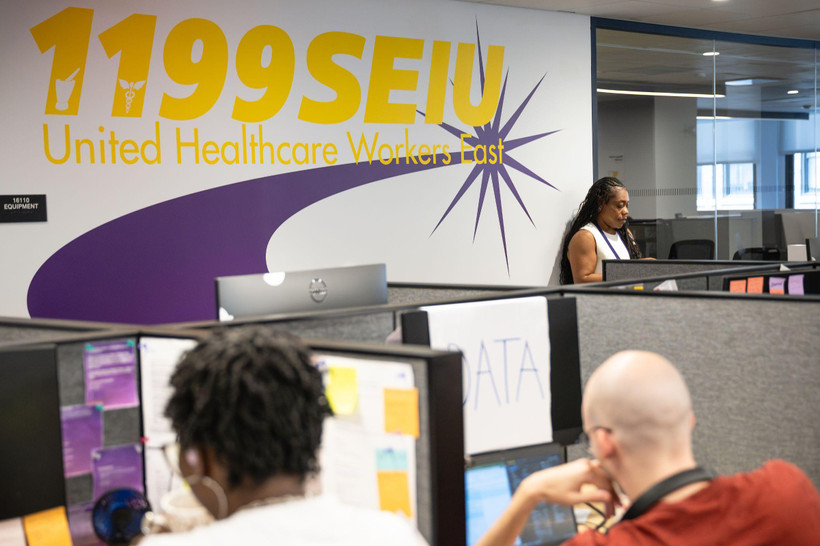
In the 1199 SEIU office, people work in at desks with a large 1199 SEIU: United Healthcare Workers East logo on the wall.
The powerful health care union 1199SEIU has been working closely with the PPL for years, New York Focus has learned. | Katie G. Nelson / New York Focus

Sign up for Staying Focused, our newsletter keeping readers up to speed on New York politics.

Since the company Public Partnerships LLC took over running New York’s $11 billion state-funded home care program in April 2025, it has faced a storm of criticism from its workers and patients. 

Home health aides the company employs have decried missed paychecks, glitchy software, and hours-long waits on the phone, among other issues. Last month, PPL agreed to a $162 million settlement to resolve claims of wage theft, and the US Department of Justice sued the company, alleging Medicaid fraud.

The powerful health care union 1199SEIU is currently seeking to unionize PPL’s roughly 200,000 workers, who care for disabled and elderly New Yorkers. But 1199 has also been working closely with the PPL for years, according to internal records obtained by New York Focus.

They show that in the months before April 2025, even as the union harbored concerns about PPL, it worked to ensure the success of the company’s takeover of the home care program, known as CDPAP. The union and the company coordinated lobbying efforts and public messaging campaigns, planned pushback against critics, and worked to give 1199 a leg up over another union seeking to unionize PPL’s workforce. 

In a statement, 1199 spokesperson Rose Ryan said the union “provided input, as a union which already represented tens of thousands of consumer-directed caregivers, on best practices for structuring the program and engaging and onboarding workers.”

Ruth Milkman, a professor of labor studies at CUNY, said it’s “par for the course” for unions and employers to work together, and having a good relationship with an employer can help unions “push for better pay and working conditions.”

But, she added, the union “shouldn’t be colluding with the company to help them with their public relations problems.”

The union has a long history of working with employers, said Joshua Freeman, a labor history professor at Queens College, since both sides “have a shared interest in increasing state funding for hospitals and medical care more generally.”

This strategy has often “radically improved the lives of 1199 members” by winning them better wages and benefits, Freeman added.

So, the marriage of convenience between 1199 and PPL isn’t entirely surprising. Unionizing home care workers is a priority for 1199, and records show that PPL was willing to support 1199’s campaign. That meant the union had a rare chance to win 200,000 members at once.

Their cooperation began before PPL even won the contract to take over the home care program. In August 2024, PPL sent the state health department a 200-page bid for the contract that touted its connection to the union. The bid document, which was obtained by New York Focus, said that PPL was conducting “regular discussions” with 1199 to “establish a collaborative working relationship.” 

PPL spokesperson Meg Fitzgerald said that the company “engaged with a broad range of stakeholders” as it prepared to take over the program, and that “1199 was one voice among many in that process.”

This image from PPL's winning bid shows that the company was already working closely with 1199. | Obtained by New York Focus


In September 2024, Governor Kathy Hochul announced PPL as the winning bidder. In the press release, then-1199 President George Gresham praised the governor for acting to “protect home care consumers and the workers who care for them.”

By December 2024, 1199 and PPL had struck an agreement that PPL would give the union contact information for its workers, according to records from a meeting that month. 

This agreement was essential for 1199’s unionization campaign. Since PPL’s employees work in people’s homes rather than in a store or a factory, organizers need to be able to reach them by phone.

PPL was willing to help, but there was a problem: Under federal labor law, employers cannot aid one potential union over another. And since another union — Home Healthcare Workers of America — had reached out to PPL, giving the contact list only to 1199 could have risked violating that law. 

In 2024, The City Reporter, a news site, found that HHWA paid millions to its leadership while its workers earned less than minimum wage and struggled to get paid for overtime work. HHWA and 1199 have clashed in the past, with 1199 accusing its rival of breaking labor law and failing to win real gains for workers.

According to December 2024 meeting records, 1199 proposed a solution that would ensure that PPL wouldn’t have to give aides’ contact information to HHWA or any other rival: The company would agree to give the list only to a union that had collected signed union cards from at least 10 percent of home health aides. Since 1199 had unionized thousands of home health aides before the transition to PPL, this target would be much more attainable for them, rather than for HHWA or another rival.

“We’re trying to make sure that they don’t have a basis for getting a list from you without proving anything,” 1199 lawyer Amy Gladstein told PPL representatives in the December meeting.

PPL had also given 1199 another reason to cooperate: The company agreed to maintain the wages and benefits for home care workers who had joined 1199 before PPL’s takeover.

But 1199 knew that the transition might lower wages for nonunion workers, who generally make less than their union colleagues. In at least three meetings with PPL in 2024, 1199 staff expressed concern that the transition could lead to pay cuts for some aides, since PPL’s wages would be lower than those paid by some of the companies PPL was replacing. Aides generally make about $20 per hour.

According to records from a November 2024 meeting, 1199 political director Helen Schaub warned PPL officials that aides could face wage cuts on a “significant scale” when PPL took over, and that this could cause “bad publicity.” Union representatives repeated this concern in multiple meetings the following month.

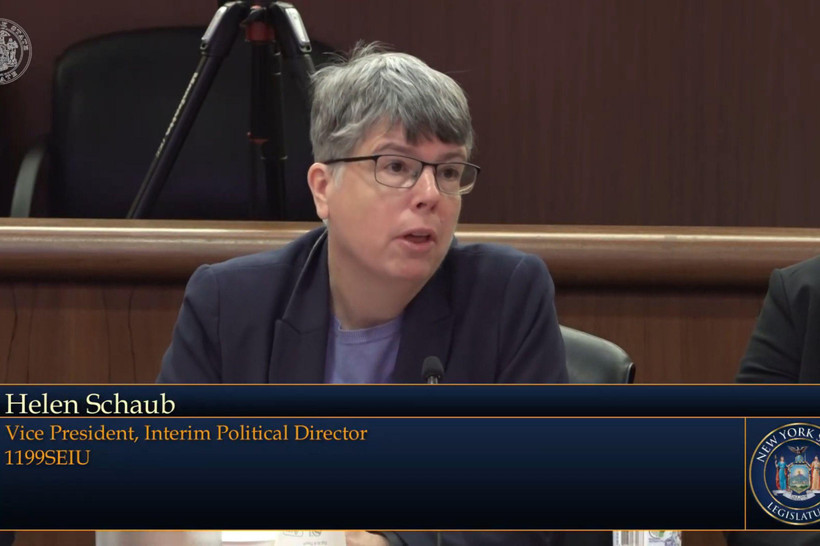
A video screenshot from a legislative hearing shows Helen Schaub testifying. She is a middle-aged woman with short gray hair and glasses.
Helen Schaub, political director of 1199SEIU, testifying at a hearing on the 2025 executive budget proposal. | NY Senate / YouTube


In public, though, 1199 supported PPL. In January 2025, while testifying to state lawmakers in Albany, Schaub praised their decision to seek savings by transferring the program to PPL “rather than cutting wages for workers.” Since PPL took over the program, numerous workers have complained of pay cuts.

In her statement to New York Focus, Ryan, the 1199 spokesperson, said that the union “repeatedly advocated for the retention of existing wage and benefit standards for workers” who faced wage cuts from PPL.

Despite such concerns, the union offered the PPL advice and lobbying support on multiple occasions, especially on how to counter anti-PPL messaging.

In 2024 and 2025, a shadowy nonprofit called the Alliance to Protect Home Care mounted a massive campaign against PPLTV ads and mailers criticized PPL’s record, and called on Hochul and state lawmakers to dump the company. With over $10 million in spending in 2024 alone, it was one of the best-funded lobbying efforts in Albany that year.

Meeting records show that 1199 and PPL jointly strategized about how to hit back and reassure lawmakers. 

During a discussion about communication strategy in a November 2024 meeting, Gladstein told PPL representatives “Our whole goal is to stay parallel with you.”

The two sides closely coordinated their public messaging, and appear to have shared information and research on several occasions.

At a meeting in December 2024, Maria Perrin, then the president of PPL, thanked 1199 for information it had sent about rival companies, and said it was “really helpful.” She asked the union for “continued support on the countermessaging, because it needs to be multifaceted.”

And in another meeting that month, Perrin thanked the union for sharing “legislative research,” saying that it was “extremely helpful” in preparing for the state legislature’s upcoming 2025 session. 

The union also offered to help PPL lobby lawmakers in Albany. In the leadup to PPL’s takeover, some lawmakers loudly opposed the company, and called for the transition to be delayed or canceled. 

The union and the company spent the end of 2024 planning how to push back against these efforts. In a December 2024 meeting, Gladstein told PPL representatives, “Helen is your best advocate in Albany,” referring to Schaub, the union’s political director. 

“We need to know how you’re doing, or where there’s other help needed,” Gladstein added.

In testimony to state lawmakers the following month, Schaub said that making the transition to PPL was “the right decision” but acknowledged difficulties. 

“Making a change of this magnitude is very challenging,” she said.

At New York Focus, our central mission is to help readers better understand how New York really works. If you think this article succeeded, please consider supporting our mission and making more stories like this one possible.

New York is an incongruous state. We’re home to fabulous wealth — if the state were a country, it would have the tenth largest economy in the world — but also the highest rate of wealth inequality. We’re among the most diverse – but also the most segregated. We passed the nation’s most ambitious climate law — but haven’t been meeting its deadlines and continue to subsidize industries hastening the climate crisis.

As New York’s only statewide nonprofit news publication, our journalism exists to help you make sense of these contradictions. Our work scrutinizes how power works in the state, unpacks who’s really calling the shots, and reveals how obscure decisions shape ordinary New Yorkers’ lives.

In the last two decades, the number of local news outlets in New York has been nearly slashed in half, allowing elected officials and powerful individuals to increasingly operate in the dark — with the average New Yorker none the wiser.

We’re on a mission to change that. Our work has already shown what can happen when those with power know that someone is watching, with stories that have prompted policy changes and spurred legislation. We have ambitious plans for the rest of the year and beyond, including tackling new beats and more hard-hitting stories — but we need your help to make them a reality.

If you’re able, please consider supporting our journalism with a one-time gift or a monthly gift. We can't do this work without you.

Thank you,

Akash Mehta
Editor-in-Chief
A photo of Sam Mellins.
Sam Mellins is senior reporter at New York Focus, which he has been a part of since launch day. His reporting has also appeared in The San Francisco Chronicle, The Intercept, THE CITY, and The Nation. Reach him on Signal: mellins.613
Also filed in New York State

Boards of Visitors are supposed to oversee state-run disability and psychiatric programs. Almost none of them have enough members.

Starting this fall, Salamanca High School will deploy a humanoid robot and avatar teaching assistant.

A sweeping report excoriates the Department of Corrections and Community Supervision for failing to protect prisoners and staff.

Also filed in Health

Unclear notices have left participants unsure about the status of their insurance and what steps to take next.

We’ve compiled information for the 450,000 New Yorkers who will lose health care coverage on July 1.

In May, state lawmakers passed a $269 billion budget after haggling for months over thousands of line items and policies affecting New Yorkers.

Also filed in Labor

New York City has no plans to opt into NY HELPS, which has been extended to 2028 after filling 60,000 government jobs.

160,000 injured New Yorkers seek workers’ compensation each year — but in recent years, regulators have tilted the scales towards employers and insurers.

The leader of Reinvent Albany discusses a data center subsidy in Rockland County that flew under the radar for years.