No Solution to Health Coverage Cliff in Delayed State Budget

Despite last-ditch efforts by a coalition of lawmakers, the state failed to avert a health coverage cliff coming this summer.

Jie Jenny Zou   ·   May 28, 2026
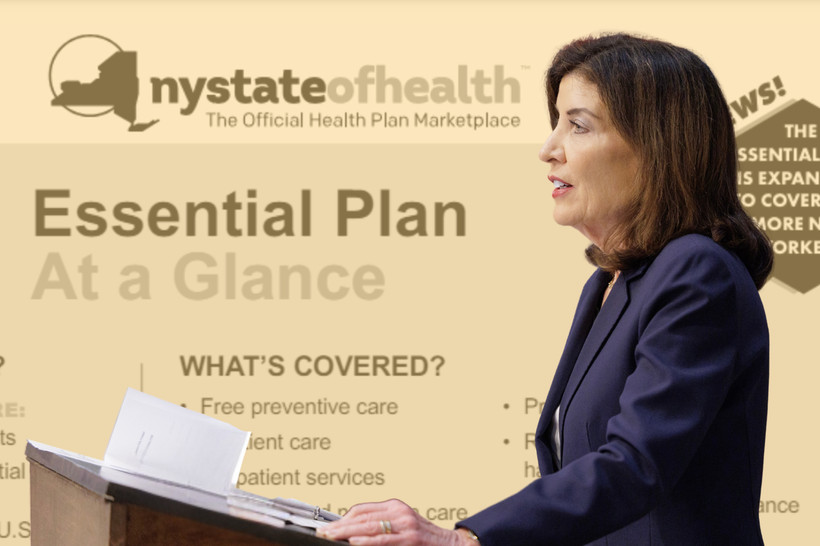
A photo collage of Governor Kathy Hochul in front of a yellow-tinted card explaining New York State of Health's Essential Plan.
Federal cuts that took effect earlier this year will eliminate coverage for those on the Essential Plan who earn between 200 to 250 percent of the federal poverty level. | Photos: Mike Groll/Office of Governor Kathy Hochul; Infographic: New York State of Health | Illustration: Leor Stylar

Sign up for Staying Focused, our newsletter keeping readers up to speed on New York politics.
The state budget does not provide a plan for the hundreds of thousands of New Yorkers set to lose their health care in July, disappointing lawmakers and advocates who had urged Governor Kathy Hochul to act in the final weeks of Albany negotiations.

Earlier this year, budget proposals by the Senate, Assembly, and governor called for robust funding increases for Medicaid providers like hospitals, but none addressed what would happen to the estimated 450,000 New Yorkers set to be kicked off the state’s Essential Plan this summer.

The flagship program provides free or low-cost health care to 1.7 million residents ineligible for Medicaid, enabling the state to maintain near-universal insurance coverage. But federal cuts that took effect earlier this year will eliminate coverage for those in the program who earn between 200 and 250 percent of the federal poverty level. Tightened eligibility criteria will also terminate coverage for some immigrants with legal status who earn even less.

In late March, Assemblymember Amy Paulin and Senator Gustavo Rivera, who chair their chambers’ respective health committees, proposed bills that would require the state to continue covering these New Yorkers, which one report estimated would cost $2.3 billion annually. Both bills racked up dozens of co-sponsors, who also signed onto a recent letter imploring Hochul to support the bills. 

The governor has said that no state can afford to backfill federal cuts. 

The letter, co-authored by Rivera and Paulin, argued that the governor had already set aside the needed funds in her January budget proposal. She had reserved over $2 billion to provide health insurance to some New Yorkers in the event that the state did not secure federal approval to keep the Essential Plan alive in a scaled-back form. The state received that approval in March, leaving the contingency funds unused. 

That argument ultimately failed to gain traction in negotiations. The state did not allocate money to address the Essential Plan cliff, rendering Rivera’s and Paulin’s bills moot during the rest of the legislative session.

The budget contains hefty rate increases for health care providers, a move that some advocates say prioritizes the interests of the health care lobby over those of working-class New Yorkers. “It really speaks to the degree to which, in Albany health politics, the voices of patients are not focused on,” said Michael Kinnucan, health policy director of the Fiscal Policy Institute.

“It’s a really astonishing abdication of responsibility,” he said of Hochul, Assembly Speaker Carl Heastie, and Majority Leader Andrea Stewart-Cousins.

The budget does include a 2.7 percent increase in payments to contracted human services providers — below the 4 percent requested by both chambers, but above Hochul’s proposal of 1.7 percent. Nonprofits provide a range of critical services like emergency shelters, but the sector has been fettered by stagnant wages.

But the budget stops short of including a Senate proposal to expand the number and type of providers included in the annual increase to cover excluded groups like domestic violence workers. “We wish we didn’t have to fight so hard for the basics,” said Michelle Jackson of the Human Services Council of New York.

The final budget funded two nutrition programs, the Hunger Prevention and Nutrition Assistance Program and Nourish NY, at $72.8 million and $55 million respectively. (Both legislative chambers had proposed funding $75 million each.) The programs support the state’s vast network of emergency food providers, which have experienced historic demand amid worsening food insecurity and reduced federal support. 

The chambers appeared to prevail with one program: The budget allocates $8.7 million for the state’s network of community-based navigators that help residents apply and certify for the Supplemental Nutrition Assistance Program, known as food stamps. That’s roughly in line with the legislature’s proposals and far exceeds Hochul’s proposal of $3.7 million.

Ryan Healy of Hunger Solutions New York said the funding will fully compensate for the federal dollars that program lost at an especially critical time. New work rule requirements went into effect for SNAP recipients this spring, causing mass confusion.

“Sustaining that network really shows New York is committed to helping families access SNAP,” Healy said, calling the funding a “highlight” of the budget.

Correction: May 29, 2026 — This article previously misstated that the final budget allocation for the Hunger Prevention and Nutrition Assistance Program matched the the governor's executive proposal. In fact, the final allocation is larger.

At New York Focus, our central mission is to help readers better understand how New York really works. If you think this article succeeded, please consider supporting our mission and making more stories like this one possible.

New York is an incongruous state. We’re home to fabulous wealth — if the state were a country, it would have the tenth largest economy in the world — but also the highest rate of wealth inequality. We’re among the most diverse – but also the most segregated. We passed the nation’s most ambitious climate law — but haven’t been meeting its deadlines and continue to subsidize industries hastening the climate crisis.

As New York’s only statewide nonprofit news publication, our journalism exists to help you make sense of these contradictions. Our work scrutinizes how power works in the state, unpacks who’s really calling the shots, and reveals how obscure decisions shape ordinary New Yorkers’ lives.

In the last two decades, the number of local news outlets in New York has been nearly slashed in half, allowing elected officials and powerful individuals to increasingly operate in the dark — with the average New Yorker none the wiser.

We’re on a mission to change that. Our work has already shown what can happen when those with power know that someone is watching, with stories that have prompted policy changes and spurred legislation. We have ambitious plans for the rest of the year and beyond, including tackling new beats and more hard-hitting stories — but we need your help to make them a reality.

If you’re able, please consider supporting our journalism with a one-time gift or a monthly gift. We can't do this work without you.

Thank you,

Akash Mehta
Editor-in-Chief
A photo of Akash Mehta.
A photo of Jie Jenny Zou.
Jie Jenny Zou covers social services and public benefits for New York Focus. She previously worked as an investigative reporter at the Los Angeles Times and the Center for Public Integrity where she delved into topics ranging from environmental health and worker safety… more
Also filed in New York State

City budget gaps and an ambitious affordability agenda may require pressing Albany again for taxes and aid.

A bill awaiting the governor’s signature would relax restrictions on who can qualify for victim compensation.

We’ve compiled information for the 450,000 New Yorkers who will lose health care coverage on July 1.

Also filed in Health

In May, state lawmakers passed a $269 billion budget after haggling for months over thousands of line items and policies affecting New Yorkers.

160,000 injured New Yorkers seek workers’ compensation each year — but in recent years, regulators have tilted the scales towards employers and insurers.

Amid abortion bans and rising digital surveillance, Albany lawmakers are revisiting an effort to stop companies from selling sensitive health information.

Also filed in Budget

State leaders are expected to pass a bill that avoids resolving how much Resorts World New York City needs to pay.

Resorts World is floating legislation to avert more than $500 million in payments to the horseracing industry.

Our searchable database breaks down the most consequential decisions Albany politicians made on climate, immigration, housing, schools, taxes, and more.

Also filed in Social Services

New York state has pumped millions of taxpayer dollars into an online portal that vowed to make life easier for Rochester’s neediest, but critics say it’s fallen short.

We’ve compiled information for SNAP recipients in New York on the changing work requirements.

The Hochul administration now has a chance to relax New York’s child care staffing ratios — among the country’s strictest — after 26 years. But will it?

Also filed in Affordability

Governor Kathy Hochul was successful in her bid to upend the Climate Leadership and Community Protection Act after legislators caved to finalize an overall budget deal.

New rules could result in thousands of New Yorkers losing their food benefits this summer.