Critics Say Messy Budget ‘Deal’ Highlights Bigger Woes

Governor Kathy Hochul’s announcement that a deal had been reached led to a flurry of recriminations from lawmakers.
Sam Mellins, Nick Garber and Amudalat Ajasa   ·   May 7, 2026
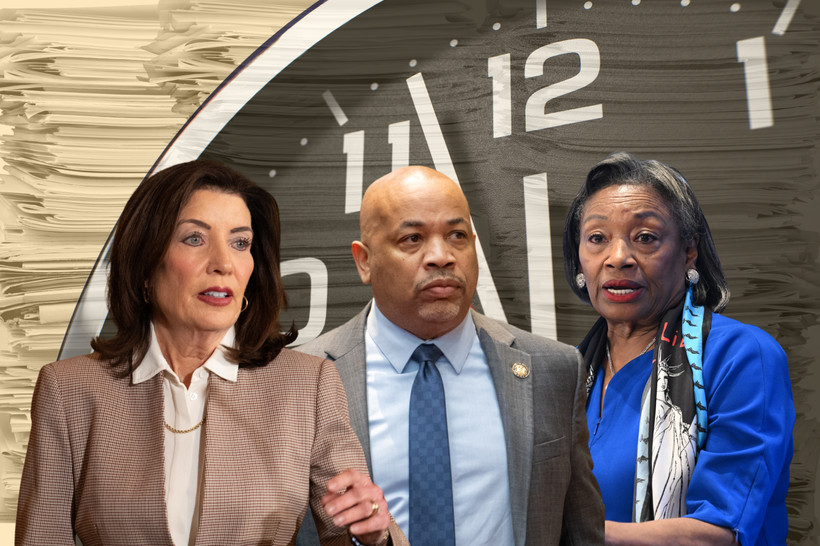
Photo collage of Governor Kathy Hochul, Assembly Speaker Carl Heastie, and Senate Majority Leader Andrea Stewart-Cousins. Behind them, a huge clock nears midnight, and stacks of papers loom.
Hochul's final budget announcement was a bust. Could it lead to changes in Albany? | Photos: Aidin Bharti/Office of Governor Kathy Hochul; New York state Assembly Majority; NYS Senate Media Services; stuartbur/Getty Images; Billion Images | Illustration: Leor Stylar

Sign up for Staying Focused, our newsletter keeping readers up to speed on New York politics.

Are New York’s legislators making the sausage the wrong way?

When it comes to the $268 billion state budget, Assembly Speaker Carl Heastie thinks the answer is yes. On Thursday, shortly after Governor Kathy Hochul announced a deal on the budget, Heastie emerged from his office to tell reporters that there was no deal, and that he’s fed up with Hochul’s practice of inserting most of her legislative agenda for the year — including numerous items that have little to do with spending — into the state’s budget.

“I’m never doing this again. Budgets are supposed to be about money, not policy,” Heastie said.

Could New York change how it makes its budget? This question has quickly escalated from a relatively fringe demand to a central issue in ongoing negotiations.

“There’s something fundamentally wrong with this process,” Heastie said.

But whether he or other lawmakers will take action to change it isn’t clear.

E.J. McMahon, a fellow at the Manhattan Institute and longtime observer of New York’s government, said that while Heastie has long complained about the budget process, he hasn’t yet thrown his muscle behind a solution. 

“When the governor submits her proposal, he could say: ‘Governor, we’re not going to act on or consider anything that is not directly related to the budget,’” McMahon said.

But it’s dangerous for lawmakers to openly challenge the governor, since she can veto their bills, or withhold funding from their districts.

“In this conflict, the governor has nuclear weapons,” said former Assemblymember Richard Gottfried. “The legislature has a lot less.”

Even so, on Thursday, Heastie appeared to be considering that step. He told reporters that he would refuse to present any new policy matters to his members in closed-door conferences until he had a clearer sense of the financial picture.

“Albany culture has devolved to a point where it is difficult to get hard policy work done without using the budget as a cudgel.”

—Ana Champeny, vice president, Citizens Budget Commission

Rich Azzopardi, who served as a senior aide to former Governor Andrew Cuomo and worked in the state Senate, said that the current system actually equalizes power between the governor and legislature. 

“As soon as the budget’s done, the legislature gets the upper hand,” he said “So the governor thinks, ‘I have a much better shot at getting my agenda passed if it’s in the budget.’”

For years, lawmakers have talked about passing a constitutional amendment that would give them power to amend items in the budget — a power that belongs only to the governor — instead of just removing them.

“If you think the founders of the country had a good idea when they created a balance of powers between the legislative and executive, this amendment would get us back to that,” said Gottfried, who sponsored the measure when he was in the legislature.

Changes to the state constitution need to pass the legislature twice and then be approved by voters statewide in a November election. A proposed amendment to the state’s budget process failed by a wide margin in 2005. 

A spokesperson for Hochul declined to comment on Heastie’s criticism or the talk about reducing the governor’s powers.

Since she became governor in 2021, negotiations over Hochul’s policy proposals have repeatedly delayed the passage of budgets.

New York’s legislature goes home for the year in June, and the delays take much of the time that the legislature would otherwise have to debate and pass laws. This year, by the time the budget passes, there will be fewer than 20 days of legislative session remaining for the year.

“Albany culture has devolved to a point where it is difficult to get hard policy work done without using the budget as a cudgel,” said Ana Champeny, vice president of the think tank Citizens Budget Commission. “Policy debates can now jump to the front of the line and delay discussion of fiscal issues. Unfortunately, the end result is that both the budget and policy get short shrift.”

Another issue with this system, according to the watchdog group Reinvent Albany, is that it increases secrecy in government, since, unlike the legislative session, budget negotiations happen behind closed doors.

“Because there are bill sponsors and a committee process (however imperfect) in the ‘regular’ session, there are more people telling stakeholder groups and journalists what is going on,” the group said in a statement.

Last month, a small group of lawmakers held a press conference over Zoom where they criticized what they see as Hochul’s outsized power. One of those lawmakers, Manhattan Assemblymember Tony Simone, said Thursday that he and some colleagues have had early discussions about amending the constitution to reduce the governor’s powers, or calling a special session in the fall to give lawmakers more time to pass bills.

“The budget process is broken,” Simone told New York Focus.

Hudson Valley Assemblymember Sarahana Shrestha echoed those criticisms, arguing that Hochul has weaponized premature agreement announcements for previous budget sessions.

“The Governor is abusing the budget process, which desperately needs to change, but that takes a constitutional amendment, which means the legislature needs to pass a law twice and the voters need to approve it on the ballot,” Shrestha said in a statement.

Senate Majority Leader Andrea Stewart-Cousins did not immediately comment on the disagreement. Stewart-Cousins told reporters on Tuesday that there were “conceptual agreements” on some major policies but no comprehensive deal.

At New York Focus, our central mission is to help readers better understand how New York really works. If you think this article succeeded, please consider supporting our mission and making more stories like this one possible.

New York is an incongruous state. We’re home to fabulous wealth — if the state were a country, it would have the tenth largest economy in the world — but also the highest rate of wealth inequality. We’re among the most diverse – but also the most segregated. We passed the nation’s most ambitious climate law — but haven’t been meeting its deadlines and continue to subsidize industries hastening the climate crisis.

As New York’s only statewide nonprofit news publication, our journalism exists to help you make sense of these contradictions. Our work scrutinizes how power works in the state, unpacks who’s really calling the shots, and reveals how obscure decisions shape ordinary New Yorkers’ lives.

In the last two decades, the number of local news outlets in New York has been nearly slashed in half, allowing elected officials and powerful individuals to increasingly operate in the dark — with the average New Yorker none the wiser.

We’re on a mission to change that. Our work has already shown what can happen when those with power know that someone is watching, with stories that have prompted policy changes and spurred legislation. We have ambitious plans for the rest of the year and beyond, including tackling new beats and more hard-hitting stories — but we need your help to make them a reality.

If you’re able, please consider supporting our journalism with a one-time gift or a monthly gift. We can't do this work without you.

Thank you,

Akash Mehta
Editor-in-Chief
A photo of Akash Mehta.
A photo of Sam Mellins.
Sam Mellins is senior reporter at New York Focus, which he has been a part of since launch day. His reporting has also appeared in The San Francisco Chronicle, The Intercept, THE CITY, and The Nation. Reach him on Signal: mellins.613
A photo of Nick Garber.
Nick Garber covers politics for New York Focus. He previously worked for Crain’s New York Business, where he covered city and state government, housing and real estate, and money in politics. He also covered neighborhood news in Manhattan and Queens for Patch, and got… more
A photo of Amudalat Ajasa.
Amudalat Ajasa covers climate for New York Focus. Amudalat comes to Focus from The Washington Post, where she wrote about the effects of air, water and chemical pollution on human health. Prior to that, she worked at The New York Times, where she… more
Also filed in New York State

A bill awaiting the governor’s signature would relax restrictions on who can qualify for victim compensation.

We’ve compiled information for the 450,000 New Yorkers who will lose health care coverage on July 1.

A lobbyist who has been romantically linked to Assembly Speaker Carl Heastie led a rally opposing the legislation a week before the speaker declined to bring it to a vote.

Also filed in Budget

In May, state lawmakers passed a $269 billion budget after haggling for months over thousands of line items and policies affecting New Yorkers.

State leaders are expected to pass a bill that avoids resolving how much Resorts World New York City needs to pay.

Resorts World is floating legislation to avert more than $500 million in payments to the horseracing industry.