State Budget Thrashes Landmark Climate Law

Governor Kathy Hochul was successful in her bid to upend the Climate Leadership and Community Protection Act after legislators caved to finalize an overall budget deal.

Amudalat Ajasa and Nick Garber   ·   May 27, 2026
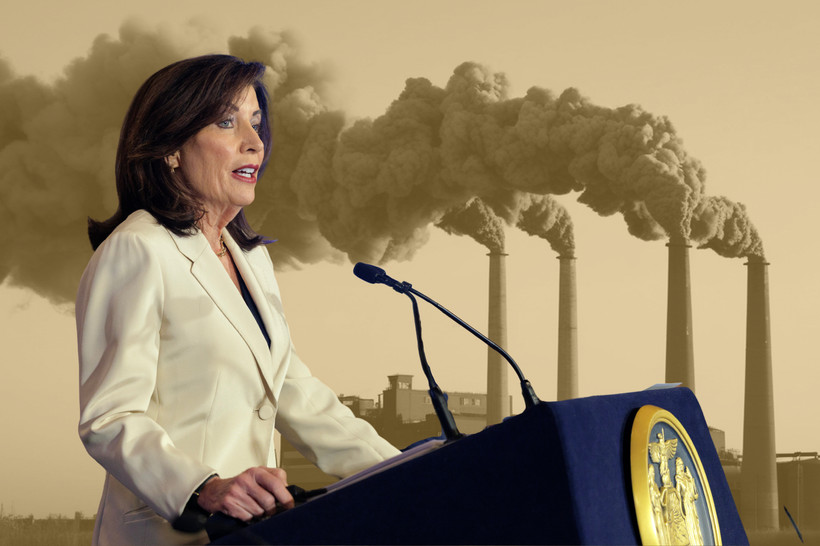
A photo collage of Governor Kathy Hochul in front of a yellow-tinted photo of four smokestacks.
One of the highest-stakes questions in Albany this year has resolved in Governor Kathy Hochul's favor. She convinced a skeptical legislature to roll back the centerpiece of New York climate policy. | Photos: Mike Groll/Office of Governor Kathy Hochul; Sumali Ibnu Chamid/Alemedia | Illustration: Leor Stylar

Sign up for Staying Focused, our newsletter keeping readers up to speed on New York politics.
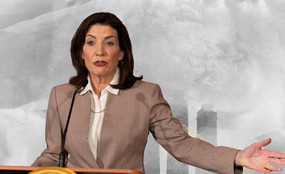
One of the highest-stakes questions in Albany this year has been whether Governor Kathy Hochul could convince a skeptical legislature to roll back the centerpiece of New York climate policy.

The final state budget, set to be passed this week after an almost two-month delay, makes clear that she succeeded. Lawmakers are punting the Climate Leadership and Community Protection Act’s first deadline for emissions regulation — which is already two years late — and creating a new interim target date by which to cut emissions. They accepted a major change to how emissions are measured that they had rejected three years ago. And they loosened the requirements binding the state to the deadlines.

Hochul said the changes were needed to protect New Yorkers’ wallets. Legislators at first appeared staunchly opposed, but eventually caved. There would have been no way to get to a budget deal if they hadn’t, Assemblymember Anna Kelles said.

“We are watching New York become the first state in the country to roll back its climate laws. It’s disappointing and embarrassing,” Kelles said.

The 2019 climate law, one of the most ambitious in the country, required the state to create regulations to reduce emission by the start of 2024. It set deadlines to cut emissions by 40 percent from 1990 levels by 2030 and achieve near net zero by 2050. 

Hochul’s administration failed to meet the 2024 requirement. Environmental groups sued, and a judge forced Hochul’s hand: Change the law or issue the regulations.

Now, the Hochul administration will have until the end of 2028 to issue regulations to reduce emissions. The deal scraps the 2030 requirement and instead sets an interim target of 2040 to reduce emissions 60 percent from 1990 levels — “to the maximum extent feasible and cost effective.” The 2050 mandate remains in place.

It also alters a key component of the law: changing the state’s emissions counting method from a 20-year one to a 100-year one, a hotly debated move that will make the state seem closer to its climate goals without doing anything else differently.

The changes largely echo the details Hochul shared when she announced that a final deal had been reached on the budget early May, a claim assemblymembers quickly disputed.

The budget leaves the door open for a “cap and invest” program, which had once been Hochul’s flagship climate policy. She abruptly shelved a version of that program, which would have charged polluters for their emissions and used much of the money to fund the energy transition, last year. 

“Governor Hochul has made clear her top priority is keeping the lights on and costs down for all New Yorkers,” said Ken Lovett, Hochul’s energy spokesperson. He added that she “remains committed to building on the state’s robust record of climate and clean energy successes.”

Environmental groups lambasted the deal. “These changes are both giving Hochul an extension on her homework and giving herself a grade inflation on the progress that the state has made so far,” said Rachel Spector, an Earthjustice attorney representing plaintiffs in the lawsuit.

Business groups, meanwhile, applauded the updates. 

“We believe these reasonable and necessary amendments will help businesses and consumers who are struggling with affordability issues, while also allowing the state to continue to make meaningful climate progress,” said Patrick Bailey, director of communications at the Business Council of New York State, in a statement.

Hochul has maintained that the 2019 climate law targets were unrealistic in light of the Trump administration’s war on renewable energy, and would make energy prices skyrocket. Environmental advocates have disputed her estimates of the cost of complying with the law.

Hochul and the legislature had an easier time agreeing on other climate and energy policies. 

The  budget includes most of Hochul’s proposed reforms to the way the Public Service Commission regulates utilities. Lawmakers agreed to Hochul’s proposal to tie executive pay at utility companies to new affordability metrics. The legislature also signed off on Hochul’s reforms to the rate hike process, including requiring utilities to justify any “major” hikes as necessary for safety, reliability, or affordability.

Like last year’s budget, the deal includes $1 billion for climate mitigation and adaptation projects through the “sustainable future program.” 

After a push by lawmakers, it also includes $1 billion in utility rebate checks — one-time credits of up to $200 for joint filers and $100 for single filers, the latest example of the state’s growing penchant for one-off handouts.

It includes $200 million in funding for the energy efficiency program Empower+ — more than Hochul originally proposed, after the legislature asked for a bigger sum. It also grows the state’s commitment to its Environmental Protection Fund, which conserves state lands and waters, to $450 million, up from $425 million last year.

The budget includes measures to make it easier to plug rooftop and community solar projects into the grid, but does not increase the state’s goal for those projects, as lawmakers had pushed for.

I hope this article helped you better answer the question that guides all of our journalism: Who runs New York? Before you click away, please consider supporting our work and making more stories like this one possible.

New York state is standing at a crossroads for climate action. After passing one of the nation’s most ambitious climate laws in 2019, the state is lagging far behind on its targets, struggling to meet deadlines to build renewable energy and clean up its buildings and roads. Other states are closely watching our progress, making decisions about their own climate plans based on New York’s ability to implement this legislation.

As New York’s only statewide nonprofit news publication, we’ve been scrutinizing the state’s climate progress. Our journalism exists to unpack how power works in New York, analyze who’s really calling the shots, and reveal how obscure decisions shape ordinary New Yorkers’ lives.

But we can't do this work without your help. We rely on reader donations to help sustain our outlet, and every gift directly allows us to publish more pieces like this.

Our work has already shown what can happen when those with power know that someone is watching, with my reporting prompting a state investigation and fine for a major corporation. I have more story ideas than I can count, but only limited resources to pursue all the leads that come across my desk.

If you’re able, please consider supporting our journalism with a one-time or monthly gift. Even small donations make a big difference.

Thank you for reading.

Colin Kinniburgh
Climate and Environmental Politics Reporter
A photo of Colin Kinniburgh.
A photo of Amudalat Ajasa.
Amudalat Ajasa covers climate for New York Focus. Amudalat comes to Focus from The Washington Post, where she wrote about the effects of air, water and chemical pollution on human health. Prior to that, she worked at The New York Times, where she… more
A photo of Nick Garber.
Nick Garber covers politics for New York Focus. He previously worked for Crain’s New York Business, where he covered city and state government, housing and real estate, and money in politics. He also covered neighborhood news in Manhattan and Queens for Patch, and got… more
Also filed in New York State

A bill awaiting the governor’s signature would relax restrictions on who can qualify for victim compensation.

We’ve compiled information for the 450,000 New Yorkers who will lose health care coverage on July 1.

A lobbyist who has been romantically linked to Assembly Speaker Carl Heastie led a rally opposing the legislation a week before the speaker declined to bring it to a vote.

Also filed in Budget

In May, state lawmakers passed a $269 billion budget after haggling for months over thousands of line items and policies affecting New Yorkers.

State leaders are expected to pass a bill that avoids resolving how much Resorts World New York City needs to pay.

Resorts World is floating legislation to avert more than $500 million in payments to the horseracing industry.

Also filed in Climate and Environment

The citizens assembly model, used for public decision-making around the world, is gaining traction in New York.

The leader of Reinvent Albany discusses a data center subsidy in Rockland County that flew under the radar for years.

No other project in the country has gotten such a large subsidy to create so few jobs, according to watchdogs.

Also filed in Affordability

We’ve compiled information for SNAP recipients in New York on the changing work requirements.

Despite last-ditch efforts by a coalition of lawmakers, the state failed to avert a health coverage cliff coming this summer.

The Hochul administration now has a chance to relax New York’s child care staffing ratios — among the country’s strictest — after 26 years. But will it?