Lawmakers Want to Stay the Course on Climate

The Senate and Assembly are resisting Hochul’s push to relax New York’s emissions targets and are instead pressing for renewed clean energy funding.

Colin Kinniburgh   ·   March 10, 2026
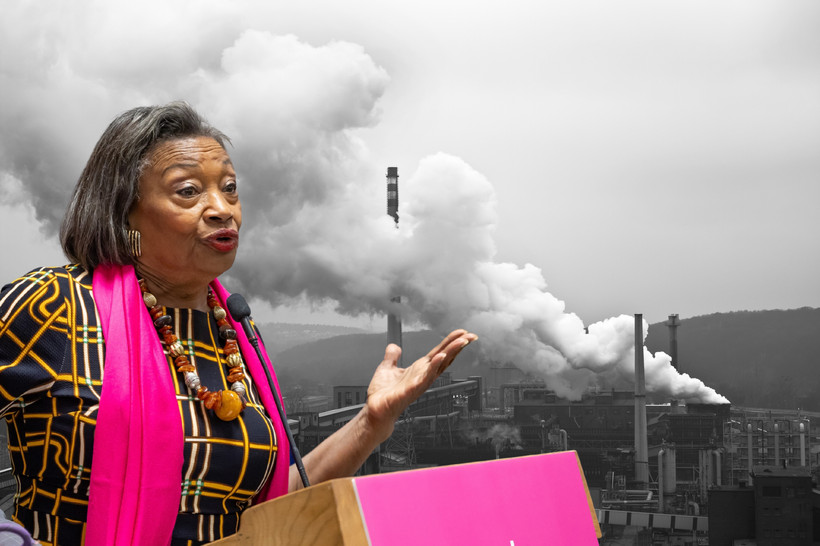
Senate and Assembly Democrats are so far rejecting Governor Kathy Hochul’s push for a budget-season rollback of the state’s climate mandates. | Photos: Senate Media Services; M-SUR/Getty Images | Illustration: Leor Stylar

Sign up for Staying Focused, our newsletter keeping readers up to speed on New York politics.
New York state lawmakers want to keep their foot on the gas — er, accelerator pedal.

Senate and Assembly Democrats are so far rejecting Governor Kathy Hochul’s push for a budget-season rollback of the state’s climate mandates, and are instead seeking renewed funding to keep inching the state toward its emissions targets.

As expected, neither chamber included language in their responses to Hochul’s budget proposal — known as “one-house budgets” — that would amend New York’s flagship climate law. They are both seeking to add $1 billion in funding for the clean energy transition, renewing a major commitment from last year’s budget that Hochul left out this year.

While lawmakers await Hochul’s next move on climate rollbacks, the two chambers’ unified $1 billion push — a key demand from advocates — sets up this year’s clearest fight over New York’s next steps on the green transition.

Like last year, the largest share of that pot would go toward cutting pollution from buildings, including a notable boost for the Empower Plus program, which funds efficiency upgrades for low- and moderate-income households, and neighborhood-scale electrification projects known as “thermal energy networks.” Smaller portions would go to clean transportation and renewable energy efforts, though the two chambers don’t fully agree on which ones.

The Senate also once again said it wants the state to move ahead with a longer-term climate funding plan — the carbon pricing program known as cap and invest, which Hochul unexpectedly shelved at the start of last year — but didn’t include any specific legislative language to advance it. (The Assembly made no mention of cap and invest.)

Senate energy committee chair Kevin Parker, speaking to New York Focus ahead of the one-house budgets’ release on Monday, said Hochul’s efforts to amend the climate law were “misguided.”

“I’m for moving ahead with cap and invest, and I think there’s… a lot of different areas in which you can address [climate] without pushing back the timetables,” he said.

That attitude is reflected in the wide array of new energy and climate measures the Senate and Assembly proposed.

The Assembly is taking major swings on energy affordability, proposing a whopping $2.6 billion in bill rebates to low-income customers through a new program. And it is seeking a two-year freeze on all electric and gas rate hikes — an entirely new proposal.

The Senate is pitching a more modest $200 million in rate relief through an existing program. And it wants to keep, but tweak, other utility reforms Hochul has put on the table — such as tying CEO pay to bill affordability — whereas the Assembly set those aside.

Both chambers want to set aside $1 million for consumer watchdog groups participating in utility rate hike proceedings. Hochul has vetoed a standalone bill to create such a program three times, but its inclusion in budget talks could change the calculus. The Assembly also wants to create a new utility consumer advocate’s office in state government, reviving another piece of legislation Hochul has repeatedly vetoed; the Senate did not include it.

The legislature is on board with Hochul’s Excelsior Power proposal, which would put $33 million toward bill rebates for customers who enroll smart thermostats with their utilities, as part of an effort to make the electric grid more flexible. But they want additional guardrails on the program, to protect customers’ privacy and guarantee that they would be able to override utilities’ control of their thermostats. (The Senate and Assembly proposals vary on the specifics.)

The Senate, meanwhile, wants to make it easier and cheaper to plug local solar projects into the grid, and to create rebates for heat pumps, e-bikes, and used electric cars.

Climate advocates have applauded the two chambers’ proposals, starting with their decisions to stand by the climate law.

Liz Moran, New York policy advocate for Earthjustice, said in a statement that the law “is not responsible for higher energy bills, and should not be negotiated under the darkness of the budget process.”

The business group Upstate United, for its part, called the legislature’s stance “infuriating.”

“Any measure that ignores the unconscionable cost increases associated with Cap-and-Invest should be dead on arrival,” the group wrote in a statement, referring to the $4,000 per household price tag that Hochul’s administration claims could result from a maximal version of the program.

None of the budget proposals include anything on two of Hochul’s flagship energy proposals this year: building new nuclear plants and regulating data centers. (Those proposals are advancing through agency regulations.) The Assembly did put forward a new excise tax on cryptocurrency mining, which it says could raise $380 million a year and help fund energy bill rebates.

While climate advocates cheered at seeing so many of their priorities reflected in the budget proposals, Parker noted that the documents remain “aspirational.”

“We put a stake in the ground on certain positions,” he said. “But we’re not building the building until the three of us can agree where it goes.”

I hope this article helped you better answer the question that guides all of our journalism: Who runs New York? Before you click away, please consider supporting our work and making more stories like this one possible.

New York state is standing at a crossroads for climate action. After passing one of the nation’s most ambitious climate laws in 2019, the state is lagging far behind on its targets, struggling to meet deadlines to build renewable energy and clean up its buildings and roads. Other states are closely watching our progress, making decisions about their own climate plans based on New York’s ability to implement this legislation.

As New York’s only statewide nonprofit news publication, we’ve been scrutinizing the state’s climate progress. Our journalism exists to unpack how power works in New York, analyze who’s really calling the shots, and reveal how obscure decisions shape ordinary New Yorkers’ lives.

But we can't do this work without your help. We rely on reader donations to help sustain our outlet, and every gift directly allows us to publish more pieces like this.

Our work has already shown what can happen when those with power know that someone is watching, with my reporting prompting a state investigation and fine for a major corporation. I have more story ideas than I can count, but only limited resources to pursue all the leads that come across my desk.

If you’re able, please consider supporting our journalism with a one-time or monthly gift. Even small donations make a big difference.

Thank you for reading.

Colin Kinniburgh
Climate and Environmental Politics Reporter
A photo of Colin Kinniburgh.
Colin Kinniburgh is a reporter at New York Focus, covering the state’s climate and environmental politics. He has worked in media for more than a decade, across print, television, audio, and online news, and participated in fellowship programs at CUNY’s Graduate School of Journalism… more
Also filed in New York State

At a Board of Regents meeting Monday, state officials proposed eliminating credit-based diploma requirements.

The last-minute influx, the biggest ever for a legislative primary, is boosting her opponent, Jessica González-Rojas.

City budget gaps and an ambitious affordability agenda may require pressing Albany again for taxes and aid.

Also filed in Budget

In May, state lawmakers passed a $269 billion budget after haggling for months over thousands of line items and policies affecting New Yorkers.

State leaders are expected to pass a bill that avoids resolving how much Resorts World New York City needs to pay.

Resorts World is floating legislation to avert more than $500 million in payments to the horseracing industry.

Also filed in Climate and Environment

The citizens assembly model, used for public decision-making around the world, is gaining traction in New York.

A lobbyist who has been romantically linked to Assembly Speaker Carl Heastie led a rally opposing the legislation a week before the speaker declined to bring it to a vote.

Governor Kathy Hochul was successful in her bid to upend the Climate Leadership and Community Protection Act after legislators caved to finalize an overall budget deal.