How a More Flexible Grid Could Save New York Billions

Officials have long eyed “virtual power plants,” which coordinate energy use across thousands of homes, but the state has lagged in adopting them.

Jack Carroll and Colin Kinniburgh   ·   February 18, 2026
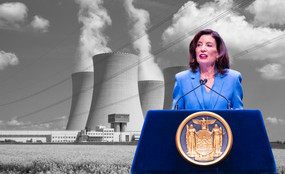
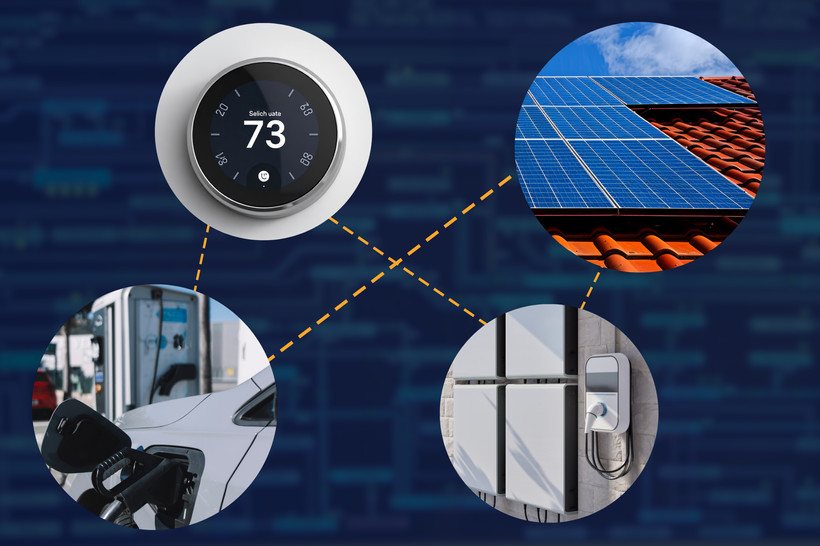
Tapping into the collective power of millions of smart devices in people’s homes to balance electricity needs, experts say, would make the grid more reliable, help phase out polluting power plants, and save billions each year on energy bills. | Photos: andiiwan, anuka5296, Jirasukhanont, Jordi Calvera/Canva | Illustration: New York Focus
  • Networks of home batteries, smart thermostats, and other devices could smooth out energy demand, making the grid more reliable and saving New Yorkers billions on their bills.

  • Tapping into these networks would allow utilities to rely less on costly and polluting power plants to keep up with state’s growing energy demand.

  • New York has long embraced the concept, known as virtual power plants, in theory — but has lagged behind other states in putting it into practice.

  • As energy bills soar, Governor Kathy Hochul is proposing putting state funds towards the idea for the first time.

Sign up for Staying Focused, our newsletter keeping readers up to speed on New York politics.

Julia Calderon’s power used to go out regularly. She lives in a rural part of Orange County, New York, near the New Jersey border, and remembers once having to bury an ice cream cake in the snow to keep it from melting on her daughter’s birthday. “Somehow it worked okay. … We’re so used to it,” she said of the outages.

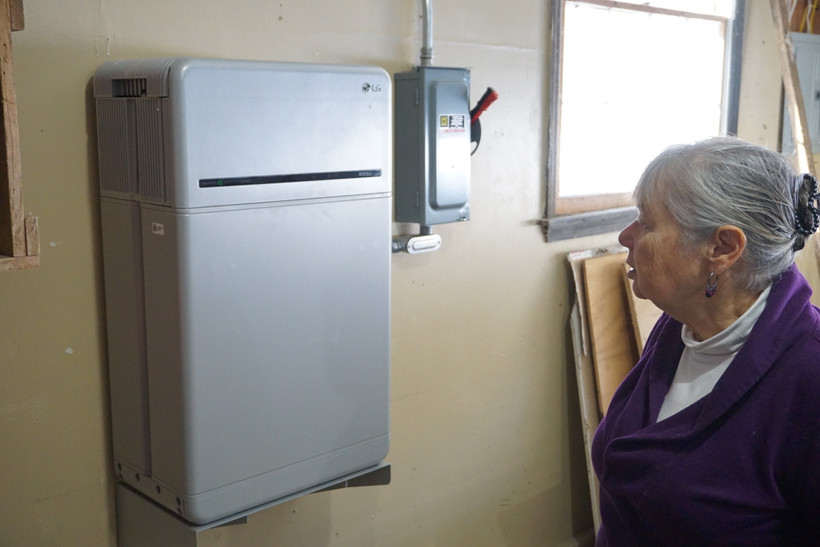
But when a major winter storm hit last month, she wasn’t worried. She hasn’t lost power for more than a few seconds at a time since getting a battery installed in her garage a few years ago. The battery doesn’t just help keep her lights on; it helps keep her neighbors’ on, too, and reduce strain on the whole electric grid.

That’s because Calderon’s battery is connected to hundreds of others in a network known as a “virtual power plant” that allows her utility to redistribute her unused energy.

Scaled up, such a network could transform New York’s grid. Tapping into the collective power of millions of smart devices in homes and businesses to balance electricity needs, experts say, would make the grid more reliable, help phase out polluting power plants, and save billions each year on energy bills.

Calderon got her battery for free through a pilot program run by the utility company Orange & Rockland and the solar company Sunrun. The 350 households participating can deliver about 1.5 megawatts of power to the grid at peak times — about enough to supply roughly 1,000 homes for a couple of hours. And they’re saving money: Calderon’s electric bill drops as low as $40 some months, she said, and she spends less on energy overall even with the $70 a month she pays to lease her solar panels.

The concept of virtual power plants is gaining traction among energy experts, who say such programs could be instrumental in coming years as the state grapples with rising energy demand and soaring energy bills.

New York was early to embrace the idea, but efforts to implement it at scale have faltered. Governor Kathy Hochul ordered the state power authority to build three virtual power plants in 2022, but none have yet materialized. Analysts say utilities are unlikely to act without more regulatory pressure, and lawmakers say they’ve heard little from environmental groups about the approach.

This year, Hochul’s executive budget proposal included $33 million to subsidize households who register new smart thermostats, in what she’s called a “clever” approach to lowering bills. Virtual power plant proponents say it’s a start. But what would it take to bring the approach into the mainstream?

Colin Kinniburgh/New York Focus

Julia Calderon’s battery is connected to hundreds of others in a network known as a “virtual power plant.”

How a ‘Flexible’ Grid Works

In a traditional electric grid, power flows essentially in one direction: from central power plants to homes and businesses. In a “flexible” grid, powered in part by virtual power plants, those homes and businesses take on a new role. Not only can they supply power back to the grid with rooftop solar and batteries, but their devices — smart thermostats and electric vehicles, for example — can communicate with each other and with grid operators to respond to the system’s demands.

Under the traditional model, utilities have to keep an army of power plants, substations, and wires on standby at all times, in preparation for peak times like hot summer days. The costs of maintaining that system show up on every energy bill, even when customers are using less energy.

“It’s built for the hottest couple of days or hours of the year, but customers are paying for it all year long,” said Richard Kauffman, who served as the state’s energy czar from 2013 to 2019 and chaired the board of the energy authority NYSERDA until last year.

The more you use technology to spread out demand and adapt to the grid’s needs, the less utilities rely on costly infrastructure to meet the peak — and the less utility spending shows up on customers’ bills.

Some New Yorkers already have the kinds of devices needed for this approach. Others would need to install them, with costs ranging from about $200 for thermostats to $10,000 or more for home batteries. (Many utilities already offer incentives to help defray those costs.)

Then, crucially, they would need to give their utility or a third-party provider some control over the devices. On a sweltering summer day when air conditioners are blasting, a utility might nudge participants’ thermostats up by a couple of degrees, but still allow them to override the controls.

In the Orange & Rockland program, participants allow the utility to call on their batteries when needed, but Calderon says she hasn’t noticed. Christian Woods, who manages the pilot, said that participants always retain 20 percent of their battery life in case of emergencies.

According to a state-commissioned report by the Brattle Group consultancy last year, if hundreds of thousands of customers participated in such efforts, New Yorkers could save at least $2.4 billion annually by 2040. And many of the savings could be achieved sooner.

Virtual power plants could also allay New York’s growing reliability concerns. 

The New York Independent System Operator, the nonprofit that manages the state’s grid, has warned that New York may not have enough energy to meet demand over the next decade, as large energy users like data centers come online and the state electrifies homes and transportation. New York City, it said, could face a gap as soon as next summer. Even last summer, NYISO had to activate emergency protocols during a worse-than-expected heat wave. 

In response (and to some controversy), NYISO recommended the state delay the retirement of multiple fossil fuel plants, including high-polluting peaker plants in New York City, and strongly consider the construction of new ones.

Some experts argue that virtual power plants offer a cheaper, cleaner way to close the gap. A 2023 Brattle analysis found that the networks can backstop the grid as reliably as an average-sized gas peaker plant, for about half the price.

What Are the Downsides?

Panayiotis Moutis, a professor of electrical engineering at the City College of New York, said that, in theory, virtual power plants “can be a perfect replacement” for dirty peakers. But coordinating enough devices to meet demand in a city like New York is no small feat.

Asking utilities with aging IT systems to adopt technologies that can remotely sense and control hundreds of thousands of devices in individual homes is “a very big leap,” he said.

Grid operators also worry about participants opting out at critical times. On average, one in five participants in National Grid’s smart thermostat program overrode the utility controls last year, Syracuse.com reported.

Some consumer advocates, meanwhile, warn that grid flexibility programs need strong privacy protections. “No customer should be required to trade control over their personal data in exchange for modest utility bill relief,” wrote the Public Utility Law Project of New York in recent comments about the governor’s smart thermostat proposal.

Some of the companies working with utilities to scale up the model have mixed track records.

Calderon said she faced issues with Sunrun. Her roof sprung a leak not long after she had solar panels installed, for example, and she had to pony up more than $2,000 to get it fixed, while waiting months for the company’s customer service to get back to her.

Chris Rauscher, the company’s head of grid services, said that, “as the industry leader, Sunrun is always trying to better our practices as well as bring the entire industry along and create uniform codes of conduct to ensure that that type of thing doesn’t happen.” (Sunrun is the largest US installer of home solar and battery systems.)

New York’s Track Record

New York’s shift toward a more flexible grid has come in fits and starts over the years.

In 2014, then-Governor Andrew Cuomo made it a centerpiece of his energy agenda, in an initiative known as “Reforming the Energy Vision,” or REV. That effort plods on today, with offshoots like the Orange County battery program, but has largely failed to bring about the kind of energy revolution it promised.

In 2022, Hochul directed the New York Power Authority to create at least three virtual power plants by the end of that year. It has yet to complete a single one. (Spokesperson Susan Craig said NYPA is still working on one on Long Island; it issued a detailed project report late last year and is working with the local utility to assess next steps.)

In 2024, Hochul launched her own effort at wider reforms — a regulatory proceeding aimed at creating a “Grid of the Future” by bringing flexible technologies into the mainstream. Its core mandate is to issue more recommendations, and it is currently running six months behind.

This year marks the first time Hochul is putting state budget funds toward the approach. She wants to pay households $300 over the course of a year for registering a new smart thermostat with their utilities. Her administration hopes that will lead about 100,000 households to sign up, roughly doubling enrollment in existing utility programs.

Hochul’s proposal would open up about 100 megawatts of capacity on the grid, or the equivalent of a small power plant. That’s a small fraction of the potential. Last year’s Brattle Group report found that fully harnessing grid flexibility could unlock some 8.5 gigawatts by 2040 — equivalent to one-fifth of peak electric demand.

“Our grid of the future is increasingly looking like the grid of today in other states.”

—Joe Silver, NineDot Energy

Other states and countries have vaulted ahead with the idea. In Vermont, the utility Green Mountain Power leases home batteries to residents that it can draw on when the grid is strained, as it did during a heat wave last summer. The 5,000-home network serves as the utility’s largest backup resource for moments of peak demand.

Across the country, major corporate utilities and rural electric cooperatives alike are adopting similar models. California assembled more than 700 megawatts’ worth of home batteries in less than three years. In a test last summer, the network matched the output of a large traditional power plant at peak evening hours. (Funding issues last year left the California program in limbo.)

At a renewable energy conference last fall, Joe Silver, a product manager at the battery storage company NineDot Energy, said it was time “to stop treating existing and proven technology like it is science fiction.”

“Our grid of the future,” he said of New York, “is increasingly looking like the grid of today in other states.”

What’s the Holdup?

For many clean energy advocates, the fundamental obstacle to a more flexible grid lies in the utility business model. Utilities make their money by building infrastructure and earning a state-approved return on the investments. That gives them very little incentive to pursue software-driven solutions that could reduce the need for grid upgrades, said Jen Downing, a former top official at the US Department of Energy’s Loan Programs Office.

Kauffman, the former state energy czar, said the core mission of New York’s REV proceeding was to change that. It introduced new ways for utilities to be rewarded for performance, but didn’t fundamentally change the equation, he said: “Utilities, I don’t believe, have embraced this as an opportunity.”

Jigar Shah, a clean energy entrepreneur who led the federal Loan Programs Office from 2021 to 2025, said the status quo has prevailed because state agencies have passed the buck on the issue.

“There’s no architect for change in New York state,” he said. Breaking the impasse would likely require new legislation, he said, along the lines of bills recently passed in Virginia, Illinois, and Colorado.

Asked about the state’s halting progress, Hochul administration officials highlighted tens of millions of dollars spent on a variety of smart grid initiatives in recent years. Public Service Commission spokesperson James Denn acknowledged that New York trails California in aggregating home batteries, but said a “Bring Your Own Battery” initiative launched in April has shown promise.

“A lot of these investments take time to come to fruition, and the regulatory world is very long-lived,” Public Service Commission Chair Rory Christian told New York Focus in January.

“We want to make sure that the investments we make are going to be sustainable.”

He cited a recent commission order to Con Edison directing the utility “to find everything under the kitchen sink” to meet New York City’s projected power shortages without increasing pollution as the next step in accelerating the state’s longstanding efforts toward a more flexible grid.

State lawmakers contacted by New York Focus said the approach has not been on their agendas. Senate energy committee chair Kevin Parker said he was eager to explore demand-side efforts but that his colleagues were largely unfamiliar with them.

Senator Kristen Gonzalez, who chairs the chamber’s tech committee, likewise said she hasn’t heard much from advocates about the approach.

Hochul’s smart thermostat proposal, and wider concerns about energy affordability, could push the conversation further into the mainstream this year. 

Woods, who runs the Orange & Rockland pilot, said he was keen to see such efforts get more funding. He said the utility’s executives “love our program” and disputed that the industry has been holding things up. 

“Even if you wrote me a blank check,’” he said, “the hardest thing about virtual power plants [is that] we can’t make the customer do anything.”

Calderon, in Warwick, doesn’t know why so many of her neighbors were reluctant to join the battery program. Despite the hiccups installing her system, she said, the added reliability and lower monthly bills have brought her more peace of mind.

“I think it’s well worth it,” she said.

Correction: March 3, 2026 — A previous version of this article overstated how much energy the Orange & Rockland battery pilot supplies to the grid. The correct figure is about 1.5 megawatts, not 50 megawatts. The larger figure reported by the utility reflected a cumulative amount over several months.

I hope this article helped you better answer the question that guides all of our journalism: Who runs New York? Before you click away, please consider supporting our work and making more stories like this one possible.

New York state is standing at a crossroads for climate action. After passing one of the nation’s most ambitious climate laws in 2019, the state is lagging far behind on its targets, struggling to meet deadlines to build renewable energy and clean up its buildings and roads. Other states are closely watching our progress, making decisions about their own climate plans based on New York’s ability to implement this legislation.

As New York’s only statewide nonprofit news publication, we’ve been scrutinizing the state’s climate progress. Our journalism exists to unpack how power works in New York, analyze who’s really calling the shots, and reveal how obscure decisions shape ordinary New Yorkers’ lives.

But we can't do this work without your help. We rely on reader donations to help sustain our outlet, and every gift directly allows us to publish more pieces like this.

Our work has already shown what can happen when those with power know that someone is watching, with my reporting prompting a state investigation and fine for a major corporation. I have more story ideas than I can count, but only limited resources to pursue all the leads that come across my desk.

If you’re able, please consider supporting our journalism with a one-time or monthly gift. Even small donations make a big difference.

Thank you for reading.

Colin Kinniburgh
Climate and Environmental Politics Reporter
A photo of Colin Kinniburgh.
Jack Carroll is a journalist in New York. His work has also appeared in Wired, City & State and The Daily Gazette.
A photo of Colin Kinniburgh.
Colin Kinniburgh is a reporter at New York Focus, covering the state’s climate and environmental politics. He has worked in media for more than a decade, across print, television, audio, and online news, and participated in fellowship programs at CUNY’s Graduate School of Journalism… more
Also filed in New York State

At a Board of Regents meeting Monday, state officials proposed eliminating credit-based diploma requirements.

The last-minute influx, the biggest ever for a legislative primary, is boosting her opponent, Jessica González-Rojas.

City budget gaps and an ambitious affordability agenda may require pressing Albany again for taxes and aid.

Also filed in Climate and Environment

The citizens assembly model, used for public decision-making around the world, is gaining traction in New York.

A lobbyist who has been romantically linked to Assembly Speaker Carl Heastie led a rally opposing the legislation a week before the speaker declined to bring it to a vote.

In May, state lawmakers passed a $269 billion budget after haggling for months over thousands of line items and policies affecting New Yorkers.

Also filed in Affordability

We’ve compiled information for the 450,000 New Yorkers who will lose health care coverage on July 1.

We’ve compiled information for SNAP recipients in New York on the changing work requirements.

Despite last-ditch efforts by a coalition of lawmakers, the state failed to avert a health coverage cliff coming this summer.