State Legislature Backs Tax Hikes on Wealthy, Adding Fuel to Mamdani’s Push

The Senate and Assembly’s budget proposals include many of the mayor’s desired revenue-raisers and give the city a larger cut of state funds.

Nick Garber   ·   March 10, 2026
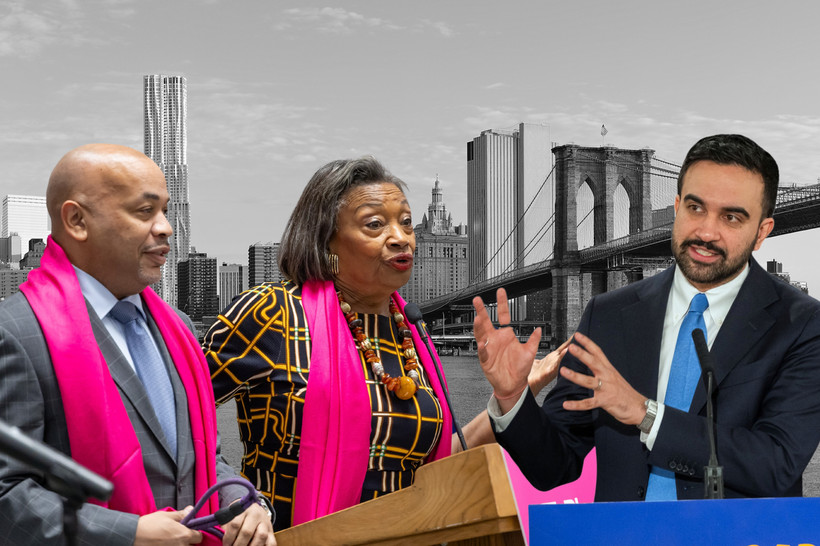
| Photos: NYS Senate Media Services; NYC Mayor's Office | Illustration: Leor Stylar

Sign up for Staying Focused, our newsletter keeping readers up to speed on New York politics.
State lawmakers gave their stamp of approval to many of the tax increases pushed by New York City Mayor Zohran Mamdani, adding fuel to his campaign to pressure Governor Kathy Hochul into approving the revenue-raisers.

In their budget proposals released Monday night, the state Senate and Assembly both included tax increases for high earners and corporations. The income tax hikes are smaller than what Mamdani is seeking, while the business tax increases match the mayor’s recent scaled-down demands. They’re both similar in scope to the legislature’s proposals last year.

Both houses also voiced support for pilot programs to make some buses fare-free, although they stopped short of meeting Mamdani’s goal of ending fares entirely.

Assembly and Senate leaders appear to have heeded Mamdani’s call to help the city deal with a $5.5 billion budget shortfall over the next two years. Both houses proposed a range of smaller tax hikes and funding shifts that would benefit the city, including shrinking a tax credit used by some well-paid executives, expanding a “mansion tax” on homes sold for more than $5 million, and sending the city hundreds of millions of dollars in aid.

Exactly how much revenue those policies would bring the city was not immediately clear, although the business taxes alone would provide about $1.75 billion, according to estimates from the mayor’s office first reported by New York Focus.

“I’m grateful that the Assembly and Senate One-House Budgets recognize the scale of the fiscal crisis facing New York City,” Mamdani said in a statement, thanking Assembly Speaker Carl Heastie and Senate Majority Leader Andrea Stewart-Cousins for taking “meaningful steps toward closing the deficit we inherited.”

It’s no shock that lawmakers are supporting tax increases, which the Senate and Assembly supported long before Mamdani’s election. The Assembly proposed raising personal income taxes statewide by 0.2 percentage points for people earning between $5 million and $10 million and adding new brackets for the highest earners, while also cutting taxes for filers earning below $323,200. The Senate is supporting a bigger increase of 0.5 points for filers earning above $5 million, and did not call for any tax cuts.

Mamdani, for his part, is pushing a bigger 2-point increase for filers earning above $1 million, which would have brought in $3 billion in revenue. Neither house signed onto Mamdani’s proposal for a new 1-percent property-tax surcharge on homes valued over $5 million.

On statewide corporate taxes, the Assembly backed a 2-point increase for businesses with at least $10 million in revenue, while the Senate would raise taxes by 1.75 points on firms earning over $5 million. And both houses signed onto Mamdani’s request to raise New York City’s own corporate tax rates. All of those increases would take effect this year.

Hochul, by contrast, has ruled out raising income taxes and omitted any increases in her January executive budget. She did propose maintaining current corporate tax rates by extending a pandemic-era surcharge through 2029, but did not support increasing business taxes.

The mansion tax backed by both houses would raise current tax rates by about 1.4 points on expensive home sales. A cut to the city’s Pass-Through Entity Tax, which currently lets some executives use their business tax payments to fully cancel out what they owe in personal income taxes, would shrink that benefit from 100 percent to 75 percent — matching what Mamdani wanted. (The Senate also called for shrinking a similar state-level benefit to 90 percent).

The Senate, meanwhile, included Mamdani’s proposal to scrap a sales-tax exemption on gold bars and other precious metals, which would produce about $300 million in revenue for the city and $601 million for the state, according to the mayor’s office.

And both houses signaled support for Mamdani’s quest to give the city a larger cut of state aid. The Assembly would give the city $1 billion, divided evenly over three years, by welcoming the city back into the Aid and Incentives to Municipalities program that it was kicked out of in 2011. The Senate would give the city $604 million over two years from the same program.

The Senate wants to offer the city $500 million to cover homeless shelter costs, while the Assembly would dole out $600 million to help the city comply with the costly school class-size mandate. And both houses would give the city upwards of $150 million to undo a previous cut in state assistance for low-income families.

On buses, the Assembly proposed $15 million to cover at least one fare-free line in each of the five boroughs. The Senate’s budget resolution offered fewer specifics, saying only that it “continues to support a revival” of the short-lived free-bus pilot that began in 2023.

The progressive Fiscal Policy Institute praised the proposed tax hikes for their potential to expand state services, while criticizing the Assembly’s proposal to cut taxes for upper middle-class earners. Emily Eisner, FPI’s acting director and chief economist, said the new revenue would go only so far for New York City.

“Both one-house proposals give New York City authority to increase its tax revenue and reverse recent cost-shifting,” Eisner said, “enough to close the current gaps and prevent cuts to vital services, but not enough to fully achieve the new mayor’s affordability mandate.”

At New York Focus, our central mission is to help readers better understand how New York really works. If you think this article succeeded, please consider supporting our mission and making more stories like this one possible.

New York is an incongruous state. We’re home to fabulous wealth — if the state were a country, it would have the tenth largest economy in the world — but also the highest rate of wealth inequality. We’re among the most diverse – but also the most segregated. We passed the nation’s most ambitious climate law — but haven’t been meeting its deadlines and continue to subsidize industries hastening the climate crisis.

As New York’s only statewide nonprofit news publication, our journalism exists to help you make sense of these contradictions. Our work scrutinizes how power works in the state, unpacks who’s really calling the shots, and reveals how obscure decisions shape ordinary New Yorkers’ lives.

In the last two decades, the number of local news outlets in New York has been nearly slashed in half, allowing elected officials and powerful individuals to increasingly operate in the dark — with the average New Yorker none the wiser.

We’re on a mission to change that. Our work has already shown what can happen when those with power know that someone is watching, with stories that have prompted policy changes and spurred legislation. We have ambitious plans for the rest of the year and beyond, including tackling new beats and more hard-hitting stories — but we need your help to make them a reality.

If you’re able, please consider supporting our journalism with a one-time gift or a monthly gift. We can't do this work without you.

Thank you,

Akash Mehta
Editor-in-Chief
A photo of Akash Mehta.
A photo of Nick Garber.
Nick Garber covers politics for New York Focus. He previously worked for Crain’s New York Business, where he covered city and state government, housing and real estate, and money in politics. He also covered neighborhood news in Manhattan and Queens for Patch, and got… more
Also filed in New York State

At a Board of Regents meeting Monday, state officials proposed eliminating credit-based diploma requirements.

The last-minute influx, the biggest ever for a legislative primary, is boosting her opponent, Jessica González-Rojas.

City budget gaps and an ambitious affordability agenda may require pressing Albany again for taxes and aid.

Also filed in Budget

In May, state lawmakers passed a $269 billion budget after haggling for months over thousands of line items and policies affecting New Yorkers.

State leaders are expected to pass a bill that avoids resolving how much Resorts World New York City needs to pay.

Resorts World is floating legislation to avert more than $500 million in payments to the horseracing industry.

Also filed in New York City

A lawsuit accuses federal officials of ignoring evidence that the boy, born in Mexico, held US citizenship through his mother.

We’ve compiled information for the 450,000 New Yorkers who will lose health care coverage on July 1.

The citizens assembly model, used for public decision-making around the world, is gaining traction in New York.