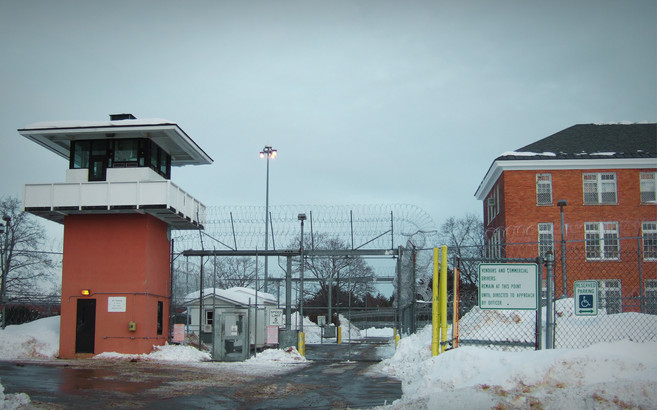
A Quieter Budget Battle on Criminal Justice and Prison Reform

Amid a crisis in the state’s prison system, the governor’s and legislature’s budget proposals differ, but largely lack major reforms.

Chris Gelardi   ·   March 10, 2026
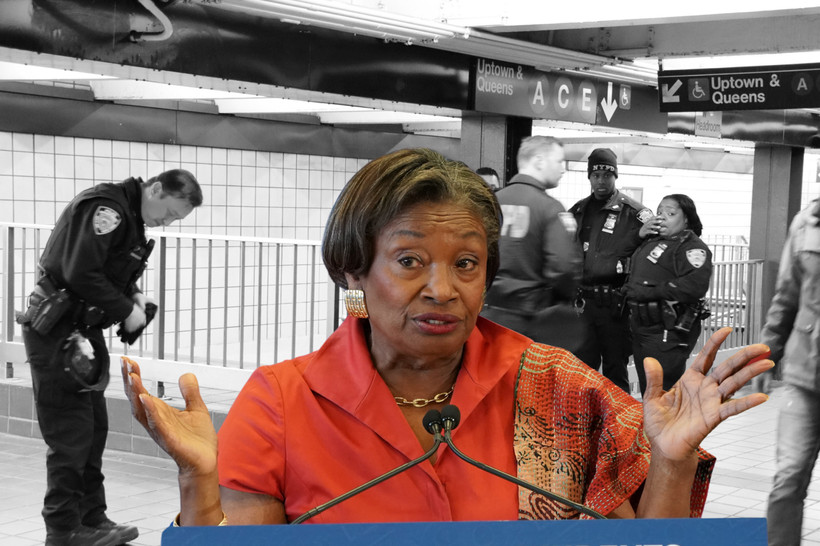
Neither chamber, nor Hochul, included major prison reforms in their proposed budgets this year. | Photos: Don Pollard/Office of Governor Kathy Hochul and Elvert Barnes/Flickr | Illustration: Leor Stylar

Sign up for Staying Focused, our newsletter keeping readers up to speed on New York politics.

With the deadline to pass New York’s state budget legislation less than a month away, governing bodies aren’t battling over the criminal justice system as they have in the past. Yet they also aren’t proposing major reforms, even as the state’s prisons are enduring one of their most tumultuous periods in half a century.

Two killings by guards and a three-week corrections officer strike left the prison system in crisis last year. After the first killing, Governor Kathy Hochul called for reform, promising that she would “not be satisfied until there has been significant culture change” within the system. She expedited the rollout of body-worn cameras, hired consultancies to review prison operations, and signed into law a limited omnibus package that expanded outside oversight bodies’ powers and responsibilities.

While progressive legislators portrayed the measures as a first step toward broader policy changes, Hochul has treated them as the final word. Her budget proposal this year didn’t put forward any new measures to reform state prisons — though it included $535 million in additional funding for the National Guard to help staff the facilities, which remain operating on varying levels of lockdown. And while the executive budget re-upped last year’s funding increase for one oversight body, the State Commission of Correction, it sought to eliminate state funding for another, the Correctional Association of New York.

The Senate re-added the $3 million for the Correctional Association, which visits prisons and has used added state money to closely monitor problematic facilities, but the Assembly didn’t, putting the group’s work at risk. The Assembly, meanwhile, proposed mandating that the State Commission of Correction, which has faced criticism for its relative inaction, hire a chief medical examiner to conduct independent investigations into jail and prison deaths — a measure the Senate proposal didn’t include. And the Senate legislation included a bill of rights for pregnant incarcerated people, while the Assembly’s didn’t.

Neither chamber, nor Hochul, included sentencing and parole legislation — a top priority for prison reformers — in their budget packages.

The hodgepodge of policy suggestions comes amid a broader de-emphasizing of criminal justice issues in this year’s state budget. In past years, Hochul proposed to roll back major criminal justice reform laws, to significant outcry from lawmakers, but she let up on those efforts this year. And while the legislature proposed tens of millions of dollars more than Hochul did for violence prevention and alternatives to incarceration programs, neither legislative chamber pushed back against her proposals to increase funding for cops.

Despite increased fears over police data enabling President Donald Trump’s “mass deportation” campaign, the chambers greenlit a Hochul initiative to beef up the state’s regional law enforcement information-sharing network, known as the Crime Analysis Center Network. Even with a 16-year low in reported subway crime last year, both chambers’ proposed budgets also included a proposal from Hochul to funnel $77 million to New York City to add up to 750 new subway patrols.

The highest-profile policing disagreement this year may be on a controversial proposal to criminalize protests near houses of worship. The Assembly axed Hochul’s bill to create a 25-foot no-protest zone outside of the entrances and exits to houses of worship. The Senate replaced it with a proposal to make it a misdemeanor to obstruct the entrance to a house of worship.

BEFORE YOU GO, consider: If not for the article you just read, would the information in it be public?

Or would it remain hidden — buried within the confines of New York’s sprawling criminal-legal apparatus?

I started working at New York Focus in 2022, not long after the outlet launched. Since that time, our reporters and editors have been vigorously scrutinizing every facet of the Empire State’s criminal justice institutions, investigating power players and the impact of policy on state prisons, county jails, and local police and courts — always with an eye toward what it means for people involved in the system.

That system works hard to make those people invisible, and it shields those at the top from scrutiny. And without rigorous, resource-intensive journalism, it would all operate with significantly more impunity.

Only a handful of journalists do this type of work in New York. In the last decades, the number of local news outlets in the state has nearly halved, making our coverage all the more critical. Our criminal justice reporting has been cited in lawsuits, spurred legislation, and led to the rescission of statewide policies. With your help, we can continue to do this work, and go even deeper: We have endless ideas for more ambitious projects and harder hitting investigations. But we need your help.

As a small, nonprofit outlet, we rely on our readers to support our journalism. If you’re able, please consider supporting us with a one-time or monthly gift. We so appreciate your help.

Here’s to a more just, more transparent New York.

Chris Gelardi
Justice Bureau Chief
A photo of Chris Gelardi
As New York Focus’s justice bureau chief, Chris Gelardi reports and edits work on the state’s criminal-legal and immigration systems. His writing on cops, jails, ICE, and the US military has appeared in more than a dozen other outlets, most frequently The Intercept… more
Also filed in Criminal Justice

A bill awaiting the governor’s signature would relax restrictions on who can qualify for victim compensation.

In May, state lawmakers passed a $269 billion budget after haggling for months over thousands of line items and policies affecting New Yorkers.

The legislation would make it easier for currently and formerly incarcerated people and child victims to sue the state over allegations of past abuse.

Also filed in New York State

At a Board of Regents meeting Monday, state officials proposed eliminating credit-based diploma requirements.

The last-minute influx, the biggest ever for a legislative primary, is boosting her opponent, Jessica González-Rojas.

City budget gaps and an ambitious affordability agenda may require pressing Albany again for taxes and aid.

Also filed in Budget

State leaders are expected to pass a bill that avoids resolving how much Resorts World New York City needs to pay.

Resorts World is floating legislation to avert more than $500 million in payments to the horseracing industry.

Our searchable database breaks down the most consequential decisions Albany politicians made on climate, immigration, housing, schools, taxes, and more.