New York May End Blame Game When Deciding Which Crime Survivors Get State Aid

A bill awaiting the governor’s signature would relax restrictions on who can qualify for victim compensation.

Cassi Feldman   ·   June 16, 2026
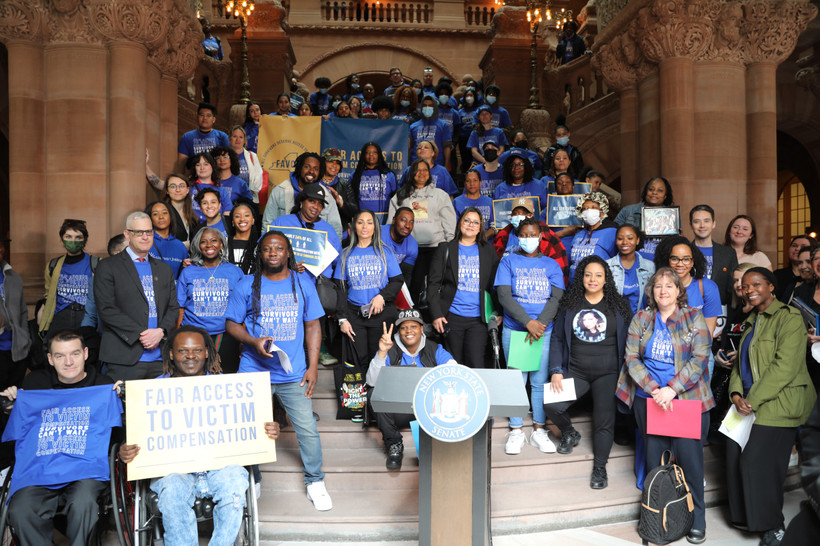
Advocates for survivors holding signs at a rally
Advocates and survivors in New York have long pushed to help victims of violent crime access state compensation. | Common Justice

Sign up for Staying Focused, our newsletter keeping readers up to speed on New York politics.

Victims of violent crime in New York can get the state to help pay for medical expenses and other costs — that is, unless it decides they’re at fault, too. A bill passed this month in the waning hours of the annual state legislative session could change that.

Known as the Survivors First Act, the legislation would bar the state from evaluating what’s known as “contributory conduct” to determine if victims are eligible for funds. Nearly all states have similar restrictions, based on factors like whether the victim was accused of using or selling drugs, fighting with the person who injured them, or being in a gang at the time of the crime.

The state Office of Victim Services decides who receives the funds, using information from law enforcement, prosecutors, claimants, and other sources. In 2024, the office denied roughly 40 percent of the nearly 8,000 claims it ruled on for reasons including incomplete applications and ineligible crimes. Of those, 16 denials included contributory conduct, the office said.

“The victim cannot be considered an innocent victim of crime and is not eligible for an award.”

—Office of Victim Services letter

Research has shown that because victim compensation decisions rely on subjective assessments, they can also lead to racial disparities. In a 2024 analysis, University of Michigan professor Jeremy Levine found that Black New Yorkers represented 31 percent of all victim compensation claims in the state — but made up 53 percent of claims denied for contributory conduct. The disparity was particularly acute for Black men, who represented 14 percent of New York claims but 47 percent of contributory conduct denials.

Kira Shepherd, vice president of organizing and policy at Common Justice, a victim services organization that helped spearhead the bill, said these patterns are harmful for survivors in the moment — and down the line. “If they’re denied because they’re criminalized, they aren’t getting the healing they need, and that just causes the cycle of violence to continue,” she said.

The bill, sponsored by state Senator Julia Salazar and Assemblymember Monique Chandler-Waterman, would strike the provision in the law that instructs the Office of Victim Services to use contributory conduct to deny claims or reduce awards, making New York one of the first states to do so. It would also make it illegal for the state to award survivors less money if they privately fundraised for funeral or medical expenses, as it does now. And it would require the office to better publicize itself and to publish regular statistics on applications for aid, rejections, and the reasons it denies applications.

Survivors and their families are sometimes unaware that they’re eligible for victim compensation or confused by the rules around it.

In 2024, Dylan Marino, 21, was stabbed to death by a worker in a Queens corner store. Grainy security camera footage shows the bodega worker chasing Marino, and then Marino chasing him back before staggering away.

The Office of Victim Services sent a funeral home $3,000 for his services, according to Marino’s mother, Kate Dessommes. Months later, however, the agency tried to claw it back without fully explaining why.

“Our investigation of this claim shows that the victim’s own actions contributed to his/her death,” the office wrote in a letter to  Dessommes. “The victim cannot be considered an innocent victim of crime and is not eligible for an award.”

Dessommes attributes the denial to what she says police told her: that Marino had stolen a beer from the corner store. After she appealed, the agency attributed it to the fact that the worker wasn’t charged in the crime, though the statute does not require that.

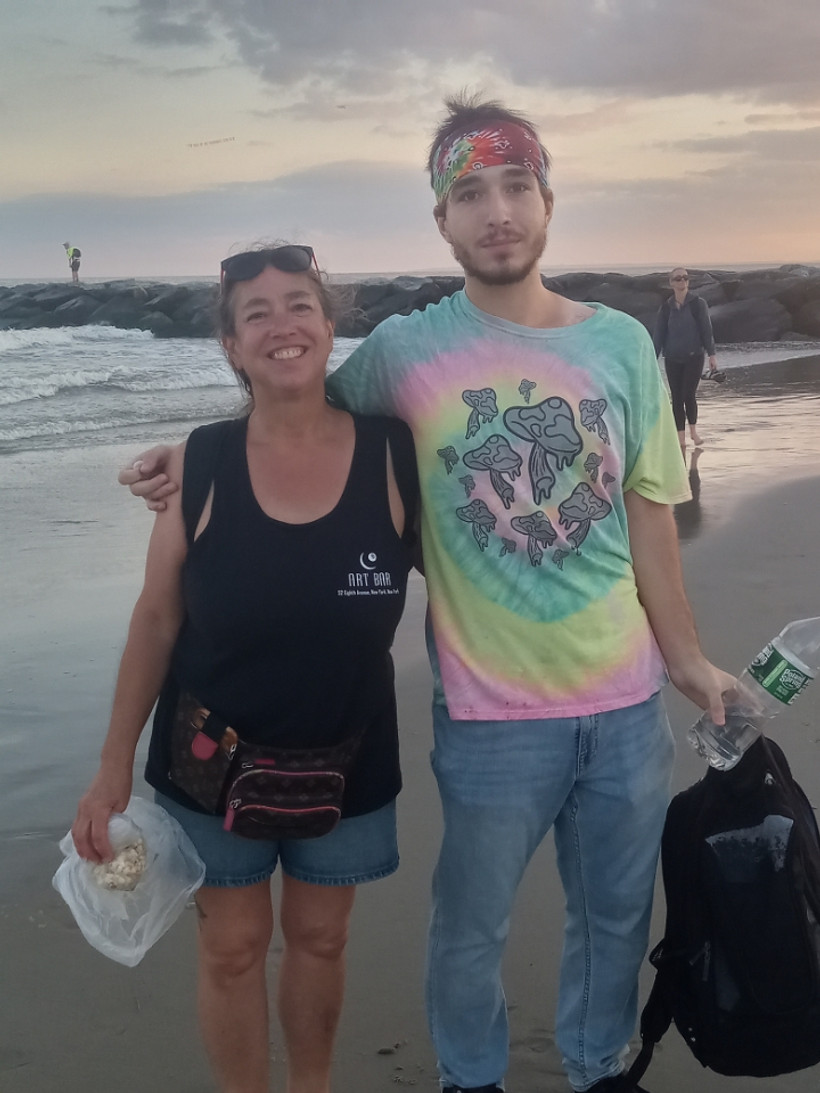
Kate Dessommes and her son, Dylan Marino, on a beach
Kate Dessommes, seen here with her son, Dylan Marino, fought efforts to rescind the victim compensation she received after his killing. | Courtesy of Kate Dessommes

To Dessommes, the letter felt like another emotional blow. “It added so much more stress to something that was already horrible,” she said through tears.

The Office of Victim Services said it could not “comment on an individual claim due to strict confidentiality laws,” but that there may be “circumstances in which OVS is limited in the information it can disclose, such as when doing so could affect an ongoing investigation or prosecution.”

Mika Dashman, founding director of the Restorative Justice Initiative, a nonprofit that advocates for non-punitive responses to harm, was working with Dessommes when she received the denial. She helped her push the state to stop trying to recoup the funding, which it eventually did.

“I couldn’t believe that an agency that was created to support victims of crime would use blaming language like that,” Dashman said. “The state should not be in the business of arbitrarily determining who is an ‘innocent’ victim and who is a ‘deserving’ victim.”

Aaron Cagwin, a spokesperson for the Office of Victim Services, said the agency reviews each claim “based on the information available at the time.”

“While OVS was required to follow the law as written,” he added, “the agency has always approached its work with a focus on supporting victims and survivors and ensuring that claims were reviewed as thoroughly as possible.”

Advocates and lawmakers have successfully pushed the agency to improve access to victim compensation. In 2023, they fought to remove a requirement that survivors report crimes to the police to qualify for aid. And in 2025, the state budget altered the contributory conduct provision so it can no longer be used against homicide victims, like Marino. In all other cases, however, the conduct restrictions still stand.

“If my child dies, they can no longer be blamed” in a way that denies or reduces compensation, explained Robert Gipson II, a New York attorney and former fellow at Giffords Law Center. But if “I catch a stray bullet and live,” he said, the Office of Victim Services “can still make an arbitrary determination about why I was shot.”

That’s where this year’s bill comes in. If signed, New York would become the second state, after Maryland, to completely eliminate contributory conduct as a factor in victim compensation, according to Gipson, who drafted the legislation and worked with the sponsors’ offices, Common Justice, Safe Horizon, and other groups to get it passed.

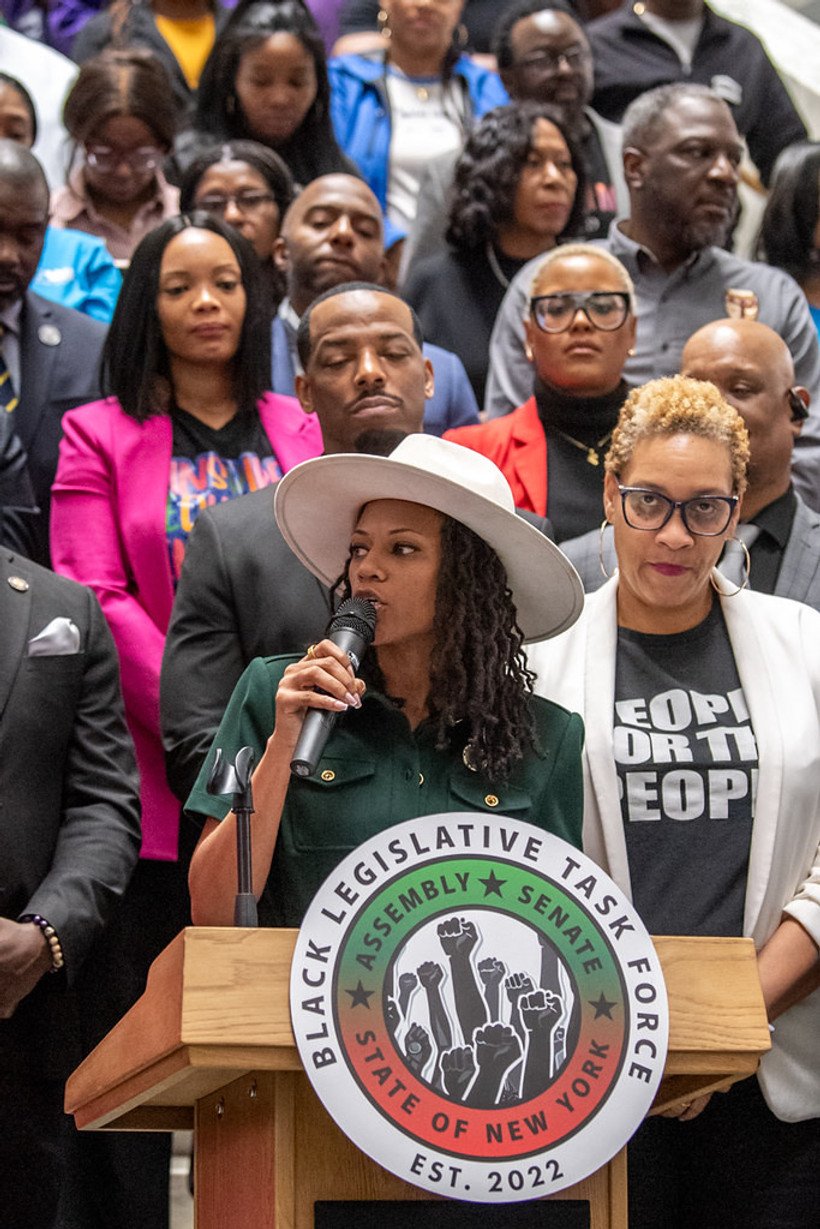
Assemblymember Monique Chandler-Waterman
Assemblymember Monique Chandler-Waterman, a lead sponsor on the bill, helped push for its passage during an unusually short legislative session. | New York State Assembly Majority

The bill passed both legislative chambers unanimously. The legislature has until December to send it to Governor Kathy Hochul, who can sign or veto it.

The governor’s office did not answer questions about whether she plans to sign the bill. In a statement, Jess D’Amelia, a spokesperson for Hochul, said the governor “has championed efforts to improve the state’s response to gun violence, sexual assault, domestic violence, gender-based violence and sex trafficking.” 

“Governor Hochul remains committed to supporting victims and survivors of all crimes and will review this legislation,” she said.

For Shepherd of Common Justice, the bill’s passage is gratifying. “No one has really looked at these policies to make sure that they were equitable,” she said. “I believe that conversation is now happening.”

BEFORE YOU GO, consider: If not for the article you just read, would the information in it be public?

Or would it remain hidden — buried within the confines of New York’s sprawling criminal-legal apparatus?

I started working at New York Focus in 2022, not long after the outlet launched. Since that time, our reporters and editors have been vigorously scrutinizing every facet of the Empire State’s criminal justice institutions, investigating power players and the impact of policy on state prisons, county jails, and local police and courts — always with an eye toward what it means for people involved in the system.

That system works hard to make those people invisible, and it shields those at the top from scrutiny. And without rigorous, resource-intensive journalism, it would all operate with significantly more impunity.

Only a handful of journalists do this type of work in New York. In the last decades, the number of local news outlets in the state has nearly halved, making our coverage all the more critical. Our criminal justice reporting has been cited in lawsuits, spurred legislation, and led to the rescission of statewide policies. With your help, we can continue to do this work, and go even deeper: We have endless ideas for more ambitious projects and harder hitting investigations. But we need your help.

As a small, nonprofit outlet, we rely on our readers to support our journalism. If you’re able, please consider supporting us with a one-time or monthly gift. We so appreciate your help.

Here’s to a more just, more transparent New York.

Chris Gelardi
Justice Bureau Chief
A photo of Chris Gelardi
A photo of Cassi Feldman.
Cassi Feldman is the interim managing editor of New York Focus. Before joining the newsroom, she was a senior enterprise editor at NBC News Digital and editor in chief of Type Investigations. She’s also worked at 60 Minutes, CBS Evening News, The Appeal… more
Also filed in Criminal Justice

In May, state lawmakers passed a $269 billion budget after haggling for months over thousands of line items and policies affecting New Yorkers.

It’s unclear whether the Correctional Association of New York will have to scale back its nascent reform initiatives.

The legislation comes after months of haggling over how best to protect New Yorkers from President Trump’s immigration crackdown.

Also filed in New York State

We’ve compiled information for the 450,000 New Yorkers who will lose health care coverage on July 1.

A lobbyist who has been romantically linked to Assembly Speaker Carl Heastie led a rally opposing the legislation a week before the speaker declined to bring it to a vote.

Millions in outside spending was a boon to Gov. Kathy Hochul’s 2022 opponent, Lee Zeldin, and influenced down-ballot races.