State Legislative Leaders Pass Last-Minute Prison Oversight Package

The bill package will now head to Governor Kathy Hochul’s desk, and she could either sign, veto, or scale it back through amendments to the legislation.

Chris Gelardi   ·   June 13, 2025
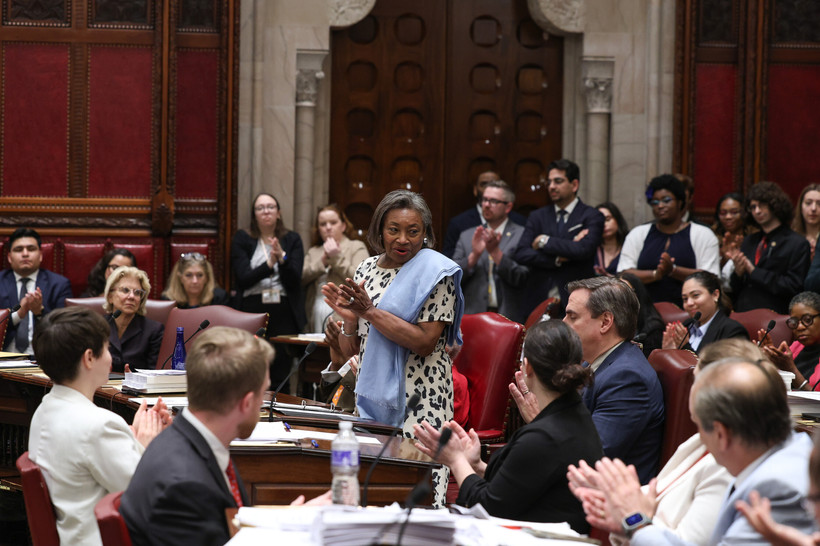
State Senate Majority Leader Andrea Stewart-Cousins delivers closing remarks at the end of her chamber's legislative session in Albany. June 13, 2025. | NYS Senate

Sign up for Staying Focused, our newsletter keeping readers up to speed on New York politics.

Amid one of the most chaotic years for New York’s prison system in recent memory, the state legislature passed a limited omnibus prison reform bill Thursday night, hours before one of its chambers closed out its lawmaking for the year.

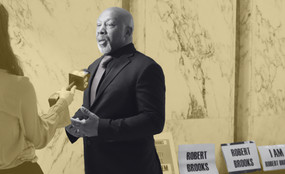
The bill is the legislature’s response to the state prison agency’s mounting scandals. In December, body-worn cameras captured corrections officers taking turns beating a handcuffed incarcerated man named Robert Brooks, who died hours later. The killing sparked nationwide outcry and served as a backdrop for months of tumultuous events that followed, including a three-week corrections officers strike, another alleged killing at the hands of prison guards, and two contentious legislative hearings.

Prison reform-minded lawmakers compiled a 23-bill package to address what they described as systemic issues underlying Brooks’s death. State Senate and Assembly leaders then picked seven of them, plus three other prison reform bills, to include in the omnibus. Both chambers passed that bill Thursday night, shortly before the Senate ended its annual legislative session early Friday morning. (The Assembly has delayed the end of its session to next week.)

Most of the provisions in the omnibus legislation center on beefing up prison oversight and transparency.

“This bill is a serious step toward finally reforming our prisons,” Julia Salazar, head of the Senate corrections committee and the original sponsor of most of the bills in the omnibus, said in a statement. “There is more work to do, including an expansion of pathways for release, but this is progress, it will make a difference, and I’m proud to stand behind it.”

A few reform advocates echoed the praise, while others criticized the final legislation’s limited scope. The Legal Aid Society said that it “represents a colossal failure by lawmakers to meet this moment.” Detractors were especially frustrated that it left out parole and sentencing reform — longstanding demands from advocates and a top priority for Brooks’s father, a central figure in this year’s campaign.

“I’m so disappointed,” Susan Shervington, an activist with VOCAL-NY, said in a statement. “I’m happy they’re passing oversight and accountability bills, but real accountability means passing reforms that will get people out of prisons, end qualified immunity, and allow people to challenge wrongful convictions.”

The bill package will now head to Governor Kathy Hochul’s desk, and she could either sign, veto, or scale it back through amendments to the legislation.

The prison omnibus’s path to passage is a case study in New York’s top-down legislative system.

In May, Governor Kathy Hochul and legislative leaders reached an agreement on New York’s budget after hashing out the state’s most consequential legislation in a cordoned-off room. The final budget was over a month late, leaving lawmakers roughly a month before the end of session to push for other bills.

At hearings last month, progressive legislators teased a sweeping reform package, but it wasn’t until last week that the legislature’s Black, Puerto Rican, Hispanic, and Asian Caucus unveiled the 23-bill Robert Brooks Blueprint for Justice and Reform.

The blueprint included oversight and accountability measures, legislation that would enshrine new incarcerated people’s rights, and parole and sentencing reform, among other bills. Almost all of them had already been introduced, but most hadn’t made it out of key Senate or Assembly committees — the first major hurdle in the traditional legislative process.

During crunch time, however, the traditional process flies out the window. As New York Focus has reported, the final weeks of session see the committee system rendered mostly meaningless, with Senate Majority Leader Andrea Stewart-Cousins, Assembly Speaker Carl Heastie, and a group of leadership-picked senators choosing which bills go up for a vote and which die.

Stewart-Cousins’s and Heastie’s offices took the Robert Brooks Blueprint and created their own list of passable bills. They were compiled into the prison omnibus and introduced on Monday as legislation sponsored by the chambers’ corrections committee chairs, Salazar and Assemblymember Erik Dilan. Leadership then rushed them through to floor votes in the two chambers. Bills to give incarcerated people more opportunities for early release, guarantee in-person visitation, allow DOCCS to quickly discipline abusive officers, and expand prison mental health services, among others, were left on the chopping block.

“We just submitted the [blueprint] bills to leadership, and internally they talked,” said Assemblymember Michaelle Solages, chair of the Black, Puerto Rican, Hispanic, and Asian Caucus. “Our leaders listened to us, and they came up with this bill package to look at accountability and how we can at least begin the path of making our correctional facilities more transparent and accountable.”

Stewart-Cousins’s and Heastie’s offices did not respond to requests for comment before press time.

Asked about the exclusion of parole and sentencing reform, Solages said there’s still too much opposition among legislators.

“We have to build capacity for these bills, because they’re not ready yet. There are members who are not ready to vote for them,” she said. “It’s not the end of the story. This is just the beginning.”

The final legislation has the potential to ramp up scrutiny and oversight of the Department of Corrections and Community Supervision.

At the same time, it includes some of the least ambitious of the Robert Brooks Blueprint proposals. Half of included measures would address prison abuse only when it results in the worst case scenario of death. Six of the bills would boost outside agencies that investigate systemic issues, but they’d leave DOCCS mostly responsible for investigating individual complaints against its officers — a dynamic that advocates, incarcerated people, and some former staff have described as key to enabling a culture of violence.

“Oversight and transparency are important and necessary, but they are not enough,” Thomas Gant, a formerly incarcerated organizer at the Center for Community Alternatives, said in a statement. “If lawmakers are serious about honoring Robert Brooks and preventing future deaths, they must offer real pathways home for incarcerated people who have transformed while inside.”

The oversight bills will empower two bodies outside of DOCCS. One would give the Correctional Association of New York, a nonprofit tasked with monitoring the prison system, automatic access to certain prison agency records. It would also give the organization the authority to conduct spontaneous oversight visits; currently, it needs to give the prison system 72 hours’ notice.

Another portion of the prison omnibus will expand the State Commission of Correction, or SCOC, an oversight body led mostly by former law enforcement that concentrates its limited resources on county jails and rarely uses its full power to enforce corrections standards. The legislature boosted the commission’s budget this year and required it to inspect every jail and prison once a year. If Hochul signs the omnibus bill, it will add to those efforts by expanding SCOC’s commissioner ranks to include health experts, a formerly incarcerated person, a criminal defense lawyer, and other non-law enforcement members.

Other parts of the legislation would require DOCCS to install surveillance cameras in all but a few select areas of prison facilities; direct SCOC to perform a study on deaths in state prisons; and give the commission branch that investigates deaths access to full autopsy reports.

“For those of us who are legislators, [Brooks’s] murder lit a fire under us to increase oversight and accountability to protect our incarcerated community members,” Assemblymember Emily Gallagher, who sponsored the standalone version of the SCOC expansion bill, said in a statement.

“There is a crisis in our prisons and jails, and oversight alone won’t solve it,” she said. “I will not stop fighting for the rights and dignity of my community members on the inside.”

BEFORE YOU GO, consider: If not for the article you just read, would the information in it be public?

Or would it remain hidden — buried within the confines of New York’s sprawling criminal-legal apparatus?

I started working at New York Focus in 2022, not long after the outlet launched. Since that time, our reporters and editors have been vigorously scrutinizing every facet of the Empire State’s criminal justice institutions, investigating power players and the impact of policy on state prisons, county jails, and local police and courts — always with an eye toward what it means for people involved in the system.

That system works hard to make those people invisible, and it shields those at the top from scrutiny. And without rigorous, resource-intensive journalism, it would all operate with significantly more impunity.

Only a handful of journalists do this type of work in New York. In the last decades, the number of local news outlets in the state has nearly halved, making our coverage all the more critical. Our criminal justice reporting has been cited in lawsuits, spurred legislation, and led to the rescission of statewide policies. With your help, we can continue to do this work, and go even deeper: We have endless ideas for more ambitious projects and harder hitting investigations. But we need your help.

As a small, nonprofit outlet, we rely on our readers to support our journalism. If you’re able, please consider supporting us with a one-time or monthly gift. We so appreciate your help.

Here’s to a more just, more transparent New York.

Chris Gelardi
Justice Bureau Chief
A photo of Chris Gelardi
As New York Focus’s justice bureau chief, Chris Gelardi reports and edits work on the state’s criminal-legal and immigration systems. His writing on cops, jails, ICE, and the US military has appeared in more than a dozen other outlets, most frequently The Intercept… more
Also filed in Criminal Justice

In May, state lawmakers passed a $269 billion budget after haggling for months over thousands of line items and policies affecting New Yorkers.

The legislation would make it easier for currently and formerly incarcerated people and child victims to sue the state over allegations of past abuse.

It’s unclear whether the Correctional Association of New York will have to scale back its nascent reform initiatives.

Also filed in New York State

A lobbyist who has been romantically linked to Assembly Speaker Carl Heastie led a rally opposing the legislation a week before the speaker declined to bring it to a vote.

Millions in outside spending was a boon to Gov. Kathy Hochul’s 2022 opponent, Lee Zeldin, and influenced down-ballot races.

State leaders are expected to pass a bill that avoids resolving how much Resorts World New York City needs to pay.

Also filed in Social Services

New York state has pumped millions of taxpayer dollars into an online portal that vowed to make life easier for Rochester’s neediest, but critics say it’s fallen short.

We’ve compiled information for SNAP recipients in New York on the changing work requirements.

Despite last-ditch efforts by a coalition of lawmakers, the state failed to avert a health coverage cliff coming this summer.