Prison Agency Is Considering Invoking Bogus Emergencies to Skirt Solitary Reforms, Lawsuit Alleges

The lawsuit reveals that DOCCS is considering pausing solitary confinement law on Fridays, Saturdays, Sundays, and any other day designated by the commissioner.

Chris Gelardi   ·   April 18, 2025
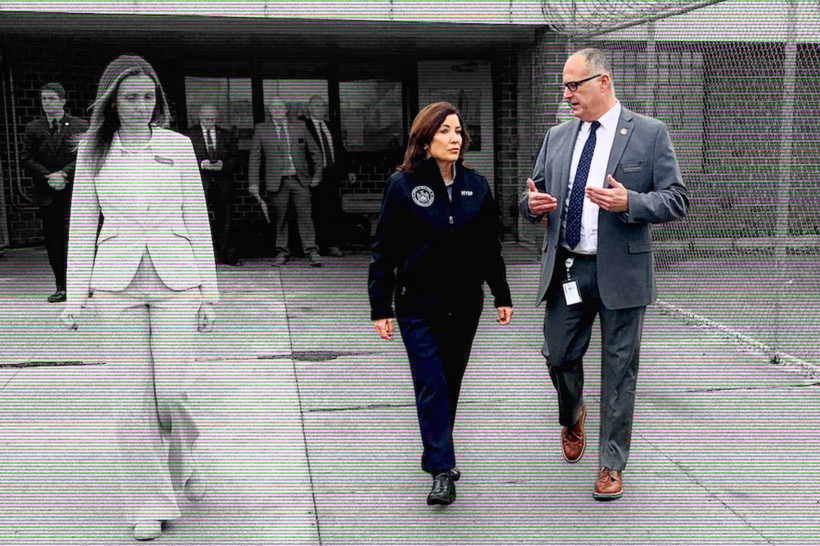
A new lawsuit asks a state court to overturn the state prison agency’s plans to suspend solitary confinement reforms, details of which attorneys only recently uncovered. | Photo: Office of Governor Kathy Hochul | Illustration: Leor Stylar

Sign up for Staying Focused, our newsletter keeping readers up to speed on New York politics.

The New York state prison system is abusing “emergency” authority to gut solitary confinement reforms indefinitely, a new class action lawsuit alleges.

The lawsuit, filed by the Legal Aid Society on Thursday, asks a state court to overturn the prison agency’s suspension of the reforms, details of which attorneys only recently uncovered.

At issue is the Humane Alternatives to Long-Term Solitary Confinement Act, known as HALT, which went into effect in 2022. The law set restrictions on which incarcerated people New York jails and prisons can send to solitary confinement, how long they can keep them there, and for what reason. It also raised standards for both traditional and new “rehabilitative” isolation units, guaranteeing prisoners a minimum number of daily out-of-cell hours for group programs and recreation.

Corrections officers have railed against the law since before its enactment, claiming that the restrictions lead to increased prison violence. When guards launched a three-week wildcat strike earlier this year, repealing HALT was one of their top demands.

The Department of Corrections and Community Supervision, or DOCCS, had suspended HALT during the strike, using emergency authority to keep most incarcerated people confined to their cells while skeleton crews and National Guard troops handled meals and medical care. As part of a strike-ending agreement, DOCCS announced that it was pausing programming aspects of HALT for an additional 90 days after officers returned to work last month.

The agency offered few other details about how it would implement that partial HALT suspension and whether it planned to extend it beyond the 90 days. As part of another, ongoing lawsuit against DOCCS, Legal Aid requested more information about it.

DOCCS’s responses, filed as part of the new lawsuit, reveal a multi-pronged plan to broaden its power to suspend aspects of HALT.

First, DOCCS is attempting to expand its emergency authority. Rather than the originally cited emergency — the strike — the agency is claiming that a pre-existing staffing crisis, exacerbated by the firing of more than 2,000 officers who didn’t return to work, gives it the power to continue to suspend some HALT provisions. (New York had one of the most richly staffed prison systems in the country before the strike, though a diffuse prison population and rampant workers’ compensation abuse, among other issues, have made it difficult to fully staff shifts.)

DOCCS is taking re-opening plans on a facility-by-facility basis with an emphasis on doing so slowly and safely given the staffing crisis,” the agency wrote in court filings.

In addition to the 90-day suspension, DOCCS is weighing a new system where it could declare an emergency anytime prisons experience “inadequate staffing levels.” The setup would allow the agency to suspend aspects of HALT on “high impact” days, which it defines as Fridays, Saturdays, Sundays, or any other day designated by the commissioner, allowing DOCCS to choose when it follows the law.

The agency had offered to implement the “high impact” day system during strike negotiations, but never officially agreed to it. In a response to Legal Aid, DOCCS said that the provision is “still under consideration.”

Finally, DOCCS is asserting that confining people to their cells during an emergency, which it did during and after the strike, doesn’t count as solitary confinement “as defined by HALT” — therefore the law’s provisions restricting the practice don’t apply. Under HALT, prisons are required to give incarcerated people between four and seven hours of out-of-cell time, depending on if and how long they’ve been in isolation.

In a statement, DOCCS said that, moving forward, Commissioner Daniel Martuscello will assess safety every 30 days “and begin programming at the facilities where it is reasonably safe to do so. This process of review and restarting programming has already begun.”

“As we are in an on-going state of emergency system wide, [HALT] specifically allows us to suspend segregated confinement rules,” DOCCS said.

“By invoking the ‘facility-wide emergency’ exception in HALT in the way that it has, as broadly as it has, DOCCS is opening the door to a long-term suspension of the law that essentially nullifies it,” said Antony Gemmell, supervising attorney of the Prisoners’ Rights Project at the Legal Aid Society.

DOCCS has attempted similar legal maneuvers before, particularly when it comes to HALT, as New York Focus has reported. Among other violations, the agency crafted its own definition of “disability” that contradicted HALT’s prohibition against sending disabled people to solitary. It similarly drafted a definition of a solitary-eligible infraction that was much broader than HALT’s. And it filed regulations in the state register that flouted the law, prompting several rounds of pushback by HALT’s authors in the state legislature.

In addition to requiring four to seven hours of daily out-of-cell time, HALT also bars prisons and jails from keeping people in traditional solitary confinement — isolation without access to group programming and recreation — for 15 consecutive days. Gemmell’s concern is that DOCCS’s attempt to expand its emergency authority could return New York’s prison system to its pre-HALT days, when prison staff could keep people locked away for 23 hours a day, virtually indefinitely. The 10 men named in the new lawsuit, incarcerated in DOCCS facilities across the state, offer a window into that brutality, he said.

During the strike, 29-year-old Alfonso Smalls was locked in his cell at Coxsackie Correctional Facility for two and a half weeks and was allowed to leave only three times to take eight-minute showers, according to the lawsuit. Since the strike ended more than five weeks ago, he’s had less than two hours out of his cell a day. He gets about eight minutes in the mess hall to eat his meals, and a 15-minute shower and 45 minutes of recreation every other day. He said the isolation has made him feel short-tempered — a common complaint among incarcerated people, who say that strict solitary confinement makes prisons more volatile.

Smalls has had thoughts of self-harm during his isolation, according to the lawsuit. Another plaintiff, Michael Williams, has acted on similar thoughts. Being locked in his solitary confinement cell at Greene Correctional Facility 23 to 24 hours a day for the past month has caused Williams’s mental health to deteriorate, the lawsuit claims, leading him to self-mutilate. Meanwhile, 28-year-old Saiwon Robbins — housed in isolation at Mid-State prison, where guards allegedly beat an incarcerated man to death during the strike — has had to call the prison’s suicide hotline several times since being locked in his cell for at least 23 hours a day, the lawsuit said.

Taron Jackson has started having nightmares, according to the suit. A father of three, he used to get weekend-long visits with his three children, a privilege he earned for good behavior. Now, guards force him to choose whether to call his family in the evening or take his one hour of recreation. He chooses his kids, meaning his only out-of-cell time is for a 10-minute shower three times a week, the lawsuit said.

“This is not just some abstract thing,” Gemmell said of the HALT suspension. “This has devastating consequences.”

Correction: April 18, 2025 — A previous version of this article stated that there are 10 named plaintiffs in the class action lawsuit filed by the Legal Aid Society. In fact, four of them are class members, not named plaintiffs. This article was also updated to clarify that the lawsuit seeks to overturn DOCCS’s current and possible future suspension of solitary confinement reforms.

Update: April 20, 2025  This article was updated with a statement from DOCCS sent after publication.

BEFORE YOU GO, consider: If not for the article you just read, would the information in it be public?

Or would it remain hidden — buried within the confines of New York’s sprawling criminal-legal apparatus?

I started working at New York Focus in 2022, not long after the outlet launched. Since that time, our reporters and editors have been vigorously scrutinizing every facet of the Empire State’s criminal justice institutions, investigating power players and the impact of policy on state prisons, county jails, and local police and courts — always with an eye toward what it means for people involved in the system.

That system works hard to make those people invisible, and it shields those at the top from scrutiny. And without rigorous, resource-intensive journalism, it would all operate with significantly more impunity.

Only a handful of journalists do this type of work in New York. In the last decades, the number of local news outlets in the state has nearly halved, making our coverage all the more critical. Our criminal justice reporting has been cited in lawsuits, spurred legislation, and led to the rescission of statewide policies. With your help, we can continue to do this work, and go even deeper: We have endless ideas for more ambitious projects and harder hitting investigations. But we need your help.

As a small, nonprofit outlet, we rely on our readers to support our journalism. If you’re able, please consider supporting us with a one-time or monthly gift. We so appreciate your help.

Here’s to a more just, more transparent New York.

Chris Gelardi
Justice Bureau Chief
A photo of Chris Gelardi
As New York Focus’s justice bureau chief, Chris Gelardi reports and edits work on the state’s criminal-legal and immigration systems. His writing on cops, jails, ICE, and the US military has appeared in more than a dozen other outlets, most frequently The Intercept… more
Also filed in Criminal Justice

A bill awaiting the governor’s signature would relax restrictions on who can qualify for victim compensation.

In May, state lawmakers passed a $269 billion budget after haggling for months over thousands of line items and policies affecting New Yorkers.

The legislation would make it easier for currently and formerly incarcerated people and child victims to sue the state over allegations of past abuse.

Also filed in New York State

The agency is adding 100 beds to the Buffalo Federal Detention Facility.

Amid growing spending on universal pre-K, school districts failed to spend millions earmarked for the 2024-25 school year.

New York City has no plans to opt into NY HELPS, which has been extended to 2028 after filling 60,000 government jobs.