Like many New York City mayors before him, Zohran Mamdani is trekking up to Albany on Wednesday to beg the state for money. But the new mayor is arming himself with an unusually provocative argument: that state leaders have systematically deprived the city of what it’s owed, and that it’s time to fix the imbalance.
“New York City is the economic engine of this state,” Mamdani said at a recent press conference, where he made a case for tax increases on the wealthy and corporations to help cover the city’s growing budget gap. “While we contribute the majority of state revenue growth, we do not receive the same proportion of state funds.”
The argument was a preview of Mamdani’s testimony at Wednesday’s annual “Tin Cup Day,” where the mayor and his aides will ask Albany leaders for tax hikes — and potentially other forms of aid — as part of the upcoming state budget.
The basic premise of Mamdani’s claim has been backed up in numerous studies dating back decades. Given its huge economy and large share of wealthy people, New York City has long paid a disproportionate share of taxes relative to its population, while getting less in return, since state leaders redistribute some of that money to poorer communities upstate. (The city’s wealthy suburbs also tend to contribute more than they get back.)
A December report found that in the 2022 fiscal year, the city contributed 55 percent of state revenues but received just 41 percent of state spending in return. Included in that calculation were the $41 billion in income taxes paid by people who work in the city — 59 percent of the state’s total — and $6 billion in taxes paid by city businesses, along with other sources like sales taxes.
“When we were cut, I assure you, it was not part of some socialist redistribution to poor, rural communities around the state.”
Over a decade earlier, a report found that in the 2010 fiscal year, the city paid 45 percent of the state’s revenues but got 40 percent back.
The increase in the city’s share of state revenue has been fueled by its strong economic growth in recent years, relative to the state’s. Where the city’s gross domestic product made up 55 percent of the state’s total in 2010, it accounted for 60 percent by 2022, according to the recent report that Mamdani cited repeatedly. (In a sign of who may be influencing Mamdani’s posture, the report was written under the advisement of Dean Fuleihan, at the time a senior fellow at CUNY and now Mamdani’s first deputy mayor.)
“There’s been a growth in the percentage of the economy and the percentage of taxes that come from New York City in the last 15 years,” said Marc Shaw, a senior adviser at the CUNY Institute for State & Local Governance, which co-authored the report, and a former top aide to mayors Rudy Giuliani and Michael Bloomberg. “That, to me, is the basis for taking a look at the issue of, are we getting our fair share?”
Critics say it’s an odd note for a progressive administration to strike.
“The whole idea of redistribution in government means that not everyone gets what they give,” said Andrew Rein, president of the fiscally conservative Citizens Budget Commission. “There’s no way in the world I would ever believe that Mayor Mamdani thinks that [if] Manhattan pays more taxes than Brooklyn, therefore we should just keep the money in Manhattan.”
Mamdani’s argument went further: that state leaders, namely former Governor Andrew Cuomo, meant to “punish” the city by extracting its wealth, creating an “imbalance” that must be fixed.
In most years, the state budget has a net positive impact on New York City — meaning that state policies send more money to the city than they take away. That was true for all but two of Cuomo’s budgets, according to estimates by the governor’s office. (The figures do not account for which regions the state’s revenue comes from.)
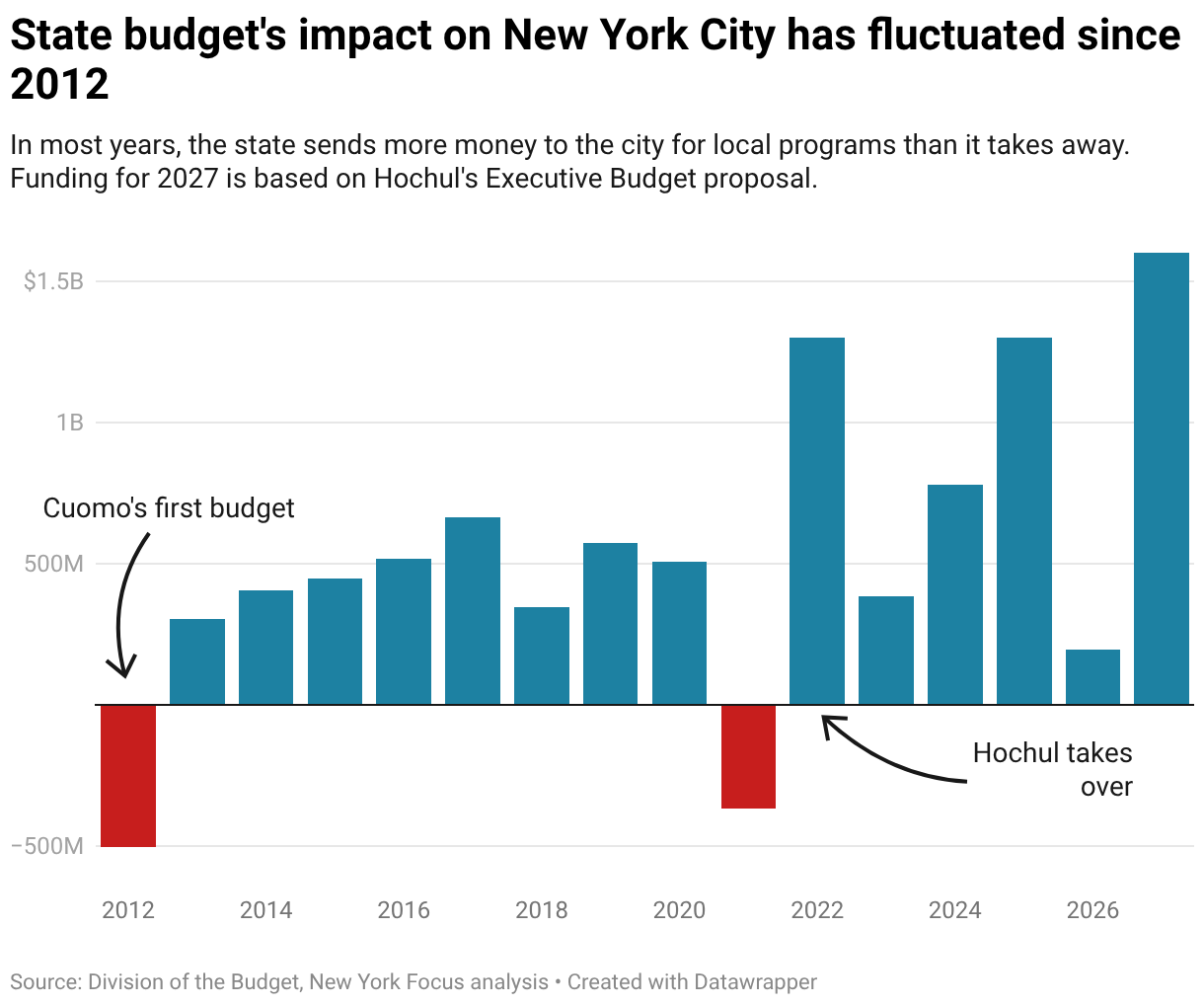
The state’s net spending on behalf of the city has significantly risen under Governor Kathy Hochul, thanks largely to annual increases in school aid. Hochul’s January budget proposal would leave the city with a $1.6 billion net increase, due partly to added money for child care and police deployments on the subway.
Former Mayor Bill de Blasio, who famously battled Cuomo for much of his tenure in office, told New York Focus that he agrees completely with Mamdani’s framing. De Blasio pointed to Cuomo’s 2011 budget, which slashed $65 million in funding for a rental voucher program called Advantage — a move that advocates have blamed for exacerbating the city’s homelessness crisis.
“When we were cut, I assure you, it was not part of some socialist redistribution to poor, rural communities around the state,” de Blasio said. “It was very much about minding the political store and getting funny where the votes were, which tended to be seen by Cuomo as the suburbs.”
Cuomo spokesperson Rich Azzopardi defended the ex-governor, accusing Mamdani of “lying through his teeth” and “padding the numbers” by relying on research that counted city-based workers, rather than city residents, toward the city’s tax contributions. Azzopardi noted that the state’s school aid to New York City grew significantly during Cuomo’s tenure despite overall enrollment dropping.
“In a month, he’s become the most intellectually dishonest mayor in history, and that is a feat,” Azzopardi said of Mamdani.
Reached for comment, Mamdani’s office said the mayor was referring to additional actions taken by Cuomo, like his 2011 cuts to the city’s juvenile justice system and funding for special education, a 2014 state law that requires the city to pay $75 million annually to rent space for charter schools, and Cuomo’s repeated decisions that diverted money from the Metropolitan Transportation Authority to the state’s general fund.
Mamdani’s allies have also pointed to the state’s 2010 decision to cut New York City out of an aid program that had previously sent it about $244 million a year. State leaders justified removing the city from the Aid and Incentives for Municipalities program by reasoning that the city relied less heavily on it compared to smaller communities.

That move — made under Cuomo’s predecessor, Governor David Paterson — has meant that all cities except New York have access to a pot of money that typically exceeds $700 million per year. Michael Gianaris, the state Senate’s deputy majority leader and a key ally of Mamdani’s in Albany, has suggested that restoring AIM funding to the city could be a way to meet the mayor’s demand.
“It seems only fair to treat the state’s largest city equitably as it relates to state support,” Gianaris told New York Focus.
Defenders of Cuomo point to actions under his watch that benefited the city. Most notable may be the decision to freeze local governments’ contributions to Medicaid, which took effect in 2015 and has saved the city upward of $1 billion each year since, according to the Citizens Budget Commission.

“That alone dwarfs the cost of any other individual program reductions to New York City over the last 10 years,” wrote longtime Cuomo aide Paul Francis in a Vital City essay last week that criticized Mamdani’s rhetoric. (Still, New York cities and counties pay a much bigger share of Medicaid costs compared to other states.)
Francis wrote that “cherry-picking individual perceived slights,” such as the Advantage cuts, distracts from the bigger picture, in which funding for the city grew by billions under the governor’s decade-long tenure.
Andrew Perry, senior policy analyst for the left-leaning Fiscal Policy Institute, noted that despite Mamdani’s rhetoric about changing the city-state relationship, the mayor’s tax plan would mainly redistribute wealth within the city, from its richest residents to its poorest.
“What he’s saying is that we need more redistribution that includes New York City, not redistribution from New York City elsewhere,” Perry said. “I think what the mayor’s going for is allowing the city to raise its own taxes, which it is not allowed to control, to extend services to people who need it in the city.”