New York to Scale Back Key Energy Affordability Program

Empower+ helps thousands of New Yorkers afford energy efficiency upgrades. The state is planning to slash funding by nearly two-thirds in two years.

Colin Kinniburgh   ·   July 18, 2025
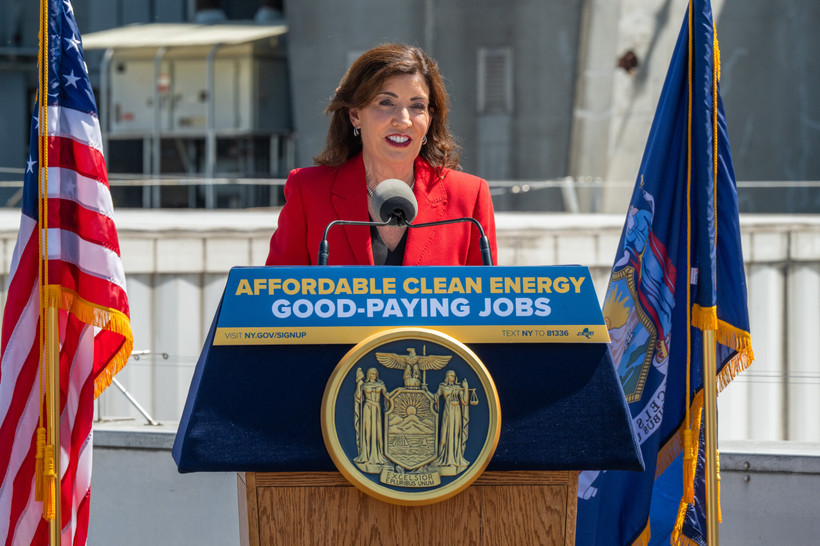
Hochul’s administration is slashing an energy affordability program that was once a priority for the governor. | Darren McGee / Office of Governor Kathy Hochul

Sign up for Staying Focused, our newsletter keeping readers up to speed on New York politics.

Governor Kathy Hochul has made energy affordability a centerpiece of her political platform this year, blasting proposed utility rate hikes and even promising to “slow down” implementation of the state’s climate law over the concern that the clean energy transition is costing New Yorkers too much.

But Hochul’s administration is slashing an energy affordability program that was once a priority for the governor, New York Focus has learned.

The Empower+ program was designed specifically to help low- and moderate-income households “save energy and money” through energy efficiency upgrades. Since 2023 — at Hochul’s initiative — it has been New York’s one-stop shop to help residents take advantage of green building upgrades they might not otherwise be able to afford, like better insulation and replacing old boilers.

“I don’t know of any other program that makes such a big difference to the energy bill and the quality of life for a household that goes through [it],” said Jessica Azulay, executive director of the advocacy group Alliance for a Green Economy.

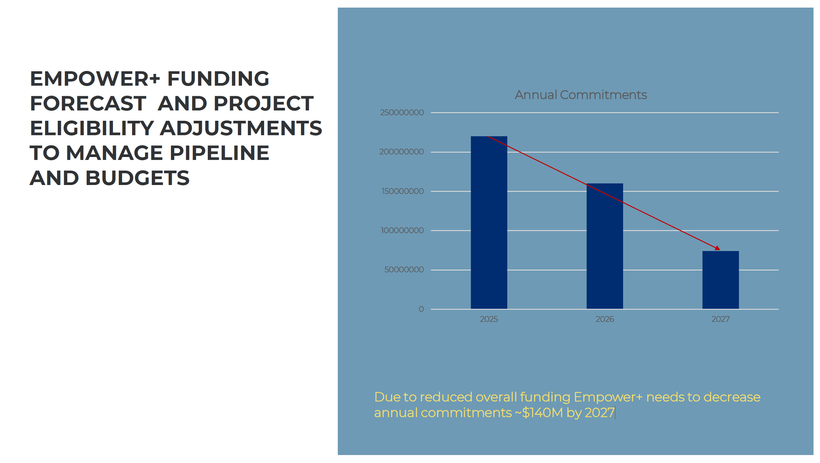
The program is now facing drastic budget cuts. In a meeting last Friday, the state’s energy research and development arm NYSERDA warned local contractors who install the upgrades that it would be cutting the Empower+ budget from roughly $220 million this year to $80 million in 2027.

Michael Hernandez, New York policy director at the pro-electrification group Rewiring America, said he was “shocked” to learn of the impending cuts, and has been sounding the alarm among advocates and lawmakers.

Azulay called the projected cuts “devastating.”

“As families are facing rising energy bills, the state is cutting back on a key tool that it has to help people get their energy bills under control, and to have homes that are more comfortable and safer and healthier,” she said.

In recent years, Empower+ has served tens of thousands of New Yorkers, helping them identify ways that their homes might be wasting energy and fix them through better insulation, air sealing, and switching to efficient new appliances like heat pumps. The program targets one- to four-family homes, allowing both homeowners and renters to participate.

The program covers up to $24,000 worth of upgrades per household, using a mix of state and federal funding. It aims to cover the full cost of upgrades for low-income households and, in some cases, guarantee that participants never pay more than 6 percent of their incomes on energy, by providing ongoing subsidies where needed.

Even New Yorkers who have gotten relatively minor upgrades through the program say it can make a big difference.

Isaac Silberman-Gorn, a first-time homeowner in Troy, outside of Albany, said the program recently allowed him to replace a “dinosaur” of a dryer with a brand new heat pump model. Thanks to the upgrade, his energy usage no longer spikes every time he does a load of laundry.

“It’s the first new appliance I’ve ever had,” he said. “Our energy bills are lower. I’m not worried about the thing starting a fire, which is nice.”

Silberman-Gorn, who works part-time as a bicycle mechanic and at an environmental nonprofit, said he wouldn’t have been able to afford the state-of-the-art new dryer if Empower+ hadn’t covered the cost. “That was a game changer,” he said.

A slide from a presentation NYSERDA officials gave to contractors who participate in the Empower+ energy affordability program. | NYSERDA


The program relies heavily on the work of local contractors, who conduct NYSERDA-funded energy audits for homes and then, typically, file the application to NYSERDA for upgrades that might be warranted. They’ve been a key avenue for bringing people into the program, often through customers who refer the companies to friends and neighbors they think might be eligible for similar upgrades.

NYSERDA told contractors in last week’s meeting that they can no longer sign up new customers for Empower+ themselves. Clean energy advocates, and contractors participating in the program, see this as another way to tighten the belt.

“That will naturally slow the program down big time,” said Hal Smith, CEO of Halco Home Solutions and president of the Building Performance Contractors Association of NYS, a trade group.

He said his own company, which works across the Finger Lakes region and has a staff of about 180, should be able to weather the cuts, because it does a variety of work and serves customers across the income spectrum. But he worries that some companies working mainly or even exclusively for Empower+ may have to shut down entirely or lay off much of their staff.

The cuts are particularly hard to stomach after years where NYSERDA was pushing for “more, more, more,” Smith said, building up the program as the state scrambled to meet clean energy targets and encouraging as many contractors as possible to get on board.

“That’s been the march for years, and we’ve all grown, grown, grown,” he said. “Now, NYSERDA is saying we have to put on the brakes.”

A NYSERDA spokesperson said that Empower+ remains a high priority for the agency and that it is only pausing applications from contractors while it reviews how to direct funds to the households most in need. (The spokesperson did not comment on the agency’s funding cuts to the program.)

Smith said he doesn’t blame any one actor for the cuts. The Empower+ program — which was the result of a 2023 merger between two others — draws its funding from a dizzying array of sources. There’s money from New Yorkers’ utility bills, through a program approved by the state’s Public Service Commission; from the East Coast cap and trade program known as RGGI; from the state budget; from a federal home energy rebate program created under former President Joe Biden; and from the longer-standing federal heating assistance program LIHEAP.

Scott Oliver, an Empower+ program administrator at NYSERDA, told contractors last week that federal and state budget cuts were forcing the agency to scale back the program. Hochul and state lawmakers gave Empower+ a $200 million funding surge in 2023, but only earmarked $50 million for the program this year. President Donald Trump’s administration is seeking to eliminate LIHEAP entirely and cut back other weatherization funds.

Hochul could direct NYSERDA to tap other funding sources for the program, advocates say.

The cap and trade program RGGI has earned New York anywhere from $100 million to $400 million a year over the last decade, and accumulated a surplus of more than $850 million, according to NYSERDA’s latest financial statement. The state’s new $1 billion climate fund only included $50 million specifically for Empower+, but has another $110 million for unspecified green buildings projects, which the governor could use for the program. (The Assembly had sought in negotiations to allocate more than $300 million just to Empower+.)

And the Public Service Commission, New York’s utility regulator, recently increased the funding going from energy customers’ bills to programs like Empower+, if not as much as some advocates had hoped.

Advocates say it’s not yet clear whether Hochul’s administration intentionally cut Empower+ or whether the program, with its complicated mix of funding, has simply slipped through the cracks.

Still, Hernandez, of Rewiring America, said it was bewildering that Hochul’s administration could allow such cuts to proceed while the governor emphasizes energy affordability as much as she has: “How can she be saying, doing both of those things at the same time?”

In a statement, the governor’s office highlighted the $50 million for Empower+ in this year’s state budget.

“Governor Hochul has made affordability for New Yorkers a top priority,” said Hochul’s energy and environment spokesperson Ken Lovett. “The Governor continues to push back against devastating cuts in Washington, and calls on our state’s Congressional Republican delegation to join the fight to protect our state’s most vulnerable citizens.”

“It’s the first new appliance I’ve ever had. Our energy bills are lower.”

—Isaac Silberman-Gorn, Troy homeowner

The Empower+ cuts further slow New York’s progress toward meeting legally binding climate targets, in particular a requirement to slash energy use in buildings by 2025. That deadline is now just months away, and the state is far from meeting it.

Some climate hawks in the state legislature are beginning to cry foul over the Empower+ cuts.

“I’m sure that right now, the governor is doing her best to look at where we can cut corners,” said Assemblymember Dana Levenberg, of Westchester and the Hudson Valley, referring to the massive funding cuts coming down from Washington. “This is not where we should be doing that.”

In their presentation last week, NYSERDA officials said they were still looking for alternate sources of funding to keep Empower+ whole.

“This is a problem that is absolutely fixable, and we need the governor to step in here and make the call,” said Azulay, of Alliance for a Green Economy.

Hochul has promised that she’s attuned to such concerns. “Utility costs are a huge burden on families,” she told reporters earlier this month, “and I’ll do whatever I can to really alleviate that.”

I hope this article helped you better answer the question that guides all of our journalism: Who runs New York? Before you click away, please consider supporting our work and making more stories like this one possible.

New York state is standing at a crossroads for climate action. After passing one of the nation’s most ambitious climate laws in 2019, the state is lagging far behind on its targets, struggling to meet deadlines to build renewable energy and clean up its buildings and roads. Other states are closely watching our progress, making decisions about their own climate plans based on New York’s ability to implement this legislation.

As New York’s only statewide nonprofit news publication, we’ve been scrutinizing the state’s climate progress. Our journalism exists to unpack how power works in New York, analyze who’s really calling the shots, and reveal how obscure decisions shape ordinary New Yorkers’ lives.

But we can't do this work without your help. We rely on reader donations to help sustain our outlet, and every gift directly allows us to publish more pieces like this.

Our work has already shown what can happen when those with power know that someone is watching, with my reporting prompting a state investigation and fine for a major corporation. I have more story ideas than I can count, but only limited resources to pursue all the leads that come across my desk.

If you’re able, please consider supporting our journalism with a one-time or monthly gift. Even small donations make a big difference.

Thank you for reading.

Colin Kinniburgh
Climate and Environmental Politics Reporter
A photo of Colin Kinniburgh.
Colin Kinniburgh is a reporter at New York Focus, covering the state’s climate and environmental politics. He has worked in media for more than a decade, across print, television, audio, and online news, and participated in fellowship programs at CUNY’s Graduate School of Journalism… more
Also filed in New York State

A lobbyist who has been romantically linked to Assembly Speaker Carl Heastie led a rally opposing the legislation a week before the speaker declined to bring it to a vote.

In May, state lawmakers passed a $269 billion budget after haggling for months over thousands of line items and policies affecting New Yorkers.

Millions in outside spending was a boon to Gov. Kathy Hochul’s 2022 opponent, Lee Zeldin, and influenced down-ballot races.

Also filed in Budget

State leaders are expected to pass a bill that avoids resolving how much Resorts World New York City needs to pay.

Resorts World is floating legislation to avert more than $500 million in payments to the horseracing industry.

Our searchable database breaks down the most consequential decisions Albany politicians made on climate, immigration, housing, schools, taxes, and more.

Also filed in Climate and Environment

The citizens assembly model, used for public decision-making around the world, is gaining traction in New York.

Governor Kathy Hochul was successful in her bid to upend the Climate Leadership and Community Protection Act after legislators caved to finalize an overall budget deal.

The leader of Reinvent Albany discusses a data center subsidy in Rockland County that flew under the radar for years.

Also filed in Affordability

We’ve compiled information for SNAP recipients in New York on the changing work requirements.

Despite last-ditch efforts by a coalition of lawmakers, the state failed to avert a health coverage cliff coming this summer.

The Hochul administration now has a chance to relax New York’s child care staffing ratios — among the country’s strictest — after 26 years. But will it?