New York Is Violating Its Flagship Climate Law, Judge Rules

The law required a state agency to issue major regulations more than a year and a half ago, and it had no excuse not to, the court found.

Colin Kinniburgh   ·   October 24, 2025
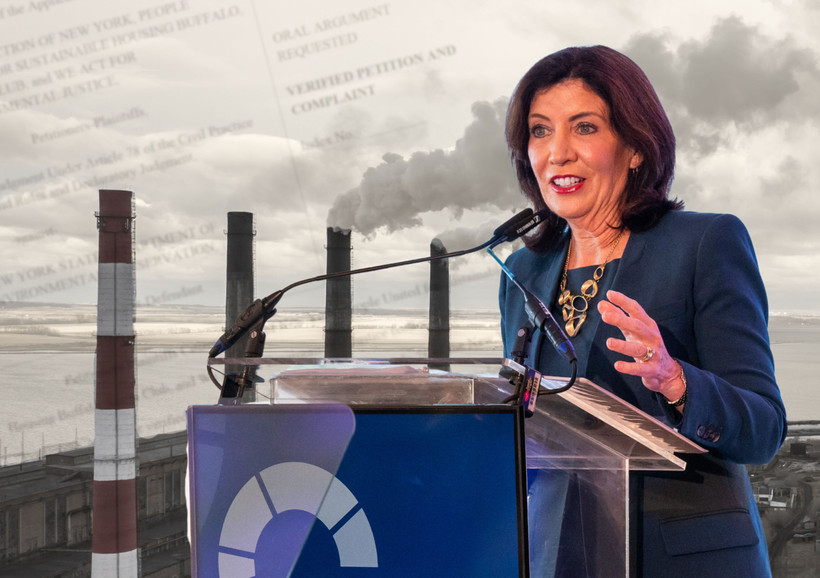
Climate groups brought the case in March after Governor Kathy Hochul slammed the brakes on what was expected to be her signature policy to implement the climate law: an emissions pricing program known as cap and invest. | Photo: Darren McGee/Office of Governor Kathy Hochul; Illustration: New York Focus

Sign up for Staying Focused, our newsletter keeping readers up to speed on New York politics.
New York is violating its climate law — and doesn’t get a pass because implementing the law is “complicated,” a judge found Friday.

The 2019 law, which remains one of the most ambitious in the country, gave the state Department of Environmental Conservation until the start of 2024 to issue regulations that would “ensure” New York meet its binding greenhouse gas emissions targets. More than a year and half later, it has not — a fact that Ulster County Supreme Court Judge Julian Schreibman said was “undisputed” in the case.

Schreibman gave the DEC until February 6 to issue regulations that comply with the law, called the Climate Leadership and Community Protection Act.

“While DEC notes that it has taken other, commendable regulatory steps to reduce greenhouse gas emissions, it candidly concedes that the impact of those regulations would fall far short” of the targets set out in the law, which requires the state cut emissions 40 percent from 1990 levels by 2030 and 85 percent by 2050, Schreibman wrote.

Climate groups brought the case in March after Governor Kathy Hochul slammed the brakes on what was expected to be her signature policy to implement the climate law: an emissions pricing program known as cap and invest. Internal emails reported by Politico show that DEC and the state energy authority NYSERDA had completed draft cap and invest rules at the beginning of this year, before Hochul’s abrupt about-face.

The DEC argued in court that issuing the regulations was “infeasible” because it “would require imposing extraordinary and damaging costs upon New Yorkers.” (Hochul in August said much the same about her own reasons for shelving cap and invest.)

The judge dismissed that argument.

“It is undoubtedly true that the task placed before the DEC is very complicated indeed,” he wrote. “But as a legal argument, this is unavailing.”

Schreibman said there were two possible paths forward: Either the legislature can step in and change the law, or the DEC must act on it. He set his deadline in February, a month into the next legislative session, to give state lawmakers a chance to weigh in. If the legislature leaves the climate law intact, he said, he is “highly unlikely” to grant DEC an extension.

The ruling does not explicitly require the state to move ahead with cap and invest; the policy is not named in the climate law, and Schreibman said the content of the DEC’s regulations is not up to him. But the law does require the regulations to reflect the findings of its 2022 scoping plan, which envisioned cap and invest as its core measure to achieve the emissions targets. State agencies spent two years working on the rules to establish that program before Hochul put them on ice. It’s not yet clear whether DEC could find a substitute by February.

There is one more possible path: The DEC could appeal the decision, potentially leading the case to drag on for months longer, if not more.

In a statement provided to New York Focus after publication, the DEC said simply that it was reviewing the decision.

Hochul went further. Reacting to the ruling on Friday evening, she said she would do what was necessary to keep New York’s energy supply reliable and affordable and keep the state attractive to business.

“New York has been, and will continue to be, a leader in climate action, but the judge’s decision fails to factor in the realities of today that include a federal government hostile to clean energy projects, the continuing impacts of post-COVID high inflation, and potential energy shortages expected downstate as soon as next year,” Hochul said, in an emailed statement. “We plan to review all our options, including working with the Legislature to modify the CLCPA and appeal, in order to protect New Yorkers from higher costs.”

Update: October 24, 2025 — This story has been updated to include comments from Governor Kathy Hochul and the DEC provided after publication.


I hope this article helped you better answer the question that guides all of our journalism: Who runs New York? Before you click away, please consider supporting our work and making more stories like this one possible.

New York state is standing at a crossroads for climate action. After passing one of the nation’s most ambitious climate laws in 2019, the state is lagging far behind on its targets, struggling to meet deadlines to build renewable energy and clean up its buildings and roads. Other states are closely watching our progress, making decisions about their own climate plans based on New York’s ability to implement this legislation.

As New York’s only statewide nonprofit news publication, we’ve been scrutinizing the state’s climate progress. Our journalism exists to unpack how power works in New York, analyze who’s really calling the shots, and reveal how obscure decisions shape ordinary New Yorkers’ lives.

But we can't do this work without your help. We rely on reader donations to help sustain our outlet, and every gift directly allows us to publish more pieces like this.

Our work has already shown what can happen when those with power know that someone is watching, with my reporting prompting a state investigation and fine for a major corporation. I have more story ideas than I can count, but only limited resources to pursue all the leads that come across my desk.

If you’re able, please consider supporting our journalism with a one-time or monthly gift. Even small donations make a big difference.

Thank you for reading.

Colin Kinniburgh
Climate and Environmental Politics Reporter
A photo of Colin Kinniburgh.
Colin Kinniburgh is a reporter at New York Focus, covering the state’s climate and environmental politics. He has worked in media for more than a decade, across print, television, audio, and online news, and participated in fellowship programs at CUNY’s Graduate School of Journalism… more
Also filed in New York State

State leaders are expected to pass a bill that avoids resolving how much Resorts World New York City needs to pay.

New York state has pumped millions of taxpayer dollars into an online portal that vowed to make life easier for Rochester’s neediest, but critics say it’s fallen short.

Resorts World is floating legislation to avert more than $500 million in payments to the horseracing industry.

Also filed in Climate and Environment

Governor Kathy Hochul was successful in her bid to upend the Climate Leadership and Community Protection Act after legislators caved to finalize an overall budget deal.

The leader of Reinvent Albany discusses a data center subsidy in Rockland County that flew under the radar for years.

No other project in the country has gotten such a large subsidy to create so few jobs, according to watchdogs.