New York’s Landmark Climate Law Goes on Trial

As environmental justice groups seek to compel the state to follow its climate law, the Hochul administration is set to argue that it deserves a pass.

Colin Kinniburgh   ·   July 25, 2025
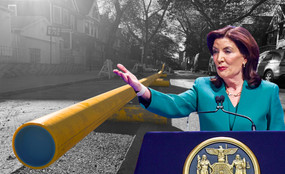
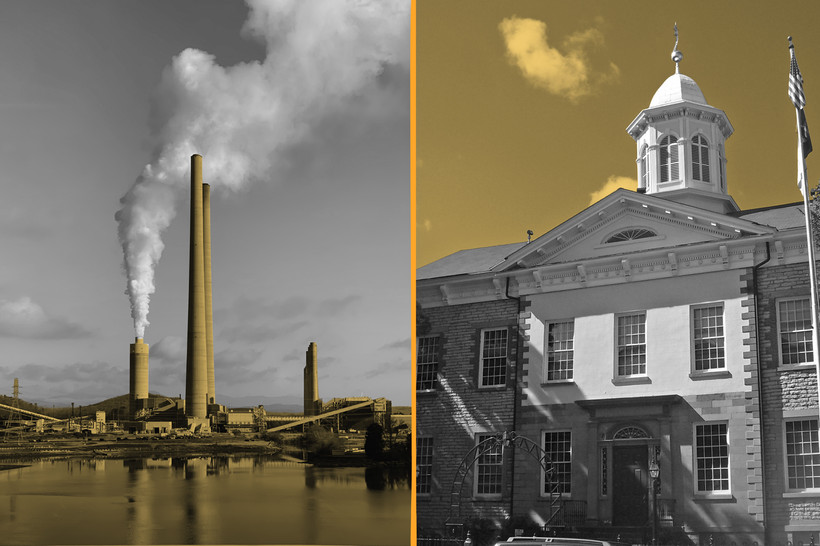
On Friday, an Ulster County judge will hear arguments in a lawsuit that could decide whether the state is forced to act on its 2019 climate law. | Photos: Wes McKeehan/Pexels; Daniel Case/Wikimedia Commons | Illustration: Leor Stylar

Sign up for Staying Focused, our newsletter keeping readers up to speed on New York politics.

Will New York follow its climate law, once hailed as one of the most ambitious in the world? Or will it be allowed to keep stalling on its legal obligations to cut greenhouse gas emissions?

That may be up to an Ulster County judge, who on Friday will hear oral arguments in a lawsuit brought by four environmental and climate justice groups over the state’s failure to act on one of the core mandates of the 2019 Climate Leadership and Community Protection Act.

The lawsuit comes after Governor Kathy Hochul in January slammed the brakes on what was expected to be her signature policy to implement the law: cap and invest.

The program would charge polluters for their carbon emissions and put the proceeds toward the clean energy transition. It was designed to meet one of the climate law’s key requirements, namely that the state issue regulations to achieve steep emissions cuts over the next several decades.

Those rules were supposed to be in place by 2024, a deadline the state blew past. The Hochul administration was finally gearing up to unveil the rules at the start of this year — but instead reversed course over concerns that the carbon pricing program would drive up everyday costs for New Yorkers.

Hochul promised at the time that she was just pressing pause. “We have to get this right,” she told reporters at the time. “Because I believe that other states will be looking at us as a model as well.”

As the year has gone on, though, Hochul’s administration has backed further away from the policy. A draft of the new state energy plan, released Wednesday, mentions it only in passing, as an option the state should “continue to evaluate.”

The administration’s court filings have been similarly non-committal. The state Department of Environmental Conservation (DEC) wrote in May that cap and invest “remains an option,” and that the agency is making “continued good faith efforts” to issue rules required by the climate law. But it did not propose a meaningful alternative to the cap and invest program, instead highlighting more minor regulations it has adopted to green certain sectors.

A Timeline of Key Events

July 18, 2019: Governor Andrew Cuomo signs the Climate Leadership and Community Protection Act (CLCPA) into law.


Jan. 10, 2023: Governor Kathy Hochul announces New York will adopt a “cap and invest” program to implement the law.


Jan. 1, 2024: The CLCPA requires New York to finalize rules to meet emissions targets.


Jan. 14, 2025: Hochul scraps plans to advance cap and invest rules as quickly as possible.


March 31, 2025: Climate groups sue.


July 25, 2025: Justice Julian Schreibman, of Ulster County Supreme Court, hears oral arguments in the case.

Those rules do not add up to anywhere near meeting the kinds of emissions cuts demanded by the climate law, which requires an initial 40 percent reduction by 2030. The state now expects it won’t hit that target until at least 2036, according to the draft energy plan.

Rachel Spector, an attorney at the environmental law group Earthjustice, is representing the four groups suing the state: Citizen Action of New York, PUSH Buffalo, Sierra Club, and WE ACT for Environmental Justice. She said the DEC’s claims in court so far have been “pretty outrageous.”

The climate law “is very clear that the DEC is in charge of issuing regulations that ensure we meet the targets,” she said. “And nowhere does DEC claim that they have done that.”

A DEC spokesperson said the agency doesn’t comment on pending litigation.

In its May filing, the agency argued that the lawsuit is baseless because the department has in fact issued regulations furthering the climate law’s goals. As evidence, it listed several sets of rules it has issued to reduce emissions, including recent ones targeting “superpolluting” refrigerants that together account for about 6 percent of the state’s total emissions.

The most important action DEC cited, however, has since been overturned by President Donald Trump: the Advanced Clean Cars and Trucks rules requiring all new cars and most new trucks sold in the state to be electric (or otherwise zero-emitting) by 2035.

Those mandates, which the DEC said would be “instrumental” in meeting climate law targets, matched ones adopted by California under a longstanding policy that allowed the state to enact stricter pollution rules than the federal government.

“We have to get this right. Because I believe that other states will be looking at us as a model as well.”

—Governor Kathy Hochul

In late May, Congress repealed the decades-old waiver that allowed California to set its own pollution standards — and, in turn, the bar that blue-leaning states including New York have followed. Trump signed the legislation in June, scrapping the framework that New York and 16 of its peers were counting on to drive down one of their largest sources of emissions.

Michael Gerrard, director of the Sabin Center for Climate Change Law at Columbia University, said that the car and truck rules were “at or near the top” of what New York had on the books to meet its climate targets, and that there aren’t any actions the state could readily take that would have the same impact.

California, New York, and nine other states immediately sued the Trump administration last month in an effort to restore their pollution rules, but Gerrard called it a “challenging case.”

“It was a violation of Senate procedure to do this,” he said, referring to Congress defying the nonpartisan “parliamentarian” who advises the Senate on procedural questions. “The courts may be reluctant to second-guess the inner workings of the Senate.”

Even if a judge salvages the rules, New York will be hard pressed to meet them. The requirements start with mandating 35 percent of sales in 2026 be electric cars. As of 2023, the figure in New York stood at just 6 percent, according to the think tank International Council on Clean Transportation, and sales have not dramatically ramped up since.

The state also appears to have abandoned a longstanding target to put 850,000 electric vehicles on the road by this year; the number currently stands just above 180,000, according to official statistics. (The governor’s office has not publicized the target since early 2023.)

Cap and invest was supposed to change the game, by giving New Yorkers a financial incentive to choose less polluting options.

Without it, even in the rosiest scenario, New York will miss its legally binding emissions targets by tens of millions of metric tons, according to an amicus brief filed in the New York climate law case in early June by the Environmental Defense Fund and two other environmental groups.

The climate law tasks DEC with making rules to “ensure” those limits are met. (DEC asked the judge for a chance to respond to EDF’s arguments, but has not done so.)

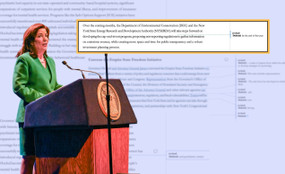
By January 1, 2024, “the Department … shall … promulgate rules and regulations to ensure compliance with the statewide emissions reduction limits.”

—Climate Leadership and Community Protection Act

The agency is moving ahead with regulations spelling out how companies should report their greenhouse gas emissions. The rules were meant to be a building block of cap and invest, but have for now been carved out. Climate activists dominated public hearings about the rules in June; at the New York City hearing, at least 50 activists rallied outside and packed the small room the agency had booked for the occasion.

Hardly any of them addressed the details of the reporting rules. Instead, one after the other called for Hochul to bring back cap and invest.

The state’s defense in court may rest less on the “strides” it says it has made in meeting the climate law than on more procedural grounds. It argues that the plaintiffs are seeking to force it to move ahead specifically with cap and invest, which the climate law doesn’t require.

The plaintiffs replied that they’re not trying to advance a particular set of regulations, but rather any that would meet the law’s requirements. (In practice, Gerrard said, it’s hard to see what that could be other than cap and invest.)

Moreover, the DEC has argued that, even if it isn’t following the law, the judge should not take the “extraordinary” step of compelling it to. The agency argues that a strong move from the court could compromise energy affordability, and that courts have restrained themselves in the past to avoid “unnecessary hardship” and “disorder” or “confusion in public affairs.”

“They’re trying to scare the judge away from issuing an order here,” said Spector, the Earthjustice attorney. “But they have it backwards. Issuing regulations would not be disrupting the status quo — it’s in line with what everyone expected, what the state has been planning for five years.”

“Really, what is out of line with the status quo is the state’s decision earlier this year to not do anything,” she added.

The DEC’s argument is in keeping with Hochul’s recent backpedaling from New York’s climate law.

“I’ve had to take a close look and realize that we cannot accomplish what those objectives were back … before I became governor, in a time frame that’s going to not hurt ratepayers,” she said in early July. “So we’re slowing things down. I want to make sure people know that.”

The DEC also appears to be fast-tracking a pipeline project that would bring more gas into New York City and Long Island, after previously denying the project permits and repeatedly arguing in recent years that expanding fossil fuel infrastructure would violate the climate law.

Eric Walker, the energy justice senior policy manager at WE ACT for Environmental Justice, said the DEC’s appeal to the judge for lenience marked an “encroachment on the separation of powers.”

“The administrative agency is asking for a free pass to essentially bypass the mandate of the people to the legislature and the administration,” he said. “This is really scary territory that we’re in.”

I hope this article helped you better answer the question that guides all of our journalism: Who runs New York? Before you click away, please consider supporting our work and making more stories like this one possible.

New York state is standing at a crossroads for climate action. After passing one of the nation’s most ambitious climate laws in 2019, the state is lagging far behind on its targets, struggling to meet deadlines to build renewable energy and clean up its buildings and roads. Other states are closely watching our progress, making decisions about their own climate plans based on New York’s ability to implement this legislation.

As New York’s only statewide nonprofit news publication, we’ve been scrutinizing the state’s climate progress. Our journalism exists to unpack how power works in New York, analyze who’s really calling the shots, and reveal how obscure decisions shape ordinary New Yorkers’ lives.

But we can't do this work without your help. We rely on reader donations to help sustain our outlet, and every gift directly allows us to publish more pieces like this.

Our work has already shown what can happen when those with power know that someone is watching, with my reporting prompting a state investigation and fine for a major corporation. I have more story ideas than I can count, but only limited resources to pursue all the leads that come across my desk.

If you’re able, please consider supporting our journalism with a one-time or monthly gift. Even small donations make a big difference.

Thank you for reading.

Colin Kinniburgh
Climate and Environmental Politics Reporter
A photo of Colin Kinniburgh.
Colin Kinniburgh is a reporter at New York Focus, covering the state’s climate and environmental politics. He has worked in media for more than a decade, across print, television, audio, and online news, and participated in fellowship programs at CUNY’s Graduate School of Journalism… more
Also filed in New York State

At a Board of Regents meeting Monday, state officials proposed eliminating credit-based diploma requirements.

The last-minute influx, the biggest ever for a legislative primary, is boosting her opponent, Jessica González-Rojas.

City budget gaps and an ambitious affordability agenda may require pressing Albany again for taxes and aid.

Also filed in Climate and Environment

The citizens assembly model, used for public decision-making around the world, is gaining traction in New York.

A lobbyist who has been romantically linked to Assembly Speaker Carl Heastie led a rally opposing the legislation a week before the speaker declined to bring it to a vote.

In May, state lawmakers passed a $269 billion budget after haggling for months over thousands of line items and policies affecting New Yorkers.