Climate Groups Sue Hochul Administration Over Climate Law Backtracking

Environmentalists have long charged that New York is falling short of its climate mandates. Now, they’re taking the state to court.

Colin Kinniburgh   ·   March 31, 2025
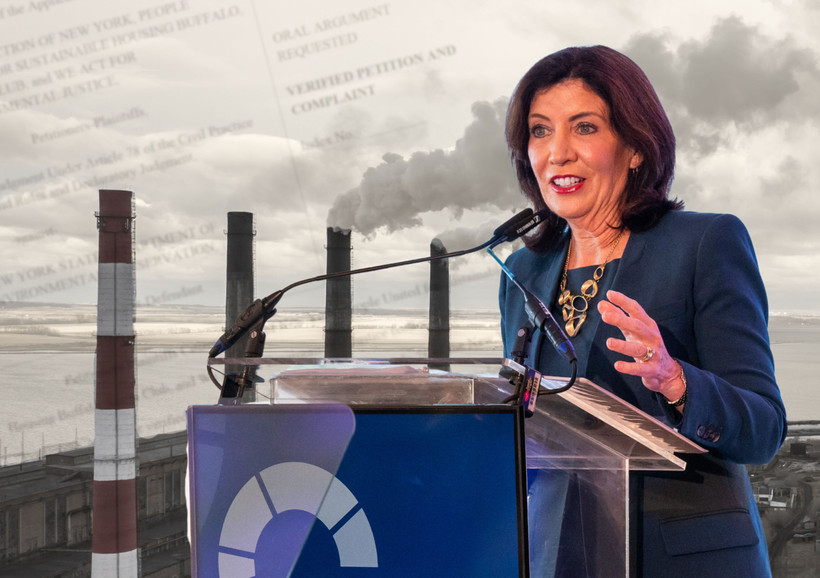
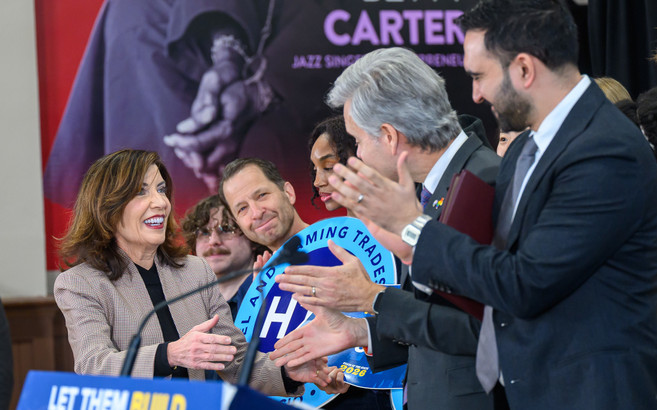
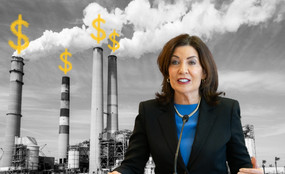
Climate groups brought the case in March after Governor Kathy Hochul slammed the brakes on what was expected to be her signature policy to implement the climate law: an emissions pricing program known as cap and invest. | Photo: Darren McGee/Office of Governor Kathy Hochul; Illustration: New York Focus

Sign up for Staying Focused, our newsletter keeping readers up to speed on New York politics.
It’s official: New York is being sued over delays in implementing its climate law.

Four environmental and climate justice groups filed a lawsuit Monday in a state court, claiming that New York is “stonewalling necessary climate action in outright violation” of its legal obligations. By not releasing economy-wide emissions rules, the suit alleges, the state Department of Environmental Conservation, or DEC, is “defying the Legislature’s clear directive” and “prolonging New Yorkers’ exposure to air pollution … especially in disadvantaged communities.”

It’s the first lawsuit to charge the state with failing to enforce the core mandate of its 2019 Climate Leadership and Community Protection Act, or CLCPA: eliminating nearly all of New York’s greenhouse gas emissions by 2050. The law tasks DEC with crafting rules to get there and to reach an interim target of 40 percent emissions cuts by 2030.

The state’s deadline to release those rules was Jan. 1, 2024 — a date the agency blew past. More than a year later, New York has yet to issue even draft rules, and it’s becoming less and less clear that it intends to do so, even though, throughout last year, Governor Kathy Hochul’s administration promised that it was working on them as quickly as possible.

The lawsuit centers on rules for cap and invest, an economy-wide carbon pricing program that Hochul has been promising since 2023. DEC and the state’s energy research and development arm, NYSERDA, spent much of the last two years developing the program. In December, agency staff told environmental groups that the draft rules were all but ready to go and would be released in January, allowing the state to start charging polluters before the end of 2025.

Then came the about-face.

At her State of the State speech in mid-January, Hochul made no mention of cap and invest. Her briefing book said DEC and NYSERDA needed more time to work out the details, promising only that DEC would publish rules requiring polluters to report their emissions. Her administration maintains that it is still moving ahead with cap and invest, but has declined to commit to any timeline for doing so. (Asked last week whether Hochul stands by this position, the governor’s office referred New York Focus to DEC and NYSERDA. A spokesperson said the agencies “are continuing to develop a cap-and-invest program” and pointed to the newly released emissions reporting rule as evidence.)

Hochul’s backtracking is at the heart of the lawsuit filed Monday by Earthjustice and two other environmental law groups on behalf of Citizen Action of New York, PUSH Buffalo, Sierra Club, and WE ACT for Environmental Justice, all members of the NY Renews coalition that led the charge to pass the CLCPA.

“We’ve just seen a continual slow walk of climate action at the state level… that puts us in a position where we need to have a judge put us back on track,” said Eric Walker, the energy justice senior policy manager at WE ACT.

A DEC spokesperson said the agency does not comment on pending litigation. They highlighted a range of efforts the agency has undertaken to reduce emissions, including rules requiring New Yorkers to shift to electric vehicles and businesses to phase out high-polluting refrigerants, as well as the new draft emissions reporting rule.

State regulators estimated that cap and invest could prevent up to 1,500 premature deaths and 1,800 asthma-related emergency room visits per year by 2035.

The draft rule DEC published last Wednesday could help the state implement cap and invest. The rule — one of three meant to set up the program — lays out which polluters are required to report their greenhouse gas emissions and how. But, as DEC emphasized in its press release, this rule “is solely for reporting purposes and would not require pollution reductions.”

Today’s lawsuit highlights that the reporting rule, if adopted as proposed, would not take effect until June 2027. It also points out that DEC intends for the collected data to “help inform other policies or actions that may be taken to reduce pollution, including but not limited to a potential future cap-and-invest program” — implying that cap and invest rules might not be released for years, if ever. An FAQ page from the agency explicitly asks when the cap and invest program will be implemented, and does not provide a date.

The plaintiffs charge that by walking back from its climate plan, New York is also infringing on its residents’ constitutional rights — specifically the rights to “clean air and water, and a healthful environment” enshrined through the Green Amendment that voters approved in 2021. Air pollution is especially harming the health of residents in disadvantaged communities, they allege, where several of the groups’ members live near fossil fuel plants or in high truck traffic areas.

State regulators estimated that cap and invest could prevent up to 1,500 premature deaths and 1,800 asthma-related emergency room visits per year by 2035.

“As we continue to not put cap and invest in place, we see the continued disproportionate impacts of air quality on disadvantaged communities, communities of color, and low-income communities across the state,” said Walker.

“We need cap and invest to be in effect right now. And it could be if we had simply just released the regs that are sitting on a shelf,” he continued. (Internal emails reported by Politico show that DEC and NYSERDA had already completed the draft rules at the beginning of this year.)

The lawsuit is not the CLCPA’s first test in court. The climate law has been at the center of nearly 20 court cases, mostly challenging agency decisions over things like air permits and highways, but also the governor’s abrupt suspension of congestion pricing last summer. But it’s the first lawsuit seeking to enforce the emissions reduction mandate as a whole, according to Rachel Spector, Earthjustice’s lead attorney in the case.

“These regulations are the core of the law, and they’re necessary for it to be effective,” said Spector, adding that the DEC must issue enforceable rules to give the law “any kind of teeth.”

Less than a year ago, Hochul spoke about cap and invest as if it were already up and running:

“We set a cap on statewide climate pollution,” she told attendees of the Global Economic Summit in Ireland last May. “Every year, we set the cap lower to align with our aggressive climate goals. Major polluters must pay to emit greenhouse gases.”

Since then, regulators have admitted that the state is far behind in meeting key climate targets, and business groups have stepped up calls for the state to rethink the CLCPA.

But for now, it’s still the law, and Spector said there’s no excuse for the state not to enforce it.

Regulators “do have discretion — they can shape regulations in a way they see fit, as long as they comply with the pretty high-level, broad requirements that are set out in the law,” she said. “But they still have to do it.”

This story has been updated to include a response from the DEC.

I hope this article helped you better answer the question that guides all of our journalism: Who runs New York? Before you click away, please consider supporting our work and making more stories like this one possible.

New York state is standing at a crossroads for climate action. After passing one of the nation’s most ambitious climate laws in 2019, the state is lagging far behind on its targets, struggling to meet deadlines to build renewable energy and clean up its buildings and roads. Other states are closely watching our progress, making decisions about their own climate plans based on New York’s ability to implement this legislation.

As New York’s only statewide nonprofit news publication, we’ve been scrutinizing the state’s climate progress. Our journalism exists to unpack how power works in New York, analyze who’s really calling the shots, and reveal how obscure decisions shape ordinary New Yorkers’ lives.

But we can't do this work without your help. We rely on reader donations to help sustain our outlet, and every gift directly allows us to publish more pieces like this.

Our work has already shown what can happen when those with power know that someone is watching, with my reporting prompting a state investigation and fine for a major corporation. I have more story ideas than I can count, but only limited resources to pursue all the leads that come across my desk.

If you’re able, please consider supporting our journalism with a one-time or monthly gift. Even small donations make a big difference.

Thank you for reading.

Colin Kinniburgh
Climate and Environmental Politics Reporter
A photo of Colin Kinniburgh.
Colin Kinniburgh is a reporter at New York Focus, covering the state’s climate and environmental politics. He has worked in media for more than a decade, across print, television, audio, and online news, and participated in fellowship programs at CUNY’s Graduate School of Journalism… more
Also filed in New York State

The last-minute influx, the biggest ever for a legislative primary, is boosting her opponent, Jessica González-Rojas.

City budget gaps and an ambitious affordability agenda may require pressing Albany again for taxes and aid.

A bill awaiting the governor’s signature would relax restrictions on who can qualify for victim compensation.

Also filed in Budget

In May, state lawmakers passed a $269 billion budget after haggling for months over thousands of line items and policies affecting New Yorkers.

State leaders are expected to pass a bill that avoids resolving how much Resorts World New York City needs to pay.

Resorts World is floating legislation to avert more than $500 million in payments to the horseracing industry.

Also filed in Climate and Environment

The citizens assembly model, used for public decision-making around the world, is gaining traction in New York.

A lobbyist who has been romantically linked to Assembly Speaker Carl Heastie led a rally opposing the legislation a week before the speaker declined to bring it to a vote.

Governor Kathy Hochul was successful in her bid to upend the Climate Leadership and Community Protection Act after legislators caved to finalize an overall budget deal.