Hochul Could Try to Change New York’s Emissions Math Again. Here’s Why It Matters.

State officials have voiced renewed interest in changing how New York counts its greenhouse gas emissions.
Colin Kinniburgh   ·   January 30, 2026
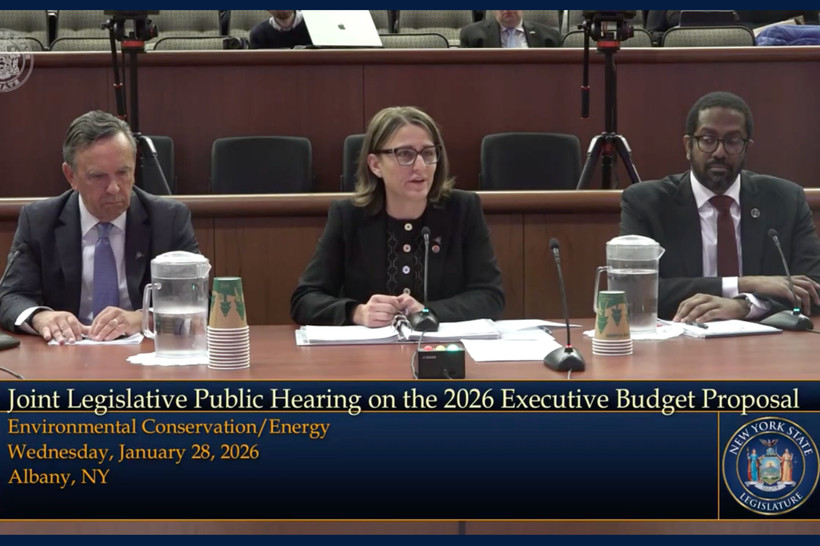
From left: New York Power Authority President Justin Driscoll, NYSERDA President Doreen Harris, and New York State Public Service Commission Chair Rory Christian spoke at a budget hearing on energy and the environment on January 28, 2026. | Screenshot: New York state Senate/YouTube

Sign up for Staying Focused, our newsletter keeping readers up to speed on New York politics.

In a marathon hearing on Wednesday, New York’s top energy and environmental officials hinted that Governor Kathy Hochul could still be looking to amend a key component of New York’s climate law, despite leaving plans to do so out of her budget proposal earlier this month.

At issue is how the state counts emissions — a technical issue that could have sweeping implications for how aggressively New York seeks to transition away from fossil fuels in the coming years. Revising the methodology would essentially allow the state to achieve its emissions targets faster, without doing anything else differently.

“The reality is, if we tracked our progress using the greenhouse gas accounting methodology used by our peers, we would be a lot closer to meeting our 2030 goals than under our current approach,” said Doreen Harris, president and CEO of the New York State Energy Research and Development Authority.

The comments came amid a mounting debate over whether New York should revise the targets in its flagship climate law, passed in 2019, as the state falls increasingly far behind on achieving them as written.

Last fall, after a judge ruled that the state was violating a key part of the law, Hochul said she was mulling changes to it. She didn’t include any such changes in her State of the State address or initial budget proposal this month — her biggest opportunities to set out her legislative agenda for the year — but she still has three weeks to propose amendments to her plan. The governor is reportedly considering proposing changes during budget negotiations, and on Wednesday, officials in her administration left the door open to the possibility.

When asked at the hearing whether Hochul’s administration is still entertaining the accounting change, Department of Environmental Conservation commissioner Amanda Lefton said she didn’t know the governor’s exact plans but said that “conversations continue.”

New York’s Climate Act requires the state to cut greenhouse gas emissions 40 percent from 1990 levels by 2030, setting a path to zero out emissions by 2050. It also requires the state to count those emissions in a specific way: by heavily weighting the climate impact of methane, the main component of natural gas.

Methane is a highly potent greenhouse gas. Though it dissipates from the atmosphere much more quickly than carbon dioxide, its warming effects in the short term are more intense. Over 20 years, it traps about 80 times more heat than CO2. Measured over a century, that figure drops to about 30 times. Scientists use the two timeframes as different benchmarks to measure total greenhouse gas emissions.

New York is one of the rare places that measures its emissions using the 20-year metric, rather than the 100-year metric used by the United Nations. (Maryland is the only other US state to do so.)

That has significant implications for how the state assesses its progress toward meeting its climate mandates. According to its latest emissions report, the state cut emissions by about 15 percent in recent decades. Under the conventional accounting, the figure would be 24 percent. That would put the state’s 2030 target within reach, officials estimate — whereas, under the current accounting, New York won’t hit it until at least 2037.

Changing the emissions accounting would relieve some of the pressure for New York to cut pollution from buildings, which, thanks to their widespread reliance on gas, currently register as its largest source of emissions and have been at the center of major fights in Albany in recent years. The change would allow homes, businesses, and power plants to continue burning more natural gas for longer, and give the state more time to find solutions to its mounting waste problem. And, if the state were to adopt a carbon pricing program like cap and invest, it could lower the price on pollution — all without running afoul of the climate law.

There is some debate among climate experts about which is the better method to use. Some, including Cornell University professor Robert Howarth, who advised state leaders on the climate law and how to implement it, have strongly championed the 20-year metric because it captures the outsized impact of methane. Other analysts have questioned it, arguing that it could discourage long-term emissions cuts in favor of quicker fixes.

Senators and Assemblymembers at the New York State Legislature Joint Public Hearing on Environmental Conservation and Energy on January 28, 2026. | Colin Kinniburgh/New York Focus


New York’s accounting has other particularities. It requires regulators to count emissions all along the fossil fuel supply chain — for example, methane leaks at gas fracking wells in Pennsylvania. And it counts emissions from the burning of biofuels, like wood pellets or methane captured from landfills, which the industry says doesn’t fairly account for the fuels’ climate impacts over their full lifecycle.

Hochul previously attempted to change the state’s climate math in a surprise maneuver during budget negotiations in 2023, but dropped the proposal within days after a swift backlash from climate groups.

Some business groups have tried to keep the issue alive. The fiscally conservative Citizens Budget Commission urged the state to reconsider its emissions accounting in a 2024 report. The gas utility National Fuel raised the issue with the governor’s office last year, according to emails New York Focus obtained through a public records request. (Asked about the lobbying, National Fuel spokesperson Karen Merkel said that New York’s standards “should be aligned” with federal and international ones, and that the current ones “can hinder progress toward the state’s climate goals.”)

The state’s energy plan, published in December, highlighted the issue again. And on Wednesday, it took center stage as lawmakers grilled Hochul’s agency heads about the state’s climate efforts.

“Every state except Maryland uses the 100-year calculation,” said state Senator Patricia Canzoneri-Fitzpatrick, a Republican from Long Island. “Are there still discussions about changing the calculation?”

“The governor has raised the issue very importantly to ensure that we continue to make substantial progress in fighting climate change and also work with many stakeholders to ensure that it is ambitious and realistic and affordable,” responded Lefton, the Department of Environmental Conservation commissioner.

The governor’s office declined to say more. “If we have something to announce, we will announce it,” spokesperson Ken Lovett told New York Focus. 

The governor has 30 days after releasing her draft budget to propose written amendments. She also has considerable leeway to negotiate with legislative leaders during closed-door talks later in the budget process. Typically, final budget legislation — which can include a wide range of policy proposals unrelated to state spending — is published only days or hours before the Senate and Assembly vote on it.

Some Democrats are prepared to push back on any change to the state’s emissions accounting if Hochul proposes one again. Liz Krueger, chair of the Senate finance committee, said she had no desire to reopen the issue and didn’t expect her colleagues would, either. She said New York has a responsibility to lead on climate, regardless of federal rollbacks. 

Assembly Speaker Carl Heastie has been more equivocal. Speaking to Spectrum News earlier this month, he said he understood the governor’s “difficult position” on climate issues. 

“I don’t think the [Democratic] conference will be okay with rolling back” the climate law, he said, “but I think the conference … will also understand you have to keep the lights on.”

Melissa Manno contributed reporting.

I hope this article helped you better answer the question that guides all of our journalism: Who runs New York? Before you click away, please consider supporting our work and making more stories like this one possible.

New York state is standing at a crossroads for climate action. After passing one of the nation’s most ambitious climate laws in 2019, the state is lagging far behind on its targets, struggling to meet deadlines to build renewable energy and clean up its buildings and roads. Other states are closely watching our progress, making decisions about their own climate plans based on New York’s ability to implement this legislation.

As New York’s only statewide nonprofit news publication, we’ve been scrutinizing the state’s climate progress. Our journalism exists to unpack how power works in New York, analyze who’s really calling the shots, and reveal how obscure decisions shape ordinary New Yorkers’ lives.

But we can't do this work without your help. We rely on reader donations to help sustain our outlet, and every gift directly allows us to publish more pieces like this.

Our work has already shown what can happen when those with power know that someone is watching, with my reporting prompting a state investigation and fine for a major corporation. I have more story ideas than I can count, but only limited resources to pursue all the leads that come across my desk.

If you’re able, please consider supporting our journalism with a one-time or monthly gift. Even small donations make a big difference.

Thank you for reading.

Colin Kinniburgh
Climate and Environmental Politics Reporter
A photo of Colin Kinniburgh.
Colin Kinniburgh is a reporter at New York Focus, covering the state’s climate and environmental politics. He has worked in media for more than a decade, across print, television, audio, and online news, and participated in fellowship programs at CUNY’s Graduate School of Journalism… more
Also filed in New York State

At a Board of Regents meeting Monday, state officials proposed eliminating credit-based diploma requirements.

The last-minute influx, the biggest ever for a legislative primary, is boosting her opponent, Jessica González-Rojas.

City budget gaps and an ambitious affordability agenda may require pressing Albany again for taxes and aid.

Also filed in Budget

In May, state lawmakers passed a $269 billion budget after haggling for months over thousands of line items and policies affecting New Yorkers.
State leaders are expected to pass a bill that avoids resolving how much Resorts World New York City needs to pay.

Resorts World is floating legislation to avert more than $500 million in payments to the horseracing industry.

Also filed in Climate and Environment

The citizens assembly model, used for public decision-making around the world, is gaining traction in New York.
A lobbyist who has been romantically linked to Assembly Speaker Carl Heastie led a rally opposing the legislation a week before the speaker declined to bring it to a vote.

Governor Kathy Hochul was successful in her bid to upend the Climate Leadership and Community Protection Act after legislators caved to finalize an overall budget deal.