Mamdani Gets a New York City Bailout, but Not the One He Wanted

Some of the city’s new aid will be canceled out by pension boosts.

Nick Garber   ·   May 27, 2026
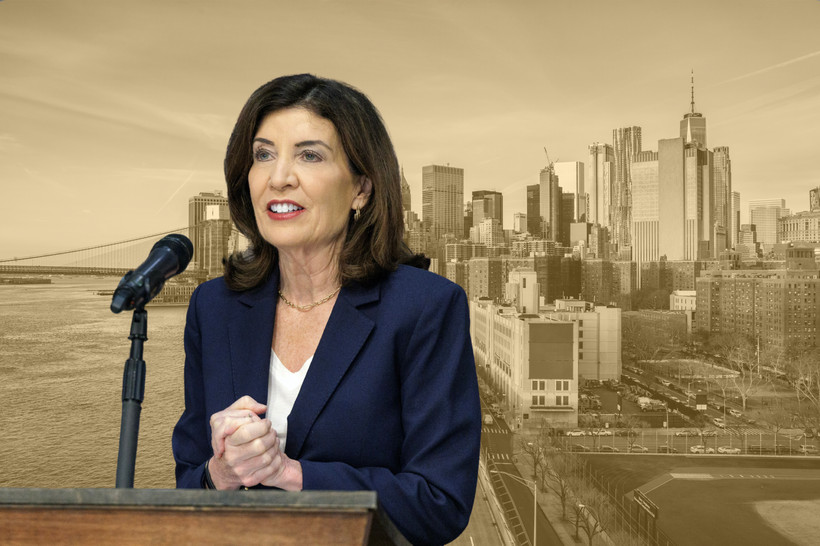
Photo collage of Governor Kathy Hochul in front of a yellow-tinted photo of New York City.
New York City Mayor Zohran Mamdani didn't get the major tax hikes he campaigned on, but he still got $28 billion in support from the state. | Photos: Mike Groll/Office of Governor Kathy Hochul; Cha_DZ/Getty Images | Illustration: Leor Stylar

Sign up for Staying Focused, our newsletter keeping readers up to speed on New York politics.
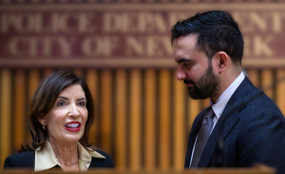
New York City Mayor Zohran Mamdani wanted a multibillion-dollar bailout from Albany this year, and he got one — but rather than a suite of big tax hikes, the final deal includes a mishmash of cost shifts, delayed pension payments and one notable new tax on pricey second homes.

The enacted state budget includes none of the corporate and personal income tax increases that Mamdani campaigned on. But it gives New York City more than $28 billion in support, according to Governor Kathy Hochul’s office, a nearly 50 percent increase from when she took office in 2021. That includes several late additions that helped Mamdani balance his latest budget plan despite inheriting a multibillion-dollar deficit.

The biggest impact comes from the state giving the city permission to delay making payments to several employee pension funds over the next five years. That “re-amortization” will save the city about $900 million next year and similar amounts through 2032, but will cost the city more in the long run, according to an analysis by Bill Hammond of the Empire Center for Public Policy.

The most attention-grabbing item is the new pied-à-terre tax on non-primary residences with sale values of $5 million or more. Homes worth between $5 million and $15 million will pay the equivalent of a 0.8 percent surcharge, climbing to 1.3 percent for properties above $25 million. To make things more complicated, the city’s convoluted assessment rules will force regulators to initially approximate the homes’ prices based on their listed assessed values, which tend to be lower than their sale values. After two years, the city and state will develop a new system to value the homes based on the sale prices of comparable properties instead.

The city is counting on the tax to raise $500 million annually starting next year, although some experts caution it may be lower.

Other tax hikes that were floated in the midst of budget talks did not end up in the final deal, including Mamdani’s last-ditch proposal to reduce the so-called pass-through entity tax credit used by some business owners, or a tax on all-cash real estate purchases. Hochul stood firm against those hikes, even as the legislature allied with Mamdani in pushing for them. 

And the state did not agree to send the city more money through the Aid and Incentives for Municipalities program, where Mamdani was hoping to get about $300 million annually to reverse a previous cut.

But the city won several non-flashy cost shifts that will save it money in the coming years. The state will stop withholding sales taxes to help shore up distressed hospitals, will raise the city’s reimbursement rate for public health services to match other localities, and will assume costs for line-of-duty deaths in the Fire Department.

The budget does not give the city any new flexibility in complying with the state’s school class size reduction mandate, although the issue could be addressed post-budget, lawmakers said. It does, however, delay a statewide mandate to start electrifying school buses from 2027 to 2032, which will save the city money in the short term.

Some of that new money will be canceled out by costs the state is imposing. Reforms to the “Tier Six” pension plan for government workers will cost the city $123 million next year, according to an analysis by the Citizens Budget Commission. And eliminating taxes on tipped wages up to $25,000 to align with a similar federal policy will cost the city an estimated $239 million over four years.

Outside of fiscal issues, Mamdani did not win approval to make buses fare-free but did receive the initial $73 million in state funding, promised by Hochul in January, to launch a free child care pilot for New York City 2-year-olds. He and Hochul have promised citywide 2-K by 2029.

The budget also includes a provision that allows him to dissolve a Charter Revision Commission created by his predecessor, Eric Adams, in the waning days of his mayoralty last year. The commission wants to explore measures to combat antisemitism and create non-partisan primary elections, which could have posed political headaches for Mamdani. Assembly Speaker Carl Heastie said that Mamdani requested that bill; its approval is a sign of the goodwill that Mamdani, who spent four years in the Assembly, still enjoys from his former Albany colleagues. 

And Mamdani’s administration strongly supported Hochul’s reforms to the State Environmental Quality Review Act, aimed at removing obstacles to building housing. The final deal, which closely resembles Hochul’s original plan, will exempt buildings of up to 250 units within New York City — and up to 500 units in higher-density areas — from the time-consuming environmental reviews, as long as they sit on previously disturbed land and are hooked up to water and sewer systems.

Mamdani’s office told New York Focus that more than 300 housing projects around the city could have been eligible for that streamlined review over the last decade. But City Hall expects that total to be higher in the coming decade, as developers make use of the new rules.

At New York Focus, our central mission is to help readers better understand how New York really works. If you think this article succeeded, please consider supporting our mission and making more stories like this one possible.

New York is an incongruous state. We’re home to fabulous wealth — if the state were a country, it would have the tenth largest economy in the world — but also the highest rate of wealth inequality. We’re among the most diverse – but also the most segregated. We passed the nation’s most ambitious climate law — but haven’t been meeting its deadlines and continue to subsidize industries hastening the climate crisis.

As New York’s only statewide nonprofit news publication, our journalism exists to help you make sense of these contradictions. Our work scrutinizes how power works in the state, unpacks who’s really calling the shots, and reveals how obscure decisions shape ordinary New Yorkers’ lives.

In the last two decades, the number of local news outlets in New York has been nearly slashed in half, allowing elected officials and powerful individuals to increasingly operate in the dark — with the average New Yorker none the wiser.

We’re on a mission to change that. Our work has already shown what can happen when those with power know that someone is watching, with stories that have prompted policy changes and spurred legislation. We have ambitious plans for the rest of the year and beyond, including tackling new beats and more hard-hitting stories — but we need your help to make them a reality.

If you’re able, please consider supporting our journalism with a one-time gift or a monthly gift. We can't do this work without you.

Thank you,

Akash Mehta
Editor-in-Chief
A photo of Akash Mehta.
A photo of Nick Garber.
Nick Garber covers politics for New York Focus. He previously worked for Crain’s New York Business, where he covered city and state government, housing and real estate, and money in politics. He also covered neighborhood news in Manhattan and Queens for Patch, and got… more
Also filed in Budget

In May, state lawmakers passed a $269 billion budget after haggling for months over thousands of line items and policies affecting New Yorkers.

State leaders are expected to pass a bill that avoids resolving how much Resorts World New York City needs to pay.

Resorts World is floating legislation to avert more than $500 million in payments to the horseracing industry.

Also filed in New York City

We’ve compiled information for the 450,000 New Yorkers who will lose health care coverage on July 1.

The citizens assembly model, used for public decision-making around the world, is gaining traction in New York.

The Department of Justice has terminated more than 100 immigration judges since last year as it has pressured courts to order more deportations.

Also filed in Housing

A law designed to protect the environment will be partially rolled back to pave the way for much-needed homes.

After a New York Focus investigation, a Bronx charity distributed nearly $400,000 to survivors of a deadly 2022 fire.

Senate Majority Leader Andrea Stewart-Cousins says she sees “no reason” to remove Senator Luis Sepúlveda as judiciary chair.

Also filed in Transit

Oswego County sheriff’s deputies held drivers for up to 45 minutes as they waited for immigration agents, potentially breaking the law.

Critics say the $10 annual fees state drivers pay to fight car insurance theft and fraud aren’t being used as intended.

Vornado Realty Trust has a stake in Halmar’s proposal to rebuild the Manhattan rail hub.

Also filed in Education

Advocates welcomed the additional funding but said it falls short of need and doesn’t do enough to support workers.

The Hochul administration now has a chance to relax New York’s child care staffing ratios — among the country’s strictest — after 26 years. But will it?

Two years after Gov. Hochul unveiled her signature literacy policy, advocates say the findings underscore an urgent need for sweeping literacy reform.