New York Business Groups Rally Around Trump-Backed Pipeline

Business interests have launched a campaign to back National Grid’s demands for more gas, with fingerprints of the utility’s lobbying firm.

Colin Kinniburgh   ·   August 29, 2025
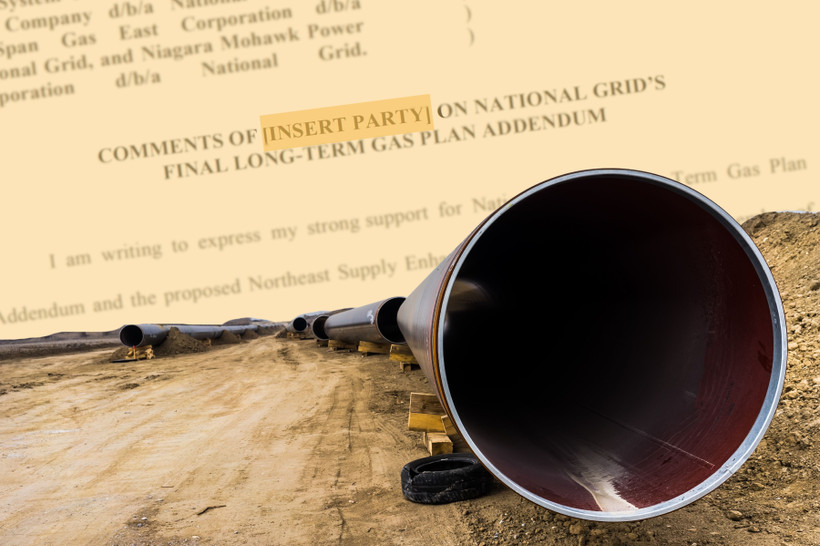
A slew of business groups have submitted matching letters to regulators in support of the NESE pipeline, with signs of a coordinated effort. | Illustration: New York Focus

Sign up for Staying Focused, our newsletter keeping readers up to speed on New York politics.

The Reporters’ Notebook features bite-sized stories and updates from New York Focus reporters on the topics they cover.

Over the past week, more than a dozen business interests have joined National Grid in backing the Northeast Supply Enhancement project, or NESE, a controversial pipeline championed by President Donald Trump that would carry gas underwater from New Jersey into New York City and Long Island. The groups, mostly based on Long Island, have submitted letters to the state utility regulator with similar — and sometimes identical — language in support of the pipeline.

The letters were filed in a case before the Public Service Commission, or PSC, which is reviewing National Grid’s long-term plan to supply gas to the downstate area. The case began more than a year ago, when the pipeline was off the table after state regulators had repeatedly rejected it.

Then, following talks between Trump and Governor Kathy Hochul, the pipeline company Williams revived the project, which would pipe gas directly into National Grid’s network. The utility filed an update to its gas plan in early July signaling its keen support for the project, turning the PSC case into a referendum on the pipeline.

Thousands of people have submitted comments opposing National Grid’s plans. They argue that the pipeline will fuel climate change, stir up toxic chemicals in the New York Bay, and saddle gas customers with more than $3 billion in construction costs. (National Grid estimates its downstate gas customers will pay an extra $7.50 each per month, on average, for the pipeline.)

Now, the utility appears to be rallying its side. National Grid and its allies — which range from regional business groups and chambers of commerce to building trades unions to a boutique real estate developer — argue in their filings that more gas is needed to shore up reliability; that the pipeline could combat climate change by reducing dependence on oil; and that it would ultimately save New Yorkers billions of dollars by bringing down the cost of electricity. One of National Grid’s main, new rationales for the pipeline is that it would help satisfy ballooning power demand from industries like artificial intelligence.

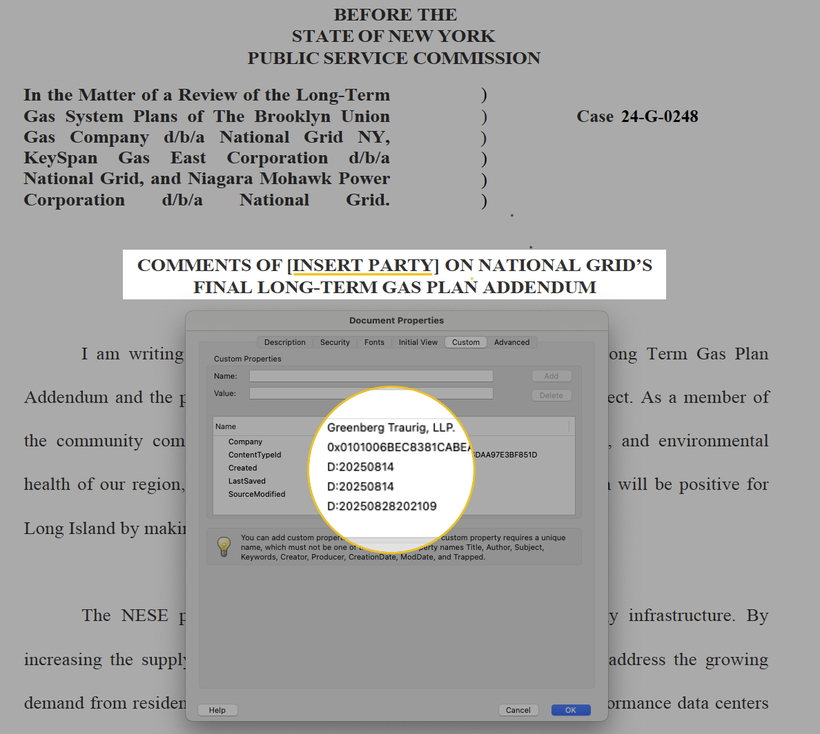
At least five of the letters contain almost entirely the same text, copied word for word; others share exact sentences, if not full paragraphs. One has the word “template” in its file name; two include “[INSERT PARTY]” in the heading, where the filers’ names should go.

Metadata in four of the documents names Greenberg Traurig, a lobbying firm that represents National Grid. The data suggests that the documents were originally created on August 14, about a week before the first letter was filed to the PSC.

Some of the letters filed in support of National Grid’s gas plan include "[INSERT PARTY]" in the headings and traces of National Grid’s lobbying firm Greenberg Traurig in their metadata. | Source: Public Service Commission | Markup: New York Focus


Kim Fraczek, director of the anti-pipeline group Sane Energy Project, said the business groups’ recent intervention bore traces of a “larger power” mobilizing to “outweigh” the opposition.

“I’ve never seen it pile on like this before, particularly at the last minute and particularly when this is such a hot political button,” she said.

The public comment period on National Grid’s gas plan closes September 5. (The process is separate from NESE’s environmental permitting, for which comments closed earlier this month.) Ten business interests and three building trades groups have joined the case as formal parties since just last Thursday, now making up a third of all participants.

Asked whether it was coordinating the lobbying, National Grid declined to answer, instead providing a general statement.

“We recommend the NESE pipeline project move forward to meet the growing power demand in the region and enhance reliability,” said spokesperson Alexander Starr. “As a provider of essential energy services, National Grid routinely meets with community leaders and stakeholders, and complies with all city, state, and federal regulations regarding lobbying.”

Greenberg Traurig did not respond to a request for comment.

The groups filing the letters provided differing accounts of what prompted them.

Terri Alessi-Miceli, president of HIA-LI, told New York Focus that National Grid approached her organization and others about supporting the pipeline.

Another pipeline backer — Kyle Strober, executive director of the Association for a Better Long Island — strongly denied that National Grid was behind his advocacy and instead took credit for “spearheading” local support for NESE.

“National Grid did not draft my letter,” he said. “I put together my letter, circulated it around, told everyone who signed up, informed National Grid that I was doing it.”

The letter, which was co-signed by a half-dozen other Long Island business groups, overlaps extensively with several of the other letters and contains “[INSERT PARTY]” in the heading.

Strober said any lapse in his filings was due to the maze of paperwork that the PSC requires from those who sign up as formal parties to its cases.

“When I had to submit things online, maybe it says, ‘Insert here,’ and then I didn’t delete it and put something there,” he said. (PSC spokesperson Jim Denn said the commission does not provide templates to commenters.)

Strober stressed that he had long supported the pipeline, since the state was first reviewing it some seven years ago.

“I don’t know what you’re alleging or not,” he continued, “but we are staunch supporters of the pipeline and we will tell everyone that it needs to be done.”

I hope this article helped you better answer the question that guides all of our journalism: Who runs New York? Before you click away, please consider supporting our work and making more stories like this one possible.

New York state is standing at a crossroads for climate action. After passing one of the nation’s most ambitious climate laws in 2019, the state is lagging far behind on its targets, struggling to meet deadlines to build renewable energy and clean up its buildings and roads. Other states are closely watching our progress, making decisions about their own climate plans based on New York’s ability to implement this legislation.

As New York’s only statewide nonprofit news publication, we’ve been scrutinizing the state’s climate progress. Our journalism exists to unpack how power works in New York, analyze who’s really calling the shots, and reveal how obscure decisions shape ordinary New Yorkers’ lives.

But we can't do this work without your help. We rely on reader donations to help sustain our outlet, and every gift directly allows us to publish more pieces like this.

Our work has already shown what can happen when those with power know that someone is watching, with my reporting prompting a state investigation and fine for a major corporation. I have more story ideas than I can count, but only limited resources to pursue all the leads that come across my desk.

If you’re able, please consider supporting our journalism with a one-time or monthly gift. Even small donations make a big difference.

Thank you for reading.

Colin Kinniburgh
Climate and Environmental Politics Reporter
A photo of Colin Kinniburgh.
Colin Kinniburgh is a reporter at New York Focus, covering the state’s climate and environmental politics. He has worked in media for more than a decade, across print, television, audio, and online news, and participated in fellowship programs at CUNY’s Graduate School of Journalism… more
Also filed in New York State

Millions in outside spending was a boon to Gov. Kathy Hochul’s 2022 opponent, Lee Zeldin, and influenced down-ballot races.

The legislation would make it easier for currently and formerly incarcerated people and child victims to sue the state over allegations of past abuse.

State leaders are expected to pass a bill that avoids resolving how much Resorts World New York City needs to pay.

Also filed in New York City

Resorts World is floating legislation to avert more than $500 million in payments to the horseracing industry.

Some of the city’s new aid will be canceled out by pension boosts.

The Department of Justice has terminated more than 100 immigration judges since last year as it has pressured courts to order more deportations.

Also filed in Climate and Environment

Governor Kathy Hochul was successful in her bid to upend the Climate Leadership and Community Protection Act after legislators caved to finalize an overall budget deal.

The leader of Reinvent Albany discusses a data center subsidy in Rockland County that flew under the radar for years.

No other project in the country has gotten such a large subsidy to create so few jobs, according to watchdogs.