Summers Are Brutal in New York’s Prisons. This Year Is Worse Than Ever.

Short-staffed since a strike this winter, the prison system is keeping people locked in their boiling cells and dorms for upwards of 21 hours a day.
Chris Gelardi   ·   August 4, 2025
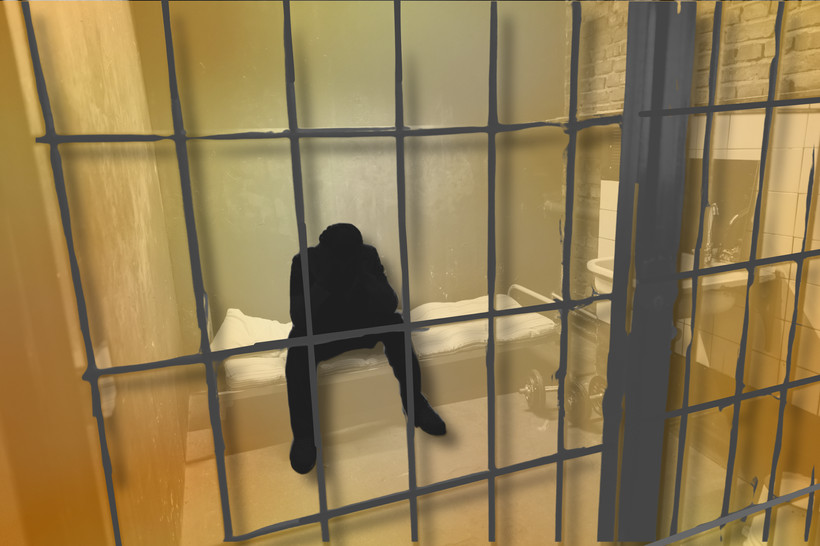
A person inside an extremely hot prison cell sits hunched over.
New York state prisons' housing units trap summer heat and humidity inside. | Photo: Ron Lach/Pexels | Illustration: Leor Stylar

Sign up for Staying Focused, our newsletter keeping readers up to speed on New York politics.

The temperature in Ossining topped 90 degrees three times last week; at its worst, the heat index hit 109. While much of the Westchester County community found respite in air conditioning or cool showers, Joseph Desmond spent the heat wave locked in what he described as a “hotbox”: his cell at Sing Sing Correctional Facility, where he said he’s trapped for upwards of 21 hours a day.

Summer heat is an annual issue in New York’s 42 state prisons. Almost none of the facilities’ housing units have air conditioning, and their small windows provide poor ventilation, trapping heat and humidity inside. It’s one of incarcerated people’s most common complaints.

This year has been especially brutal. Whereas incarcerated people can normally spend much of their day working, taking classes, or participating in activities in cooler parts of facilities, most have spent the last five months largely confined to their cells or dorms, sometimes only getting a precious hour or two outside them.

“You have no sense of relief,” Desmond said. “You’re just sitting in a cell, baking.”

That’s because the state prison agency has severely limited out-of-cell time since corrections officers launched a three-week wildcat strike in February. The strike ended with some 2,000 officers losing their jobs; four months later, dozens of facilities are operating with anywhere from 30 to 60 percent fewer guards than the state prison agency says they need to operate. (Governor Kathy Hochul deployed the National Guard to staff the facilities during the strike, and about 3,000 servicemembers remain assigned to prisons, but prison administration doesn’t allow them to do most security work without trained corrections officers present.)

The prison agency has said it needs more guards than it currently has to supervise programs and escort incarcerated people from one area to another. To make up for the lack of officers, facilities have canceled or shortened college courses, religious services, work release, outdoor recreation, and more — and kept prisoners locked away.

“There’s no break,” said Jennifer Scaife, executive director of the Correctional Association of New York, a nonprofit tasked by the state with overseeing prison conditions.

Scaife recently visited Marcy Correctional Facility in Central New York on a 90-plus-degree day. “You could stand in front of someone’s cell and just feel hot, humid air pouring out,” she said.

Incarcerated people have long complained that heat raises tensions and can lead to violence. It can also exacerbate medical issues and is especially dangerous for elderly people, advocates have warned. Scaife was particularly concerned for those in Marcy’s mental health unit, since many psychiatric medications can make it harder for the body to regulate temperature.

“There’s 90 people in this unit,” she said. ”They’ve been essentially in those circumstances for months.”

During her visit, Scaife witnessed incarcerated men trying to marginally improve the temperature in their cells, by reminding guards to give them ice, per prison agency guidance, and convincing staff to install more fans in locations that facilitate airflow. New York prisons don’t allow incarcerated people to have large fans of their own. Facilities do allow each prisoner to have one small personal fan — but they have to buy those and obtain a permit to do so.

The nonprofit New Hour, which provides services to incarcerated and recently released women, raised over $9,000 to purchase fans for women in prison. The fans were about $20 a piece, said New Hour’s executive director, Serena Martin, and the organization had to buy them from one of the prison agency’s approved third-party vendors.

“You’re just sitting in a cell, baking.”

—Joseph Desmond

“Why isn’t this part of the budget?” said Martin. “It should be a mandatory thing that you get, like a pillow and a blanket.”

The Department of Corrections and Community Supervision, which runs the state prison system, did not answer questions about why it doesn’t provide free personal fans. It also didn’t answer questions about why it limits the size of fans incarcerated people can possess; Martin, who is formerly incarcerated herself, chalked that up to security policies aimed at limiting access to materials that can be fashioned into weapons.

Some have had trouble obtaining fans. Mary Maguire said the commissary at Elmira Correctional Facility, where her son is incarcerated, didn’t have them in stock for several weeks.

State Senator Julia Salazar, head of the chamber’s corrections committee, said in a statement that her office receives regular calls about difficulty accessing fans, among other complaints about the heat. The roughly $20 price tag “is more than most incarcerated people can afford,” she said, and obtaining a permit can take time. “Based on the calls we receive, these permits can take anywhere from 48 hours to several weeks to be approved,” Salazar said.

Desmond, from Sing Sing, was able to buy a six-inch fan. It’s barely enough to cool his face, let alone his cell, he said.

Conditions at Sing Sing appear even more dire than in other facilities. Administrators recently reported that roughly 100 corrections officers at the facility are calling out sick every day. “These people don’t come to work,” Desmond said.

That makes beating the heat a particularly tall order. Desmond would love to cool off with regular showers, but the facility has only been taking the men to shower for a few minutes three times a week, he said — and the water lately has come out hot.

While conditions this summer are especially oppressive, advocates have fielded complaints about extreme heat in New York prisons for years as temperatures have risen due to climate change. At Great Meadow Correctional Facility in 2021, incarcerated people told Scaife’s Correctional Association that it was so hot — and corrections officers ignored their complaints so often — that one man started a fire in an attempt to force staff to open windows. During oversight visits to Elmira and Coxsackie prisons the following summer, incarcerated people complained to the organization about extreme heat exacerbated by lack of ventilation. There was no cold water and not enough fans to go around, they said.

Air conditioning would resolve these issues, but it would require a massive investment. Many of New York’s prison buildings, some of which were built in the 1800s, would need new electrical infrastructure to support air conditioning units, Scaife said. And DOCCS is in the middle of other large capital projects, like a nearly billion-dollar effort to install system-wide security camera coverage, fast-tracked after a fatal beatdown by corrections officers in December.

“The scale of the issues right now, it’s just so great,” Scaife said. While heat exacerbates other problems, it falls low on the priority list for DOCCS administration and elected officials, she said. “Because it’s seasonal, they’ll just kind of move beyond it.”

With air conditioning unlikely to be installed anytime soon, Scaife’s organization has called for DOCCS to develop and publish detailed plans to ensure that incarcerated people are able to cope with extreme heat. The department didn’t take up the recommendation, but last year, Hochul signed into law a bill that requires DOCCS to establish more heat mitigation regulations. Among other factors, the rules are meant to require staff to facilitate access to industrial fans and extra shower time and ensure that facilities are fully stocked with personal fans.

The law, however, didn’t give DOCCS a deadline to publish those regulations. DOCCS told New York Focus the heat mitigation plan is still “in development.”

“The health and safety of incarcerated individuals and staff is a top priority,” DOCCS said in a statement. The department said that its chief medical officer sent a memo to staff in June instructing them to keep incarcerated people hydrated, look out for signs of heat stroke, and use all of the available fans. “Air conditioning is provided in medical areas, as well as the housing unit and dayroom of the nursery at Bedford Hills Correctional Facility. All other housing units in DOCCS facilities are properly ventilated in accordance with national standards set by the American Correctional Association,” DOCCS said.

With few tools to escape the heat, incarcerated people yearn for the end of summer. Milli, who only provided a first name, said a loved one incarcerated at Five Points Correctional Facility describes the heat as “unbearable.” He and his cellmate put a blanket over the window to block the sun and turn all the lights off.

“They sit in the dark all day,” Milli said, “because that’s the only way to get relief.”

BEFORE YOU GO, consider: If not for the article you just read, would the information in it be public?

Or would it remain hidden — buried within the confines of New York’s sprawling criminal-legal apparatus?

I started working at New York Focus in 2022, not long after the outlet launched. Since that time, our reporters and editors have been vigorously scrutinizing every facet of the Empire State’s criminal justice institutions, investigating power players and the impact of policy on state prisons, county jails, and local police and courts — always with an eye toward what it means for people involved in the system.

That system works hard to make those people invisible, and it shields those at the top from scrutiny. And without rigorous, resource-intensive journalism, it would all operate with significantly more impunity.

Only a handful of journalists do this type of work in New York. In the last decades, the number of local news outlets in the state has nearly halved, making our coverage all the more critical. Our criminal justice reporting has been cited in lawsuits, spurred legislation, and led to the rescission of statewide policies. With your help, we can continue to do this work, and go even deeper: We have endless ideas for more ambitious projects and harder hitting investigations. But we need your help.

As a small, nonprofit outlet, we rely on our readers to support our journalism. If you’re able, please consider supporting us with a one-time or monthly gift. We so appreciate your help.

Here’s to a more just, more transparent New York.

Chris Gelardi
Justice Bureau Chief
A photo of Chris Gelardi

I hope this article helped you better answer the question that guides all of our journalism: Who runs New York? Before you click away, please consider supporting our work and making more stories like this one possible.

New York state is standing at a crossroads for climate action. After passing one of the nation’s most ambitious climate laws in 2019, the state is lagging far behind on its targets, struggling to meet deadlines to build renewable energy and clean up its buildings and roads. Other states are closely watching our progress, making decisions about their own climate plans based on New York’s ability to implement this legislation.

As New York’s only statewide nonprofit news publication, we’ve been scrutinizing the state’s climate progress. Our journalism exists to unpack how power works in New York, analyze who’s really calling the shots, and reveal how obscure decisions shape ordinary New Yorkers’ lives.

But we can't do this work without your help. We rely on reader donations to help sustain our outlet, and every gift directly allows us to publish more pieces like this.

Our work has already shown what can happen when those with power know that someone is watching, with my reporting prompting a state investigation and fine for a major corporation. I have more story ideas than I can count, but only limited resources to pursue all the leads that come across my desk.

If you’re able, please consider supporting our journalism with a one-time or monthly gift. Even small donations make a big difference.

Thank you for reading.

Colin Kinniburgh
Climate and Environmental Politics Reporter
A photo of Colin Kinniburgh.
A photo of Chris Gelardi
As New York Focus’s justice bureau chief, Chris Gelardi reports and edits work on the state’s criminal-legal and immigration systems. His writing on cops, jails, ICE, and the US military has appeared in more than a dozen other outlets, most frequently The Intercept… more
Also filed in Criminal Justice

In May, state lawmakers passed a $269 billion budget after haggling for months over thousands of line items and policies affecting New Yorkers.

The legislation would make it easier for currently and formerly incarcerated people and child victims to sue the state over allegations of past abuse.

It’s unclear whether the Correctional Association of New York will have to scale back its nascent reform initiatives.

Also filed in New York State

A lobbyist who has been romantically linked to Assembly Speaker Carl Heastie led a rally opposing the legislation a week before the speaker declined to bring it to a vote.

Millions in outside spending was a boon to Gov. Kathy Hochul’s 2022 opponent, Lee Zeldin, and influenced down-ballot races.

State leaders are expected to pass a bill that avoids resolving how much Resorts World New York City needs to pay.

Also filed in Climate and Environment

Governor Kathy Hochul was successful in her bid to upend the Climate Leadership and Community Protection Act after legislators caved to finalize an overall budget deal.

The leader of Reinvent Albany discusses a data center subsidy in Rockland County that flew under the radar for years.

No other project in the country has gotten such a large subsidy to create so few jobs, according to watchdogs.