Putting a Price Tag on ‘Universal’ Pre-K

The state’s universal pre-K funding model is notoriously complex. How does it actually work, and can the governor’s plan fix it?

Melissa Manno   ·   March 20, 2026
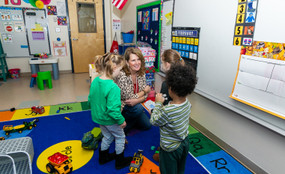
Last week, the state legislature officially backed Governor Kathy Hochul’s plan to offer every 4-year-old in New York a free pre-K seat within the next three years. | Photo: Warren LeMay/Flickr; Graphics: Oleksa/Canva, FatCamera/Getty Images | Illustration: Leor Stylar

Sign up for Staying Focused, our newsletter keeping readers up to speed on New York politics.

Last week, the state legislature officially backed Governor Kathy Hochul’s plan to offer every 4-year-old in New York a free pre-K seat within the next three years.

New York’s public pre-K program served three-quarters of eligible 4-year-olds last school year. But thousands of children statewide still lack access because their districts have limited seats or don’t offer it at all, New York Focus reported earlier this month. Last year, 49 districts opted out, many citing insufficient state funding, limited space, or staffing issues.

Hochul’s proposal would nearly double the state’s minimum reimbursement to $10,000 per student, but some district superintendents contend that amount would still not be enough to provide a seat to all applicants by the 2028–29 school year.

At the heart of the tension is how the cost of the program should be divided between the state and school districts. State aid rarely covers the full cost of pre-K, leaving districts to make up the difference from their local — and, often, already strained — budgets. Some superintendents argue that the state should shoulder a larger share of the expense. Other officials think that the model, which is similar to how public K-12 is funded, should suffice.

How does the program’s funding model actually work, and can the governor’s plan fix it? Here’s what you need to know.

How is universal pre-K funded, and what does it cover?

Universal pre-K draws from multiple funding streams.

To start, school districts receive state funding per child enrolled in public pre-K. The current rate is set at either half of what a district receives in Foundation Aid — the state’s complex funding formula for K-12 education — or $5,400, whichever is higher.

When a district joins the program, the state sets a target enrollment number, typically around 85 percent of the district’s kindergarten enrollment, which it uses to calculate the maximum funding the district can receive each year.

On top of that, many districts receive competitive grants that can boost per-pupil funding up to $10,000. A small grant program offers funding for a limited number of low-income preschoolers, and state funding is available for children with disabilities.

The 2025 state budget included four separate funding streams for pre-K totaling $1.2 billion, according to a NYSED analysis that recommended consolidating the program funding to achieve universality.

“It’s an incredibly complicated set of funding streams,” said Andrew Perry, director of fiscal research at the Fiscal Policy Institute.

That money is primarily for 4‑year‑olds, but some districts get a separate allotment for 3‑year‑olds. They can use the money for a wide range of expenses, from employee salaries to classroom supplies to transportation services.

Some school leaders and advocates say state funding covers only a fraction of the true cost of educating a 4-year-old. The National Institute for Early Education Research, for example, estimated that in 2023, the cost of high-quality full-day preschool in New York state exceeded $19,000 per child.

How does the funding model differ from other public school funding?

As with Foundation Aid, school districts often have to contribute local funds to operate a pre-K program. According to state Senator James Skoufis, who has called for a pre-K mandate to kick in sooner, school districts have had ample time to find money in their local budgets.

“The state does not pay for the full expenses associated with any grade,” Skoufis told New York Focus last month. “I think any school district that expects us to pay the full cost of UPK is living on another planet.”

But unlike Foundation Aid, which is recalculated each year to account for changing enrollment numbers, universal pre-K funding is largely fixed at the level set when a program is launched. Districts are funded for a set number of seats and generally do not receive additional state aid if they enroll more students than planned.

Between the 2024–25 and 2025–26 school years, all New York school districts saw a boost in their K-12 Foundation Aid, but none saw an increase in maximum universal pre-K aid, according to a report from the Alliance for Quality Education, the Children’s Agenda, and the Public Policy Education Fund.

“This is one of the ways in which the current UPK funding is totally inadequate,” Perry said.

Does the state pay for private pre-K?

Enrollment in public pre-K is voluntary, and in some wealthier areas where districts don’t offer it, superintendents told New York Focus that parents prefer private providers.

Some private programs receive state funding. State law requires school districts to contract out at least 10 percent of their pre-K funds to community providers, and many rely entirely on this model because it’s often more cost-effective than housing and staffing a school-based program.

Private, public, and state-funded private pre-K operate under slightly different standards for curricula, certification, and class size.

School districts must choose pre-K curricula aligned with New York State Learning Standards and ensure their teachers are certified in early childhood education. Community-based organizations can use uncertified teachers, as long as they show proof that they are working toward certification. Fully private pre-K providers, on the other hand, are not required to comply with state curriculum or certification standards, but those that operate as child care centers must be licensed with the state and follow health, safety, and staffing ratio requirements.

Public and private pre-K classes are capped at 20 students, but public classes are required to have a higher staff-child ratio. When a school district has more applicants than available seats, it has to use a lottery, which means it can’t prioritize higher-need children, like those with disabilities or those from low-income families.

“That is a general frustration and has been for awhile,” said Bob Lowry, deputy director for advocacy, research and communications at NYS Council of School Superintendents. “Districts would prefer to be able to target children who really need a program, and whose families are unlikely to be able to provide something out of pocket.”

Will the governor’s proposal address all these issues?

Hochul’s proposal would eliminate the need for lotteries, since it requires school districts to provide a seat to every eligible child. In addition to boosting the minimum per-child allotment, it would also consolidate the state’s funding streams into one.

Both the state Senate and Assembly backed the plan with modest tweaks: The Senate wants to provide transportation aid for pre-K, and the Assembly wants the increased allotment to also apply to 3-year-olds.

Advocates and school officials have largely applauded the plan, but some say the boost to $10,000 per child still won’t be enough to foot the cost of a mandate and overcome systemic barriers to offering pre-K.

Assemblymember Amy Paulin, who represents several Westchester County school districts that do not offer public pre-K, has been advocating to increase the per-pupil reimbursement for over a decade — but noted that $10,000 has significantly less purchasing power in today’s economy.

“We’re talking about a huge differential in cost,” she said. “If we have this expectation, we have to give districts more flexibility or more money. I’m okay with both.”

At New York Focus, our central mission is to help readers better understand how New York really works. If you think this article succeeded, please consider supporting our mission and making more stories like this one possible.

New York is an incongruous state. We’re home to fabulous wealth — if the state were a country, it would have the tenth largest economy in the world — but also the highest rate of wealth inequality. We’re among the most diverse – but also the most segregated. We passed the nation’s most ambitious climate law — but haven’t been meeting its deadlines and continue to subsidize industries hastening the climate crisis.

As New York’s only statewide nonprofit news publication, our journalism exists to help you make sense of these contradictions. Our work scrutinizes how power works in the state, unpacks who’s really calling the shots, and reveals how obscure decisions shape ordinary New Yorkers’ lives.

In the last two decades, the number of local news outlets in New York has been nearly slashed in half, allowing elected officials and powerful individuals to increasingly operate in the dark — with the average New Yorker none the wiser.

We’re on a mission to change that. Our work has already shown what can happen when those with power know that someone is watching, with stories that have prompted policy changes and spurred legislation. We have ambitious plans for the rest of the year and beyond, including tackling new beats and more hard-hitting stories — but we need your help to make them a reality.

If you’re able, please consider supporting our journalism with a one-time gift or a monthly gift. We can't do this work without you.

Thank you,

Akash Mehta
Editor-in-Chief
A photo of Akash Mehta.
A photo of Melissa Manno.
Melissa Manno is a reporter at New York Focus, covering the state’s school system and education politics. She was previously an education reporter for the San Antonio Express-News, where she reported on discipline, special education, school funding and other issues impacting students in… more