Cuomo Tried to Stop a $550 Million Debt Scam. It Didn’t Go as Planned.

As Attorney General, Andrew Cuomo put fraudulent debt collection firms on notice. He may have strengthened their hand.

Sam Mellins   ·   June 22, 2025
| Photos: Jorge Láscar / Wikimedia Commons; Diana Robinson / Flickr | Illustration: Leor Stylar

Sign up for Staying Focused, our newsletter keeping readers up to speed on New York politics.

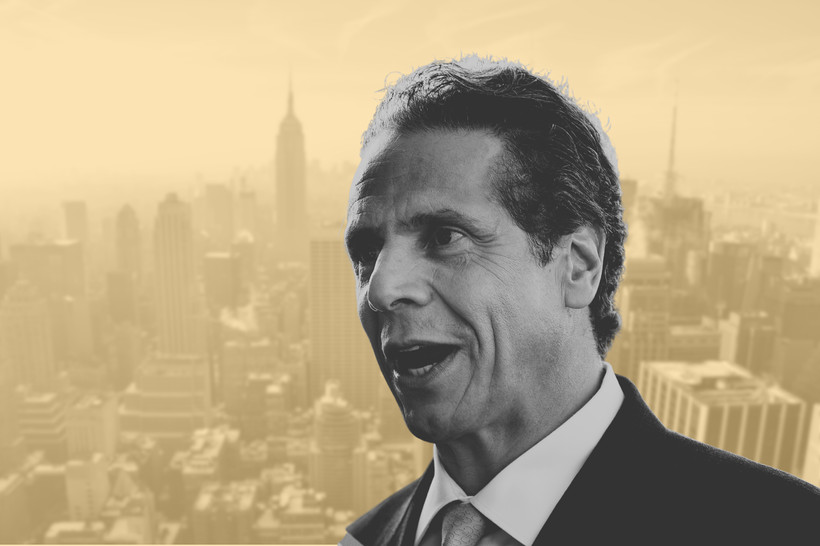
Andrew Cuomo has centered his mayoral campaign on affordability, arguing that his experience in government has equipped him to bring down the cost of living in New York City.

His campaign cites as examples his achievements as governor, like raising the minimum wage and slashing taxes.

But the result of one affordability-centered episode from his time as New York’s attorney general has never received public attention: his pledge to protect 100,000 New Yorkers who had been victimized by shady debt collectors.

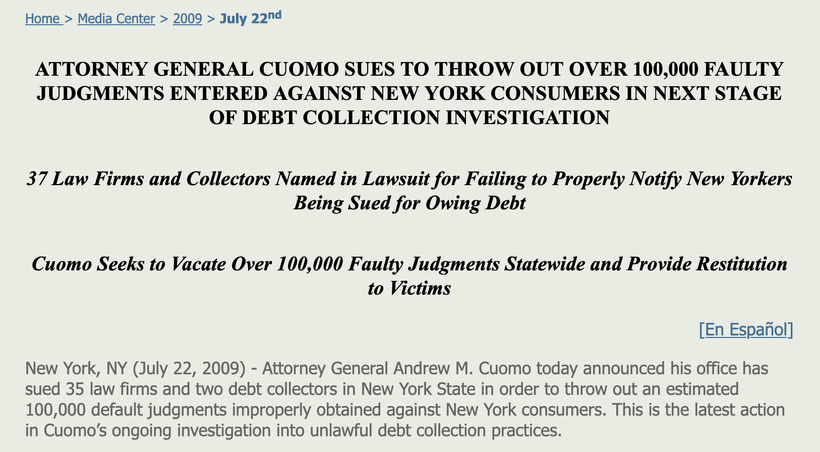
Cuomo took office as attorney general in 2007. After the 2008 financial crisis, he began working to bring financial relief to New Yorkers buffeted by the recession. In July 2009, he launched a lawsuit on behalf of a judge to recover up to $550 million from collection firms that, he alleged, had violated basic due process rights by filing lawsuits against consumers without legally notifying them.

Because consumers didn’t know there was a case against them, they couldn’t show up in court to defend themselves. Often, they first learned that they’d been sued when money was taken out of their paychecks to pay off the alleged debt.

Cuomo called his lawsuit targeting 35 debt collection law firms across the state a “key step in our efforts to uproot unlawful debt collection practices.” He asked a judge to toss out the faulty cases and direct “proper restitution” to any debtor who made payment on an “improperly obtained default judgement.” His office estimated that the average default judgement was around $5,500.

Cuomo’s office reached settlements with the firms the following year. Very few of the cases were tossed out, and even fewer consumers got their money back.

The settlements did not require a judge to vacate any past judgements or refund the money to debtors. In some cases, the settlements actually strengthened collectors’ legal cases.

Carolyn Coffey, a career consumers’ rights attorney, remembered praising Cuomo at the time for taking action against the “devastating effects” of fraudulent debt collection and sewer service.

But when his office unveiled the settlement, Coffey was “absolutely horrified,” she told New York Focus.

“It was a complete pass” for the debt collectors Cuomo had promised to hold accountable, she said.

A press release from July 22, 2009, announces Cuomo's lawsuit against 35 law firms and two debt collectors, calling it "the latest action in Cuomo’s ongoing investigation into unlawful debt collection practices." | Attorney General's website accessed through the Wayback Machine.

Steve Cohen, Cuomo’s former chief of staff and counselor during his tenure as Attorney General, told New York Focus that the effort did result in providing “much of the relief sought” in the lawsuit. He repeatedly stressed that the lawsuit was made on behalf of then-Chief Administrative Judge Ann Pfau and was not a Cuomo-instigated undertaking.

“This case was about the deceptions with respect to process serving and default judgements obtained as a consequence,” Cohen said. “This case was not about the debt collection industry.”

The case against the debt collectors grew out of criminal charges Cuomo’s office had brought a few months earlier against the Long Island-based company American Legal Process and its owner, William Singler.

ALP was a process service company, meaning that law firms hired it to deliver documents informing defendants that they were being sued, a legal requirement in civil cases. A state investigation into ALP’s activities revealed that employees were committing widespread fraud with Singler’s knowledge and approval. The company frequently engaged in what’s known as sewer service, the industry term for when a server falsely claims they delivered court documents.

Despite years of enforcement efforts, sewer service is still a widespread problem in New York’s debt collection industry, New York Focus recently reported.

On 450 separate occasions, one ALP process server had claimed to deliver papers in two different locations at once, according to an investigation filed as evidence in the case. Nineteen other servers had also reported the same thing.

“I am putting all law firms on notice. They are responsible for the conduct of the companies they use.”

—Andrew Cuomo

One server reported being in Western New York at 10:17 A.M. and then in Brooklyn — 350 miles away — two minutes later. Many servers recorded similarly impossible feats.

These actions led to thousands of New Yorkers losing court cases they didn’t know existed, which directly benefited the law firms that Cuomo’s office was suing.

Because alleged debtors never received notice of the lawsuit and failed to show up in court, they would lose the case by default. The prevailing law firms could then use the judgment to take money directly from their targets — for example, by garnishing their paychecks. Cuomo alleged that the firms that hired ALP had done this to the tune of $550 million.

Singler pleaded guilty in January 2010 and was sentenced to a year in jail. ALP was quickly dissolved.

But Cuomo wasn’t done. When he annouced the lawsuit against ALP in April 2009, he also said who he was going after next: the company’s clients. He promised to bring a case against the law firm Forster & Garbus, which was the client in over 28,000 of ALP’s 100,000 allegedly falsified service cases.

“I am putting all law firms on notice,” Cuomo said. “They are responsible for the conduct of the companies they use.”

A few months after his announcement, Cuomo made good on his promise, suing on behalf of Pfau not only Forster & Garbus, but 34 other law firms and two debt collectors, each of which had used ALP to deliver documents at least 100 times.

The lawsuit outlined ALP’s fraudulent behavior and how the law firms had benefited from it, winning thousands of default judgments. It asked the judge to toss out all default judgments obtained through ALP’s faulty services and provide restitution to debtors in those cases. If firms wanted to sue again, they’d have to prove that they had served the alleged debtors with notice — and without using ALP.

But there was a major weakness in the attorney general’s case.

“At the time we filed the lawsuit, we had no evidence that the law firms had actual knowledge that American Legal Process used fraudulent means to serve cases,” said James Morrissey, a now-retired lawyer who led Cuomo’s team on the case.

The firms argued that they, too, were victims of ALP’s bad behavior and shouldn’t be punished for it.

A lawyer for the firm Leschack & Grodensky, which had used ALP to serve defendants nearly 2,000 times, wrote in a court filing that the lawsuit “unfairly attempts to shift the burden of ALP’s wrongs upon the innocent and unsuspecting respondents simply because they used ALP’s services.”

It appears that Cuomo’s office did not have an effective rebuttal to this argument. Shortly after the first hearing in the case, the two sides began settlement talks, Morrissey told New York Focus. By February 2010, the Attorney General had begun inking settlements with the defendants, and by October 2010, nearly all of them had signed.

“Cases are filed all the time to seek based on incomplete information; that is the nature of civil litigation,” said Cohen, Cuomo’s former counsel. “As I understand it, the law firms all consented to the relief sought other than what was not legally available.”

From 2019 to 2023, defendants only responded to about 17 percent of the 366,000 consumer credit lawsuits filed in the city’s civil courts. | Photo: Mike Peel / Wikimedia Commons | Illustration: New York Focus

The settlement terms were drastically different from what Cuomo originally sought: For one, none of the judgments were automatically tossed out.

Instead, the law firms had to send letters to all the alleged debtors. If they didn’t respond — as records obtained by New York Focus indicate that the vast majority did not — nothing changed, and the judgments against them remained in effect.

If they did respond, they were potentially worse off.

An agreement within the letter said that if the alleged debtors responded, the law firms could sue them again for the same debt by mailing them another letter containing the charges.

That’s a much simpler method than usual for bringing a lawsuit. Normally, suing someone requires making multiple attempts to deliver the papers in person and leaving a copy at the defendant’s house if no one responds.

The speedy resolution to Cuomo’s case wasn’t necessarily surprising, but the terms of the settlement were, said Dennis Vacco, who served as New York’s attorney general from 1995 to 1998.

“What this is telling me is that the law firms almost immediately thought that it was in their best interest to negotiate their way out of this,” Vacco told New York Focus. “It just seems strange that the law firms, who were part and parcel of this effort, essentially walked away unscathed.”

Documents obtained by New York Focus suggest that the settlement Cuomo’s office negotiated changed nothing for the vast majority of people it was supposed to help. As a condition of the settlement, the law firms were required to send reports to the attorney general’s office detailing which defendants they had mailed the letter to and who had responded.

New York Focus obtained a sampling of these reports, which contained data for roughly 6,300 of the 100,000 cases that Cuomo had tried to get tossed. The reports show that fewer than 300 cases were tossed out, and the alleged debtors in many of those cases were sued again for the same debt.

Some alleged debtors were lucky enough to get legal help.

“At my office, whenever anyone we found or who found us said they’d received this notice, we told them not to sign it,” since it would open them up to being sued again, said Coffey, the consumer attorney. Instead, Coffey and her colleagues advised them to file a motion in court challenging the original judgment and seeking to get it tossed out.

Since the case changed little for the vast majority of debtors, it barely made a ripple in the court system. Only one judge cited the settlement in a published opinion — and he had some strong feelings about it.

In a 2011 case in Justice Fred Hirsh’s courtroom on Long Island, a debt collection firm was seeking to re-sue an alleged debtor who had signed and returned the settlement papers. Hirsh objected, saying that the settlement was tantamount to “giving [the] plaintiff the opportunity to avoid the consequences of having used an unscrupulous and unethical process server.”

If he hadn’t signed the settlement, the alleged debtor would have had a stronger defense, since there was no proof he’d been served originally.

Because he had signed, Hirsh wasn’t able to dismiss the case. In an interview with New York Focus, Hirsh, now retired, expressed dismay at the attorney general’s settlement that led to this scenario.

“Maybe there was no better offer, or maybe it was a situation where somebody should have played hardball,” he said. “All I can tell you is that people wound up getting screwed.”

Cohen argued there was a positive outcome from the lawsuit: “Firms began requiring more robust confirmation of compliance” with the law requiring proper notice and “few incidents of the kinds discovered by Judge Pfau were reported.”

Many of the law firms that Cuomo went after continue to be major players in New York’s debt collection industry.

Forster & Garbus, ALP’s top customer, continues to file thousands of lawsuits a year in New York courts, and has repeatedly run into legal trouble since settling with Cuomo’s office.

“It just seems strange that the law firms, who were part and parcel of this effort, essentially walked away unscathed.”

—Dennis Vacco, former NY Attorney General

Numerous cases have been filed against the firm in federal court since the settlement, many by aggrieved debtors alleging violations of their rights and the federal laws governing debt collection.

In 2020, New York’s financial regulation agency brought charges against Forster & Garbus for failing to provide its targets with proof that it had the right to collect debts from them. When one customer asked Forster & Garbus to prove that she owed the debt they were seeking to collect, the firm responded by suing her, the department said. That case is ongoing.

In 2023, the firm paid a $100,000 penalty to the Consumer Financial Protection Bureau to settle charges that it had attempted to collect on thousands of debts without proof that its targets owed the money.

The firm’s issues with sewer service haven’t gone away, either. One New Yorker who fought off a Forster & Garbus attempt to garnish their wages wrote to federal regulators last year: “I was unaware of this alleged debt, and I didn’t have an opportunity to dispute this … because I was never served,” they said. “I am filing this complaint to save others from going through such a traumatic experience.”

At New York Focus, our central mission is to help readers better understand how New York really works. If you think this article succeeded, please consider supporting our mission and making more stories like this one possible.

New York is an incongruous state. We’re home to fabulous wealth — if the state were a country, it would have the tenth largest economy in the world — but also the highest rate of wealth inequality. We’re among the most diverse – but also the most segregated. We passed the nation’s most ambitious climate law — but haven’t been meeting its deadlines and continue to subsidize industries hastening the climate crisis.

As New York’s only statewide nonprofit news publication, our journalism exists to help you make sense of these contradictions. Our work scrutinizes how power works in the state, unpacks who’s really calling the shots, and reveals how obscure decisions shape ordinary New Yorkers’ lives.

In the last two decades, the number of local news outlets in New York has been nearly slashed in half, allowing elected officials and powerful individuals to increasingly operate in the dark — with the average New Yorker none the wiser.

We’re on a mission to change that. Our work has already shown what can happen when those with power know that someone is watching, with stories that have prompted policy changes and spurred legislation. We have ambitious plans for the rest of the year and beyond, including tackling new beats and more hard-hitting stories — but we need your help to make them a reality.

If you’re able, please consider supporting our journalism with a one-time gift or a monthly gift. We can't do this work without you.

Thank you,


A photo of Sam Mellins.
Sam Mellins is senior reporter at New York Focus, which he has been a part of since launch day. His reporting has also appeared in The San Francisco Chronicle, The Intercept, THE CITY, and The Nation. Reach him on Signal: mellins.613
Also filed in New York State

In May, state lawmakers passed a $269 billion budget after haggling for months over thousands of line items and policies affecting New Yorkers.

Millions in outside spending was a boon to Gov. Kathy Hochul’s 2022 opponent, Lee Zeldin, and influenced down-ballot races.

The legislation would make it easier for currently and formerly incarcerated people and child victims to sue the state over allegations of past abuse.

Also filed in Affordability

We’ve compiled information for SNAP recipients in New York on the changing work requirements.

Despite last-ditch efforts by a coalition of lawmakers, the state failed to avert a health coverage cliff coming this summer.

Governor Kathy Hochul was successful in her bid to upend the Climate Leadership and Community Protection Act after legislators caved to finalize an overall budget deal.