Here’s what we still don’t know about the clandestine program.
Here’s what we still don’t know about the clandestine program. ·  View in browser
NEWSLETTER
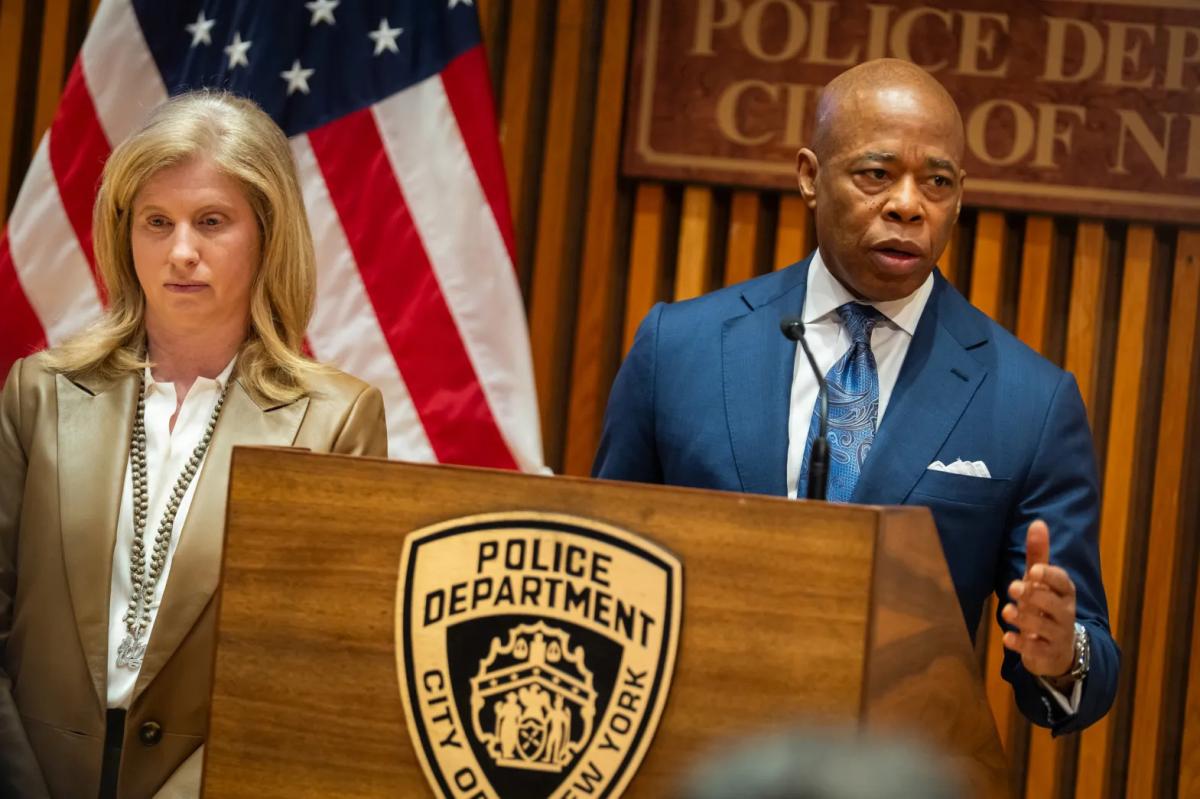
Mayor Eric Adams and NYPD Commissioner Jessica Tisch at 1 Police Plaza, April 3, 2025. Ed Reed/Mayoral Photography Office
Big Apple Connect, the mayor’s flagship free internet service for public housing residents, is quietly being used to expand the NYPD’s real-time, remote surveillance. Here’s what we still don’t know about the clandestine program.
By Zachary Groz

On Monday, New York Focus revealed that one of New York City Mayor Eric Adams’s signature technology projects is also a backdoor for police surveillance.

The NYPD has been using Big Apple Connect, the mayor’s free broadband program for public housing residents, to connect CCTV cameras at New York City Housing Authority (NYCHA) developments to the department’s city-wide surveillance software, called the Domain Awareness System. The connections enable the police department to stream footage in real-time, without needing to ask for NYCHA’s permission.

The video surveillance component of the project was never publicly disclosed. New York Focus learned about it after reviewing Office of Technology and Innovation documents that laid out the agency’s intention to link the housing authority’s cameras to the NYPD three years ago. Only recently did the NYPD confirm to New York Focus that the program is being used to implement real-time, remotely viewable video surveillance at at least 20 NYCHA developments.

There’s still a lot that the Adams administration hasn’t told us. Here’s what we still don’t know about Big Apple Connect ...

The NYPD is gaining live access to CCTV footage in public housing, without having to ask NYCHA for permission. Photos: Phonlamai Photo/Getty Images; Johnramos1978/Wikimedia Commons; Badge: Wikimedia Commons | Illustration: Leor Stylar
The Adams administration is using its flagship broadband program to give police real-time access to NYCHA camera feeds — without telling anyone.
By Zachary Groz

New York City Mayor Eric Adams’s administration is quietly using a flagship free internet program for public housing residents for another purpose: expanding NYPD surveillance.

The New York City Police Department is working to use network connections established under the three-year-old Big Apple Connect program to link cameras at New York City Housing Authority (NYCHA) developments directly to the NYPD’s central digital surveillance system, a police department spokesperson confirmed to New York Focus.

Cameras at one development were linked last Wednesday, the spokesperson said, and 19 more are set to follow.

Recent Stories

Data from the first half of 2025 continues a long decline from New York City’s peak of 2,262 murders in 1990. Photo: kat wilcox/Pexels; Graphics: Adam Smigielski/Getty Images; med.asf/Canva | Illustration: Leor Stylar
There were 351 shooting incidents, 413 shooting victims, and 149 murders during the first half of the year.
By Ferdi Ferhat Özsoy

YES.

New York City recorded the lowest number of shooting incidents, shooting victims, and homicides in its modern tracking history during the first half of 2025.

NYPD data shows 351 shooting incidents, 413 shooting victims, and 149 murders between January 1 and July 6. These totals are lower than any comparable six-month period since the department began collecting data in the 1990s.

This continues a long decline from the city’s peak of 2,262 murders in 1990. Officials attributed the drop to real-time data analysis, hotspot deployments, and precision policing tools. While cases of rape rose slightly year-over-date, major felony offenses overall declined compared to the same period in 2024.

Broader trends have also been shaped by demographic change, economic development, community engagement, and prevention programs. These efforts are part of a multi-decade shift that has made violent crime less frequent across most areas of the city.

New York Focus partners with Gigafact to produce fact briefs, or quick-response fact checks, about trending claims relating to New York state.

This fact brief is responsive to conversations such as this one.

Got a claim you want us to check? Submit it here.

The Northeast Supply Enhancement project, or NESE, could mark a turning point for New York’s approach to energy. Photos: Gage Skidmore / Office of Governor Kathy Hochul | Map: Williams application documents | Illustration: New York Focus
Public comments are closing soon for an underwater pipeline project that sprang back to life this spring after talks between Hochul and Trump.
By Colin Kinniburgh

Next week, New York could move a step closer to approving its biggest gas pipeline in at least a decade. August 16 marks the end of the public comment period for a 37-mile pipeline that would carry gas from New Jersey, underwater, to an existing pipe just south of the Rockaways, adding a new link in a network that spans from Texas to Long Island.

The Northeast Supply Enhancement project, or NESE, could mark a turning point for New York’s approach to energy. For years after passing its flagship climate law in 2019, the state rejected one large fossil fuel project after another, arguing that they would violate the state’s legal mandate to cut greenhouse gas emissions and other environmental protections.

The state Department of Environmental Conservation has previously rejected NESE three times — in 2018, 2019, and 2020 — on the grounds that it would harm water quality in the New York Bay. The pipeline was left for dead.

Then Donald Trump returned to the presidency in January, promising a new age of fossil fuel dominance. NESE’s sudden revival comes after talks between Trump and New York Governor Kathy Hochul in May, when the White House lifted a stop-work order on a major offshore wind project off Long Island while Hochul committed to, in her words, “work with the Administration and private entities on new energy projects.” Just 10 days later, the energy company Williams revealed it was reapplying for approval from New York regulators for NESE and the even larger Constitution Pipeline project.

In addition to the 21 counties not accepting new parents, four counties said in early July that they might have to start turning down parents later in the month. Photos: DAPA images; Aflo images/Canva | Illustration: Leor Stylar
There are 1,500 families on the program waitlist in New York City alone, new state data shows.
By Julia Rock

More than a third of New York counties, home to over half of the state’s population, have stopped enrolling eligible parents in the state’s child care voucher program, new data shows.

At least 21 counties were not accepting applicants for the vouchers as of early July due to lack of funding. Thirteen are keeping waitlists; 1,500 families are on New York City’s waitlist alone. (Counties are required to provide the vouchers to parents who are homeless, receiving cash assistance, or involved in the child welfare system, but can turn down other income-eligible parents when funds run low.)

The state Office of Children and Family Services, or OCFS, published data on the program online after New York Focus requested it under the Freedom of Information Law.

The data sheds light on the status of the Child Care Assistance Program, which covers almost the entire cost of private child care for nearly 100,000 low- and middle-income families, after a drawn-out battle over its funding during state budget negotiations earlier this year.

Copyright © New York Focus 2024, All rights reserved.
Staying Focused is compiled and written by Alex Arriaga
Contact Alex at alex@nysfocus.com

Feedback? Tips? Pitches? Contact us at: editor@nysfocus.com

Support our work!

Interested in sponsoring these emails? Get in touch! Email editor@nysfocus.com.

This email was sent to *|EMAIL|*

unsubscribe from this list  ·  update subscription preferences

New York Focus · *|HTML:LIST_ADDRESS_HTML|* · USA