Five Unanswered Questions About Eric Adams’s Expanded Surveillance at NYC Public Housing

Big Apple Connect, the mayor’s flagship free internet service for public housing residents, is quietly being used to expand the NYPD’s real-time, remote surveillance. Here’s what we still don’t know about the clandestine program.

Zachary Groz   ·   August 12, 2025
Mayor Eric Adams and NYPD Commissioner Jessica Tisch at a press conference
Mayor Eric Adams and NYPD Commissioner Jessica Tisch at 1 Police Plaza, April 3, 2025. | Ed Reed/Mayoral Photography Office

Sign up for Staying Focused, our newsletter keeping readers up to speed on New York politics.

On Monday, New York Focus revealed that one of New York City Mayor Eric Adams’s signature technology projects is also a backdoor for police surveillance.

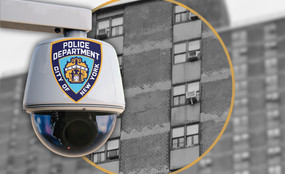
The NYPD has been using Big Apple Connect, the mayor’s free broadband program for public housing residents, to connect CCTV cameras at New York City Housing Authority (NYCHA) developments to the department’s city-wide surveillance software, called the Domain Awareness System. The connections enable the police department to stream footage in real-time, without needing to ask for NYCHA’s permission.

The video surveillance component of the project was never publicly disclosed. New York Focus learned about it after reviewing Office of Technology and Innovation documents that laid out the agency’s intention to link the housing authority’s cameras to the NYPD three years ago. Only recently did the NYPD confirm to New York Focus that the program is being used to implement real-time, remotely viewable video surveillance at at least 20 NYCHA developments.

There’s still a lot that the Adams administration hasn’t told us. Here’s what we still don’t know about Big Apple Connect.

1) Whether the housing authority knew how the NYPD was using its cameras.

NYCHA initially told New York Focus that Big Apple Connect “is not intended to support NYCHA’s CCTV cameras.” When that turned out not to be true, New York Focus asked NYCHA multiple times whether the housing authority was aware OTI was linking its video cameras to the NYPD’s central surveillance hub through Big Apple Connect.

A NYCHA spokesperson declined to comment and told New York Focus instead to “reach out to OTI, NYPD and City Hall with questions about if and how this program is being utilized beyond internet service for NYCHA residents.”

New York Focus asked the NYPD whether the department had coordinated with NYCHA on the implementation of the video surveillance component of Big Apple Connect. The spokesperson told New York Focus: “I’m not aware of the conversations that have been happening, broadly speaking, between NYCHA and PD.” City Hall did not respond to multiple requests for comment.

2) Where exactly the NYPD is expanding surveillance.

The NYPD told New York Focus that it has networked CCTV cameras at one NYCHA development so far and will network 20 sites by the end of this year. The agency declined to say which developments are included. “That’s typically information we don’t share,” a spokesperson said.

3) What the plans for the program are going forward.

Big Apple Connect is currently deployed in more than 200 NYCHA developments. The NYPD spokesperson declined to say whether cameras at more of those sites will be networked after this year.

“It is my understanding that, as of now, the focus is on doing this work for the 20,” he said.

4) Why the agencies’ stories changed.

Over the course of multiple interviews and email exchanges with NYCHA, OTI, and the NYPD, the agencies’ narratives about the video surveillance component of Big Apple Connect changed rapidly.

  • June 23: A NYCHA spokesperson said that Big Apple Connect “provides free home internet to NYCHA residents at eligible developments” and “is not intended to support NYCHA’s CCTV cameras.”

  • July 7: An OTI spokesperson said that through Big Apple Connect, the agency was “providing free high-speed internet access to 330,000 New Yorkers and more efficiently using existing top-notch security infrastructure to enhance safety in public housing.” The spokesperson added that “importantly, these are not live camera feeds that the NYPD has access to.” In the same email, the spokesperson used the phrase “Big Apple Connect cameras” to describe the security infrastructure.

  • July 10: The OTI spokesperson reversed course, writing: “The mention of Big Apple Connect cameras was an inadvertent mistake on my part. There’s no Big Apple Connect cameras.”

  • July 18: An NYPD spokesperson said that “these are existing NYCHA CCTV cameras, that is the kinds of cameras that we have access to,” and that “there’s modems that we now have access to, which we physically go to NYCHA to go and look at the camera footage.”

  • July 23: The NYPD spokesperson said that Big Apple Connect “does allow for real time access,” and “instead of physically needing to go and watch the CCTV footage, we can now remotely access it.”

  • August 7: The NYPD spokesperson said that “right now the focus is on 20 NYCHA developments,” which, he said, “does not mean that we are live at 20 NYCHA developments.” Later that day, the spokesperson wrote that cameras at only one development had been linked to the NYPD’s surveillance hub so far — on August 6, the previous day.

5) How the NYPD will use its expanded access to NYCHA footage.

The NYPD often uses facial recognition software alongside the Domain Awareness System, and New York Focus asked whether video footage captured by the city housing authority’s cameras and streamed to that system will be used the same way. “I don’t have an answer to that,” the spokesperson said.

BEFORE YOU GO, consider: If not for the article you just read, would the information in it be public?

Or would it remain hidden — buried within the confines of New York’s sprawling criminal-legal apparatus?

I started working at New York Focus in 2022, not long after the outlet launched. Since that time, our reporters and editors have been vigorously scrutinizing every facet of the Empire State’s criminal justice institutions, investigating power players and the impact of policy on state prisons, county jails, and local police and courts — always with an eye toward what it means for people involved in the system.

That system works hard to make those people invisible, and it shields those at the top from scrutiny. And without rigorous, resource-intensive journalism, it would all operate with significantly more impunity.

Only a handful of journalists do this type of work in New York. In the last decades, the number of local news outlets in the state has nearly halved, making our coverage all the more critical. Our criminal justice reporting has been cited in lawsuits, spurred legislation, and led to the rescission of statewide policies. With your help, we can continue to do this work, and go even deeper: We have endless ideas for more ambitious projects and harder hitting investigations. But we need your help.

As a small, nonprofit outlet, we rely on our readers to support our journalism. If you’re able, please consider supporting us with a one-time or monthly gift. We so appreciate your help.

Here’s to a more just, more transparent New York.

Chris Gelardi
Justice Bureau Chief

A photo of Chris Gelardi
Zachary Groz is a freelance journalist based in New York. He previously served as co-editor-in-chief of The New Journal, an investigative magazine at Yale University that during his tenure was named Best Student Magazine in America by the Society of Professional Journalists. He is… more
Also filed in Criminal Justice

A bill awaiting the governor’s signature would relax restrictions on who can qualify for victim compensation.

In May, state lawmakers passed a $269 billion budget after haggling for months over thousands of line items and policies affecting New Yorkers.

The legislation would make it easier for currently and formerly incarcerated people and child victims to sue the state over allegations of past abuse.

Also filed in New York City

We’ve compiled information for the 450,000 New Yorkers who will lose health care coverage on July 1.

The citizens assembly model, used for public decision-making around the world, is gaining traction in New York.

Resorts World is floating legislation to avert more than $500 million in payments to the horseracing industry.