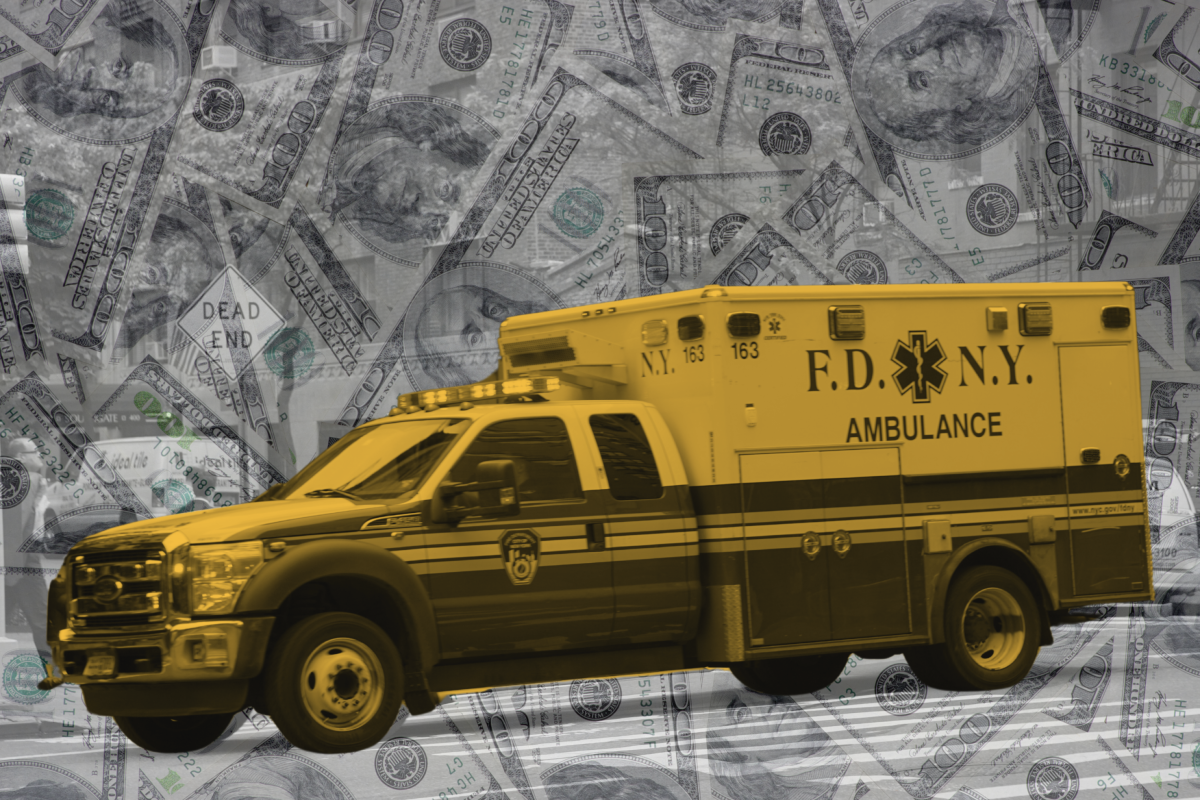
Plus: This ‘best-kept secret’ in health care can shave down your medical debt; Lobbyists deploy to stop sovereign debt bill.
Plus: This ‘best-kept secret’ in health care can shave down your medical debt; Lobbyists deploy to stop sovereign debt bill. ·  View in browser
NEWSLETTER

Funding local news is more important than ever, and it will take a village to succeed. Join us in our work to rebuild local journalism as a pillar of democracy in New York.

Robyn Hodgson at a rally in Lancaster, PA. Courtesy of Robyn Hodgson
A company with a history of lawsuits and unpaid claims is now managing health insurance for thousands of New Yorkers on the taxpayers’ dime.
By Sam Mellins

Due to a rare genetic condition, Robyn Hodgson has had cancer twice and needs frequent surgeries to remove tumors. Plagued by migraines, chronic pain, and hand tremors, she stopped working as a journalist and writing teacher several years ago, and relies on extensive screenings to catch any potential cancers early.

So when her wife’s employer, a central Pennsylvania nursing home, began offering a new health insurance plan two years ago, the couple was hopeful. The premium for the top plan on offer was expensive — $1,100 per month — but given Hodgson’s health issues, it seemed worth the price.

There was a lot they didn’t know.

They didn’t know that the company managing her insurance plan, Leading Edge Administrators, has been repeatedly accused of not paying doctors and leaving patients with the bills. They didn’t know that its founder, Jerry Weissman, was found guilty of health insurance-related crimes in 1997 and sentenced to 18 months in prison. And they didn’t know the plan would leave them in five-figure debt by frequently refusing to pay for her treatments and surgeries, even though she receives them at in-network hospitals and clinics.

“I have to live on credit cards,” Hodgson told New York Focus. “I have 70 cents in the bank.”

Hodgson’s massive bills aren't a freak accident. Rather, they’re the natural result of Leading Edge’s unorthodox business practices, which systematically underpay doctors and shift the costs of care to patients.

And her experience may soon be the norm for thousands of New Yorkers.

To keep their tax-exempt status, nonprofit hospitals must provide free or discounted health care to patients who fall under certain income limits. Photos: xtberlin / pixabay | Illustration: Leor Stylar
Nonprofit hospitals are required to help those struggling with medical debt, but critics say their policies are poorly advertised and underutilized.
By Jie Jenny Zou

On a recent Tuesday afternoon, a team of volunteers armed with laptops helped New Yorkers shave hundreds or even thousands of dollars off their hospital bills by tapping into a little-known program called “charity care.”

Rose Gasner, a retired health care attorney who organized the free clinic at the central branch of the Brooklyn Public Library, called charity care a “best-kept secret.”

To keep their tax-exempt status, nonprofit hospitals must provide free or discounted health care to patients who fall under certain income limits. In New York, those who earn up to 400 percent of the federal poverty level are eligible — this year, that’s $62,600 for an individual or $128,600 for a family of four. Some hospitals go further, providing discounts to those who earn up to twice as much. Immigration status cannot be considered during the application process and both insured and uninsured patients are eligible.

The catch? Figuring out charity care exists in the first place.

Related: Need Help Paying Medical Bills? Here’s How Charity Care Works in New York.

Lobbying groups representing Wall Street firms are mounting an eleventh-hour push to stop proposed legislation that would limit creditor lawsuits against countries that default on their debt payments. Photo: kevinjeon00 / Getty Images | Illustration: Leor Stylar
Four lobbying groups representing Wall Street firms are trying to block the bill from passing in the final days of the legislative session.
By Julia Rock and Chris Bragg

Lobbying groups representing Wall Street firms are mounting an eleventh-hour push to stop proposed legislation that would limit creditor lawsuits against countries that default on their debt payments. Those lawsuits are often brought by hedge funds that are not satisfied with the debt repayment terms that other creditors, like governments, accept in restructuring negotiations.

The bill was developed by community groups after Puerto Rico defaulted on its debt and New Yorkers watched as friends and family in the territory faced school and hospital closures and lost their pensions.

The legislation passed the state Senate last week, and the bill’s Assembly sponsor, Jessica González-Rojas from Queens, was optimistic that it would pass her chamber as well.

But now, four groups are pressing the Assembly to stop the bill in its tracks.

RelatedAmid Global Debt Crisis, Albany Advances Bill to Rein In Hedge Funds Suing Poor Countries

Recent Stories

Documents reviewed by New York Focus show that half a dozen county sheriffs’ offices, as well as state-level agencies, have recently included a discredited syndrome called excited delirium in their training. Logo: New York State Division of Criminal Justice Services | Illustration: New York Focus
Documents show that six county sheriffs’ offices and two state agencies have recently included excited delirium in their training.
By Chris Gelardi

State and local agencies across New York train law enforcement officers on a condition that much of the medical establishment has disavowed as unscientific and a catalyst for police violence, newly unearthed documents show.

The condition, known as excited delirium syndrome, is said to turn people into erratic, super-strong aggressors and can supposedly lead to cardiac arrest. It dates to largely debunked research from the 1980s, which cited it as an alternate explanation for deaths at the hands of cops.

New York authorities, however, have continued to train officers on the discredited syndrome. In 2023, New York Focus revealed that the New York City Police Department was training its recruits to tase and pepper spray suspected excited delirium sufferers.

Now, documents obtained by the police reform group Campaign Zero and shared with New York Focus show that half a dozen county sheriffs’ offices, as well as state-level agencies, have also recently included excited delirium in their training.

Tens of thousands of NYC residents are sued every year for consumer debt. Many of them don’t know about it.
By Julia Rock

For decades, people being sued in New York City civil courts over unpaid debt never learned about the lawsuits against them.

The reason? ‘Sewer service,’ a phrase that refers to an old practice of process servers, or the people hired to hand court documents to defendants, throwing those papers in the sewer rather than delivering them.

While servers may not be literally trashing papers anymore, a New York Focus investigation has found that even after New York City and the state court system implemented reforms to fix the issue, servers are still failing to inform defendants about consumer debt lawsuits against them.

To understand the issue, we reviewed court records, analyzed complaints to regulators, and spoke with consumer attorneys across the city.

Here are five key takeaways from our investigation.

“Internal politics within DOCCS contribute to a lack of urgency in making conditions better.” Photo: hboening / Getty Images via Canva; Illustration: New York Focus
The Legislative Correspondents Alumni Association recognized Chris Gelardi with its award for the year’s best state government reporting — the second year in a row that Focus has earned the honor.

By New York Focus

As New York Focus’s criminal justice reporter, Chris Gelardi has spent years investigating New York state’s sprawling prison system. That system exploded into chaos this year after authorities released a video of guards beating an incarcerated man to death and corrections officers staged a three-week-long wildcat strike. Gelardi released a series of features and news stories helping readers make sense of the tumult. He also published an investigation into the family dynasty at the agency’s helm, uncovering its decades-long ascent to power and the many scandals it has weathered along the way.

For this work, the Legislative Correspondents Alumni Association awarded Gelardi the annual Walter T. Brown Award for excellence in coverage of New York state government. (Last year, the award went to Focus’s other Chris — our Albany bureau chief, Chris Bragg — for his reporting on the Assembly Speaker’s romantic relationship with a legislative lobbyist.) Gelardi sat down with New York Focus’s editor-in-chief, Akash Mehta, to talk about the stories.

Copyright © New York Focus 2024, All rights reserved.
Staying Focused is compiled and written by Alex Arriaga
Contact Alex at alex@nysfocus.com

Feedback? Tips? Pitches? Contact us at: editor@nysfocus.com

Support our work!

Interested in sponsoring these emails? Get in touch! Email editor@nysfocus.com.

This email was sent to *|EMAIL|*

unsubscribe from this list  ·  update subscription preferences

New York Focus · *|HTML:LIST_ADDRESS_HTML|* · USA